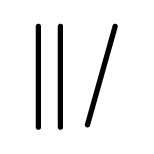
Sign
M93
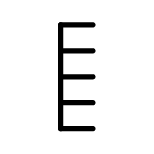
Looks like: three long strokes, the last one slanting
Adapted from the field-cady sign descriptions (Parpola 152). This describes the picture, not the meaning: a sign that looks like a fish may stand for a sound or another word.
Appears in 10 texts (11 uses), mostly on seals at Chanhu-daro; usually ends a text.
Where it appears 10
Counts are distinct texts in the Mahadevan 1977 concordance (a text repeated on many moulded tablets counts once). 11 objects in all carry it.
| Object | Texts | Share |
|---|---|---|
| Seal | 9 | 90% |
| Sealing | 1 | 10% |
| Site | Texts | Share |
|---|---|---|
| Chanhu-daro | 10 | 100% |
| Where | Uses | Share |
|---|---|---|
| First sign | 0 | 0% |
| Inside | 2 | 20% |
| Last sign | 8 | 80% |
| Whole text | 0 | 0% |
Position counts use only texts with no damaged passage (10 uses).
No Wells equivalent in the concordance this project uses, so there are no ICIT counts.
Variants




Neighbours and fixed pairs
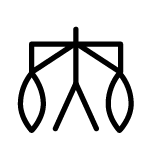



Published readings 1
- Parpola (cited by Mukhopadhyay 2023) · 1975Tested, see detail
the ancient name of Chanhu-daro
experiments/toponyms finding 4: local end mark at Chanhu-daro (10/10 texts), replicated; nothing local travels on sealings.
From proposals.json and CATALOGUE.csv. A claim is listed under every sign it names.
Project tests 10
Role in the text
- Positional class
- Unclassified. Its raw label was post-closer, but it did not keep that label reliably. Grammar
- Functional reading
- NUMERAL(tall) 1.00. Tall-stroke numeral 3. tall strokes count M328/M211/M60 only (F2/F8); side-2 docket formula (F15); values 2-3 favoured Functional reading
Role names such as opener or noun are labels for positions, not tested meanings.
Mentioned in 10 result files
- Chanhu-daro follow-up: results14 lines. “Partly a few signs, chiefly M93.”
- Detached signs: a layout class, but not a class apart from the text6 lines. “The class was defined on dev only (BH q < 0.05 over 112 signs, plus p < 0.05 within multi-line texts). It is M242, M374, M93, M326 and M393.”
- Toponym test (Jemdet Nasr city-seal method, Fable plan F7)3 lines. “The strongest single local item is a Chanhu-daro end mark: M93 (Wells writes it W031 W032). It occurs in 10 of 10 M77 texts at Chanhu-daro (9 seals, 1 sealing found there), and 8 of 9 in ICIT. The nin…”
- Line breaks as constituent boundaries (Fable plan 6, test 1)2 lines. “…almost never occur inside running text: M242 (9), M374 (7, never in a single-line text), M393 (4), M93 (4, the Chanhu-daro end mark). 18 of 40 such signs occur in fewer than 5 single-line texts. Thes…”
- Open Indus: reproducible tests on the Indus script2 lines. “…vs Harappa; the tie also holds within unicorn seals at the margin. Recoding Chanhu-daro’s end mark M93 as a common sign leaves the Chanhu-daro gap, and all four Chanhu-daro intervals include zero. Un…”
- Administrative archaeology: relational readings without sounds1 line. “…76 dev + 28 held-out distinct second lines of length ≥ 2. One-sign second lines (M242, M374, M393, M93) were excluded as uninformative. They behave like field marks or end signs, not names.”
- Red team: pair_numeral_long claims A (number-names), B (counted items), C (long texts)1 line. “Dropping the doubtful tall-3 forms (M88 dotted, M92 roofed, M93/M94 slanted) gives 29/40.”
- Roof modifier vs context: is a roofed sign a “house of X”?1 line. “L5/L5b M93 at Chanhu-daro, and line-final;”
- Proskouriakoff test: object fate vs sign content (board #33, N1)1 line. “numerals: M86-M121, minus M90, M92 and M93”
- A positional grammar of the Indus seal text1 line. “c7 post-closer 0.040 0.01 0.67 0.03 / 0.14 / 0.83 M176 0.50, M1 0.26, M242 0.07, M139 0.04, M224 0.03, M93 0.03, M374 0.02”
Example texts 3

 /
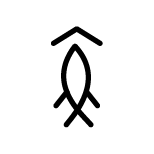

Text 6108 · Chanhu-daro · seal · M216 M123 | M65 M294 M176 M211 M93


Text 6233 · Chanhu-daro · sealing · incomplete · M59 M387 M87 M59 M17 M406 M162 M93


 /
Text 6113 · Chanhu-daro · seal · M234 M342 M343 M225 M87 M261 | M93
Signs in reading order, first sign on the left. Text numbers are Mahadevan’s (1977). / marks a line break, … a damaged passage.