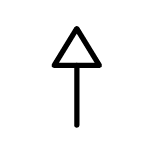
Sign
M211
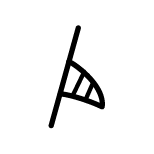
Looks like: triangle on top of a vertical line, like an arrow or spear head
Adapted from the field-cady sign descriptions (Parpola 217). This describes the picture, not the meaning: a sign that looks like a fish may stand for a sound or another word.
Appears in 170 texts (227 uses), mostly on seals at Mohenjo-daro; usually ends a text. In the larger ICIT corpus its Wells equivalent W520 is in 224 texts, including at Dholavira.
Project finding: Validated closer: ends texts Held up
Where it appears 170
Counts are distinct texts in the Mahadevan 1977 concordance (a text repeated on many moulded tablets counts once). 226 objects in all carry it.
| Object | Texts | Share |
|---|---|---|
| Seal | 142 | 84% |
| Sealing | 18 | 11% |
| Tablet | 4 | 2% |
| Copper tablet | 3 | 2% |
| Pottery | 2 | 1% |
| Other | 1 | 1% |
| Site | Texts | Share |
|---|---|---|
| Mohenjo-daro | 116 | 68% |
| Harappa | 35 | 21% |
| Lothal | 8 | 5% |
| Kalibangan | 6 | 4% |
| Chanhu-daro | 4 | 2% |
| Other sites | 1 | 1% |
| Where | Uses | Share |
|---|---|---|
| First sign | 0 | 0% |
| Inside | 36 | 21% |
| Last sign | 133 | 78% |
| Whole text | 1 | 1% |
Position counts use only texts with no damaged passage (170 uses).
In the ICIT corpus (Wells numbering)
W520: 224 distinct texts, 321 uses.
By object: seals 169, tablets 31, sealings 13, pottery 6, copper tablets 4, other objects 1. Top sites: Mohenjo-daro 119, Harappa 59, Dholavira 15, Lothal 9, Kalibangan 6, Chanhu-daro 4.
Variants
Wells (ICIT) equivalent: W520.
Looks alike but used differently (probably a separate sign):
 M153drawing similarity 0.92, context similarity 0.18
 M155drawing similarity 0.66, context similarity 0.22
Pairs from the prior project’s allograph model (image × distribution, signs with at least 8 uses).
Merged with other signs in alternative sign lists (used to test whether findings survive):
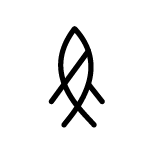
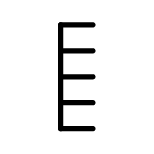
Neighbours and fixed pairs




Published readings 3
- MahadevanNot tested on its own
military title (contrasted with priestly jar)
Jyothibabu review of Mahadevan
- Mahadevan · 2009Tested, see detail
warrior (‘one who carries the arrow’)
harappa.com (403 to us) · test record
As MAH09-jar-bearer. ‘Man never with arrow’ was tested in experiments/dominik_w090 (mixed; not special).
Yajnadevam’s sound value
- Yajnadevam · 2024Did not hold
n
Yajnadevam 2024 ‘A cryptanalytic decipherment of the Indus script’; per-sign key from yajnadevam/lipi xlits.csv via sources/field-cady_indus_valley_script_corpus/xlits.csv · test record
Part of a 714-value sound key that scores no better than keys fitted to noise (atlas 1.1).
From proposals.json and CATALOGUE.csv. A claim is listed under every sign it names.
Project tests 23
Established results
- Validated closer: ends textsHeld up
Kept its class in 100% of bootstrap resamples; the Wells-list grammar agrees.
Role in the text
- Positional class
- Closer (bootstrap stability 1.00) Grammar
- Functional reading
- CLOSER 1.00. Closer of a title block. final 80% dev; tall-stroke counted (F8); closes title block M59-M336-M89 (F28) Functional reading
Role names such as opener or noun are labels for positions, not tested meanings.
Mentioned in 22 result files
- Functional reading: a role grammar that “reads” every Indus text without phonetics6 lines. “Role grade A: 38 (openers M267/M391, M99, jar M342, M176, M1, M211, M169, M328, strokes, M343/344/345, M403).”
- Space and sealing: what small seals leave out, and whether sealings differ from seals (Fable plan 5, T4 and T6)4 lines. “Non-jar closers (M211, the M169 family, M12/M15, M254...): -0.021 share per doubling, Holm p = 0.004.”
- Novel methods from other fields: results3 lines. “{M342, M211, M162, M169, M15, M249, M51, ...}: closers”
- Pair graph, numeral distributions, long texts (Fable 5.2 plan F1, F2, F6)3 lines. “Lexeme-like: one numeral value dominates. Examples: tall 2 + M59 fish (65/71), tall 3 + M211 (39/41), tall 2 + M60/M244/M284, short 7 + M194/M197 (100%), short 3 + M190/M403 (100%), short 3 + M15, sho…”
- Phonetic grid (automated Kober triplets + Ventris grid)3 lines. “…ollows M267-M99, another what follows M391-M99 and M293-M123-M343. A third is a closer block (M342, M211, M347, M169, M162, M15, …) and a fourth a post-closer block (M176, M12, M1, M328, M130, M375).”
- Structure of the Indus texts: direction, inventory, positional classes, segmentation, grammar3 lines. “Asymmetry. The first position is diverse: 291 sign types, H=6.69 bits. The last position is concentrated: 196 types, H=4.94 bits, with the top five closers M342, M176, M211, M169, M1.”
- One-to-many substitution (X YZ): does a single sign ever trade places with a 2-3 sign spelling?3 lines. “M321 = M89 M211 2 0.002 0.001 2844 M336 M321 M176 \ \ 1251 M72 M336 M89 M211 M176 SCE; M336 + {M321 \ M89 M211}; held-out 0”
- Administrative archaeology: relational readings without sounds2 lines. “…-M59, M171-M59), openers (M267, M293, M391, M150, M216) and register signs (M176, final M342, final M211) were tested against excavation area within site × object type × length strata:”
- Iconography: what do the signs depict, and does it matter?2 lines. “Closers are not vessels: 2/17, expected 1.4, p=0.42. Besides the jar M342, closers are mostly “tools”, e.g. arrow M211 and comb M176.”
- Literature map: Indus script research, with emphasis on 2015-20262 lines. “The jar M342 is the commonest sign and ends about 70% of the texts it appears in. Other terminal signs: M176, M211, M1.”
- Potter’s marks and the frame signs (Fable 5.2 plan 2, item 7)2 lines. “The openers M267 and M391 have no early attestation under any definition, and the closer M211 has only one loose match. So the frame did not arrive ready-made from pot marks. At most, one closer and o…”
- Red team: pair_numeral_long claims A (number-names), B (counted items), C (long texts)2 lines. “Three of the advertised names have zero held-out tokens: tall 3 + M211, short 7 + M197, short 3 + M403.”
- A positional grammar of the Indus seal text2 lines. “closer 7 0.141 M342 (776, 1.00), M211 (142, 1.00), M15 (58, 1.00), M254 (47, 0.80), M12 (42, 0.88), M14 (7, 0.95), M388 (4, 0.76)”
- Copper tablets: calendar series, tallies or amulets?1 line. “T06 8/10/10 goat-antelope, twirled horns M70 M112 M194 M18 M211 M87 M169 horned-U x9”
- Detached signs: a layout class, but not a class apart from the text1 line. “Check whether other closers (M211, M176, M342) are also set on their own line on large faces, beyond what face size predicts. If they are, detachment is a layout rule for closers and not a sign class.…”
- Dominik 2026: “W090 follows W740 but never W520” (board task #19, M5, agent H4)1 line. “Bridge (bridge_WM.json): W090 = M1 (“man”), W740 = M342 (jar), W520 = M211 (arrow), W033 = M89, W220 = M59 (fish). W520 tokens adjacent to W033 are excluded, as in the claim.”
- Genres from scratch: unsupervised text types checked against objects (board #34, N2)1 line. “an “M86/M336 opener … M211” type;”
- Grammar: a validated positional grammar of the Indus seal text (fable plan 6, part B)1 line. “closer 7 14.1% M342, M211, M15”
- Internal phonetics: does Indus spelling variation leak sound values?1 line. “M171 before M59/M8; M211 after fish; M249/M162.”
- Proskouriakoff test: object fate vs sign content (board #33, N1)1 line. “closers: 7 signs (M342, M211, M15, M254, M12, M14, M388)”
- Sealing function: do title signs mark a role by what the sealing closed? (Fable plan 3, R5)1 line. “arrow-final M211: 5 of 12 (p = 0.19)”
- Negative atlas: Indus routes closed or found undecidable1 line. “Planted control. Planted OR 2 detected at 0.92 (jar), 0.85 (M211), 0.84 (M169), 0.69 (ticked fish) on all sites; 0.51-0.75 without Lothal.”
Example texts 3
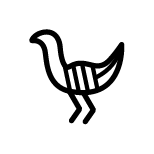

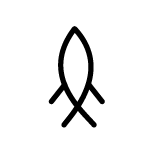
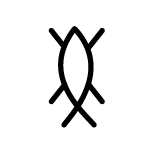


Text 1008 · Mohenjo-daro · seal · M76 M402 M87 M59 M67 M336 M89 M211


Text 1606 · Mohenjo-daro · sealing · M264 M387 M336 M89 M211
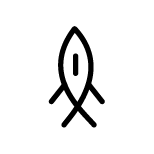



Text 1803 · Mohenjo-daro · copper tablet · M70 M112 M194 M18 M211 M87 M169
Signs in reading order, first sign on the left. Text numbers are Mahadevan’s (1977). / marks a line break, … a damaged passage.