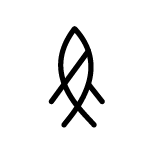
Sign
M72
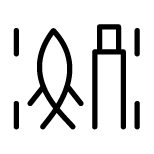
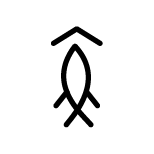
Looks like: fish with a horizontal line through body
From the field-cady sign descriptions (Parpola 058). This describes the picture, not the meaning: a sign that looks like a fish may stand for a sound or another word.
Appears in 155 texts (188 uses), mostly on seals at Mohenjo-daro; usually sits inside a text. In the larger ICIT corpus its Wells equivalent W233 is in 172 texts, including at Dholavira.
Project finding: The fish signs are variants of one sign Likely
Where it appears 155
Counts are distinct texts in the Mahadevan 1977 concordance (a text repeated on many moulded tablets counts once). 188 objects in all carry it.
| Object | Texts | Share |
|---|---|---|
| Seal | 128 | 83% |
| Sealing | 17 | 11% |
| Tablet | 2 | 1% |
| Copper tablet | 6 | 4% |
| Pottery | 2 | 1% |
| Site | Texts | Share |
|---|---|---|
| Mohenjo-daro | 94 | 61% |
| Harappa | 41 | 26% |
| Lothal | 13 | 8% |
| Kalibangan | 3 | 2% |
| Chanhu-daro | 2 | 1% |
| Other sites | 2 | 1% |
| Where | Uses | Share |
|---|---|---|
| First sign | 31 | 20% |
| Inside | 116 | 75% |
| Last sign | 7 | 5% |
| Whole text | 1 | 1% |
Position counts use only texts with no damaged passage (155 uses).
In the ICIT corpus (Wells numbering)
W233: 172 distinct texts, 192 uses.
By object: seals 131, tablets 22, copper tablets 12, sealings 4, other objects 2, pottery 1. Top sites: Mohenjo-daro 99, Harappa 45, Lothal 12, Dholavira 7, Chanhu-daro 3, Kalibangan 2.
Variants
Wells (ICIT) equivalent: W233.
Probably the same sign (looks alike and is used alike):
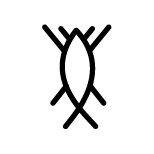
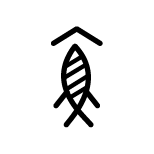
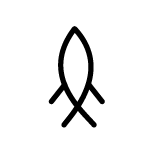 M59drawing similarity 0.94, context similarity 0.91
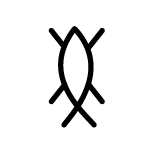 M67drawing similarity 0.88, context similarity 0.95
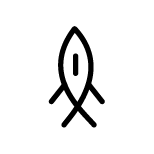 M70drawing similarity 0.94, context similarity 0.97
Pairs from the prior project’s allograph model (image × distribution, signs with at least 8 uses).
Merged with other signs in alternative sign lists (used to test whether findings survive):

Neighbours and fixed pairs


Published readings 2
- Mukhopadhyay · 2025, 2023Tested, see detail
fish signs denote gemstones, beads, jewellery and shiny metals (Dravidian min/mani; Mesopotamian ‘fish-eye stones’ NA4.IGI.KU6)
papers.ssrn.com (abstract only; full text not opened) · test record
Updated 2026-11-23: experiments/bead_workshops coded bead/jeweller units blind to signs: only 4 primary units with 32 inscribed objects at unseen sites; power about 21% at 1.5x under clustering (56% at 2x), so no test was run. The western-object side prediction fails at low power (experiments/meluhha goods.py).
Yajnadevam’s sound value
- Yajnadevam · 2024Did not hold
Yajnadevam 2024 ‘A cryptanalytic decipherment of the Indus script’; per-sign key from yajnadevam/lipi xlits.csv via sources/field-cady_indus_valley_script_corpus/xlits.csv · test record
Part of a 714-value sound key that scores no better than keys fitted to noise (atlas 1.1).
From proposals.json and CATALOGUE.csv. A claim is listed under every sign it names.
Project tests 22
Established results
- The fish signs are variants of one signLikely
Six fish-like signs replace each other in the same places and pair with the same neighbours. They behave like forms of one word, not like names of six different gods.
Role in the text
- Positional class
- Medial (bootstrap stability 0.98) Grammar
- Functional reading
- FISH-CLASS NOUN 1.00. Fish-class name element. fish paradigm: M65/67/70/72 swap with M59 in identical frames 10 vs 2.4 (novel_methods exp1/3) Functional reading
Role names such as opener or noun are labels for positions, not tested meanings.
Mentioned in 21 result files
- Novel methods from other fields: results12 lines. “…t to the end of the text. Five fish signs have bracketed forms (M59→M60, M65→M66, M67→M68, M70→M71, M72→M73). Plain fish signs end a text 5% of the time. Their bracketed forms end it 60% of the time.”
- Internal phonetics: does Indus spelling variation leak sound values?11 lines. “…transitivity 8/80 planted pairs (23/80) 0.6 slot-paradigm pairs per corpus 2 pairs at q<0.05: M65\ M72 (look alike), M99\ M402 (do not look alike) neither replicates (k=1, p=0.23; k=0) inconclusive.…”
- Functional reading: a role grammar that “reads” every Indus text without phonetics3 lines. “(MD seal, HO). [OPENER M267+M99] [FISH M72] [FISH M65] [TITLE-BLOCK M336+M89+M211]. Same frame with an individual part of two fish-class elements: [opener][individual][title block + closer], exactly a…”
- Red team: the shape-only merge list (board #40, attacks #36 / experiments/signlist_shape)3 lines. “Half of the gain is one merge: the fish signs M67 = M70 = M72, worth +0.008 (CI +0.001 to +0.015). No other class is significant on its own.”
- One-to-many substitution (X YZ): does a single sign ever trade places with a 2-3 sign spelling?3 lines. “M321 = M89 M211 2 0.002 0.001 2844 M336 M321 M176 \ \ 1251 M72 M336 M89 M211 M176 SCE; M336 + {M321 \ M89 M211}; held-out 0”
- A positional grammar of the Indus seal text3 lines. “…ial 85 0.348 M59 (234, 0.98), M67 (173, 1.00), M336 (155, 0.90), M65 (129, 0.96), M343 (124, 0.82), M72 (123, 0.98), M249 (108, 0.82), M245 (105, 0.94), M53 (91, 0.99), M387 (80, 0.96), M48 (72, 0.97)…”
- Three follow-up checks from the assumption audit (#27)2 lines. “The four largest are plain fish: M67->W240 (39 times), M65->W235 (24), M72->W233 (22), M70->W231 (11). Ticked M66->W236 adds 3.”
- Consensus corpus: the nine headline tests at the real transcription error rate2 lines. “The plain fish were cross-wired. The correct pairs are M65=W235, M67=W240, M70=W231, M72=W233 (22/23, 37/38, 9/9 and 20/23 same-position). Mahadevan’s drawings match: roofed, cross-headed, inner-strok…”
- Copper tablets: calendar series, tallies or amulets?2 lines. “T05 11/11/11 goat-antelope, arching horns M389 M72 M326 M342 M346 x4”
- Core semantics: head direction and meaning classes of Indus name-core signs2 lines. “One core class is solid: the fish family (M59, M65, M67, M70, M72, M75). On held-out data:”
- Is the fish tick a closer drawn inside the sign? (plan 9, story 3)1 line. “M72/73 4 / 10 / 39 -0.07 0.62 0 / 6 / 20 untestable”
- Forward predictions for the surviving leads (board #44)1 line. “F5 plain fish M67 = M70 = M72 are one sign: merged class trigram beats plain gain > 0 and CI lower > 0 CI upper < 0 30 fish tokens live”
- Stratigraphic half-life: do name signs turn over faster than frame signs? (Fable plan 2, item 9)1 line. “Signs that run late in both Harappa excavations: M127, M387, M197, M341, M72, M173, opener M293. Early in both: closer M12, M375, opener M205, M1, title element M347.”
- Iconography: what do the signs depict, and does it matter?1 line. “M59, M65, M67, M72 = fish;”
- Language hypotheses: results (historical-linguistics tester, 2026-11-14)1 line. “…= compounds sharing fish’s slot neighbour similarity to M59 above frequency-matched signs M67, M70, M72 at the 100th percentile, M60 97th, M65 88th (all texts); held-out: M60 100th, others 51st–79th s…”
- Red team: Harappa relative chronology (half_life P3)1 line. “…-2.4. Compared with half_life’s lists: late M127, M387, M197, M341, M293 and early M12, M347 agree. M72, M173 (late) and M375, M205, M1 (early) are weaker here ( z < 1.3).”
- Red team #38: does the consensus corpus result (#35, N3) hold up?1 line. “…s at the same position. The new partners win clearly: M65=W235 22/23, M67=W240 37/38, M70=W231 9/9, M72=W233 20/23, M59=W220 40/46.”
- reg_chrono: does sign use change with decimal depth inside one site?1 line. “half_life’s Harappa markers, applied to Mohenjo-daro depth, point the wrong way: late signs M127, M387, M197, M341, M72, M293 vs early signs M12, M375, M205, M347 give p = 0.83.”
- reg_findspot: do seals found in one house or room share signs?1 line. “Exploratory checks. The block result survives removing house 12/V (p=0.018). The plain fish bases M59, M65, M67, M70 and M72 do not cluster (block p=0.31, house p=0.87).”
- Sign list from shape plus context: 400 or 700 signs?1 line. “fish M70 = M72 and M67 = M70;”
- Open Indus: reproducible tests on the Indus script1 line. “The fish family (M59, M65, M67, M70, M72, M75) is a class of signs that substitute for each other. It substitutes as a set, forms more compounds than frequency predicts, compounds with itself, and kee…”
Example texts 3
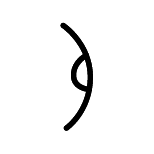
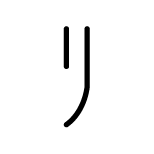

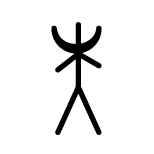

Text 1024 · Mohenjo-daro · seal · M293 M123 M343 M72 M65 M8 M342

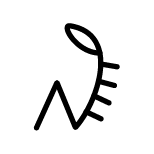
Text 1701 · Mohenjo-daro · copper tablet · M389 M72 M48 M342



Text 4013 · Harappa · seal · M72 M336 M89 M48 M247 M342
Signs in reading order, first sign on the left. Text numbers are Mahadevan’s (1977). / marks a line break, … a damaged passage.