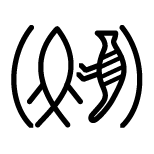
Sign
M64
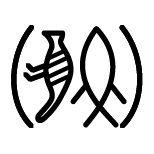
Looks like: simple fish and bird inside parentheses
From the field-cady sign descriptions (Parpola 054). This describes the picture, not the meaning: a sign that looks like a fish may stand for a sound or another word.
Appears in 2 texts (2 uses), on seals at Mohenjo-daro; too rare to say where it sits in a text.
Project finding: Validated opener: starts texts Held up
Where it appears 2
Counts are distinct texts in the Mahadevan 1977 concordance (a text repeated on many moulded tablets counts once). 2 objects in all carry it.
| Object | Texts | Share |
|---|---|---|
| Seal | 2 | 100% |
| Site | Texts | Share |
|---|---|---|
| Mohenjo-daro | 1 | 50% |
| Harappa | 1 | 50% |
| Where | Uses | Share |
|---|---|---|
| First sign | 0 | 0% |
| Inside | 2 | 100% |
| Last sign | 0 | 0% |
| Whole text | 0 | 0% |
Position counts use only texts with no damaged passage (2 uses).
No Wells equivalent in the concordance this project uses, so there are no ICIT counts.
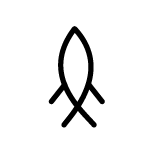
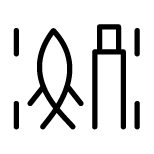
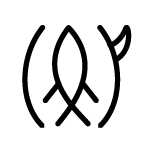
Variants
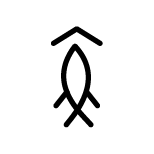
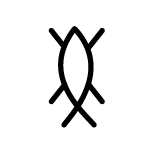
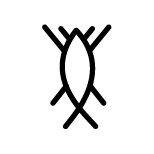
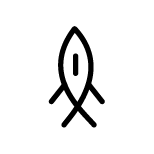

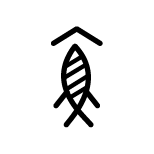
Neighbours and fixed pairs
Published readings
No published reading of this sign is in the project’s lists.
From proposals.json and CATALOGUE.csv. A claim is listed under every sign it names.
Project tests 2
Established results
- Validated opener: starts textsHeld up
Kept its class in 70% of bootstrap resamples.
Role in the text
- Positional class
- Opener (bootstrap stability 0.70) Grammar
- Functional reading
- FISH-CLASS NOUN 0.00. Fish-class name element. fish paradigm: M65/67/70/72 swap with M59 in identical frames 10 vs 2.4 (novel_methods exp1/3) Functional reading
Role names such as opener or noun are labels for positions, not tested meanings.
Mentioned in 1 result file
- A positional grammar of the Indus seal text1 line. “opener 10 0.073 M267 (254, 0.99), M391 (142, 0.99), M293 (99, 0.75), M150 (35, 0.97), M286 (10, 0.93), M412 (4, 0.98), M146 (3, 0.75), M395 (3, 0.97), M305 (2, 0.98), M64 (2, 0.70)”
Example texts 2
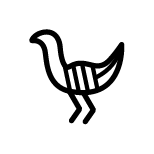

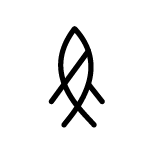


Text 2593 · Mohenjo-daro · seal · M76 M64 M99 M72 M224 M342



Text 4087 · Harappa · seal · M336 M64 M99 M102 M287 M342
Signs in reading order, first sign on the left. Text numbers are Mahadevan’s (1977). / marks a line break, … a damaged passage.