
Sign
M89
Looks like: three long vertical strokes
Adapted from the field-cady sign descriptions (Parpola 147). This describes the picture, not the meaning: a sign that looks like a fish may stand for a sound or another word.
Appears in 152 texts (314 uses), mostly on seals at Mohenjo-daro; usually sits inside a text. In the larger ICIT corpus its Wells equivalent W033 is in 235 texts, including at Dholavira.
Where it appears 152
Counts are distinct texts in the Mahadevan 1977 concordance (a text repeated on many moulded tablets counts once). 306 objects in all carry it.
| Object | Texts | Share |
|---|---|---|
| Seal | 112 | 74% |
| Sealing | 18 | 12% |
| Tablet | 8 | 5% |
| Copper tablet | 9 | 6% |
| Pottery | 5 | 3% |
| Site | Texts | Share |
|---|---|---|
| Mohenjo-daro | 91 | 60% |
| Harappa | 46 | 30% |
| Kalibangan | 6 | 4% |
| Chanhu-daro | 4 | 3% |
| Lothal | 2 | 1% |
| Other sites | 2 | 1% |
| West Asian finds | 1 | 1% |
| Where | Uses | Share |
|---|---|---|
| First sign | 21 | 13% |
| Inside | 122 | 77% |
| Last sign | 15 | 9% |
| Whole text | 1 | 1% |
Position counts use only texts with no damaged passage (159 uses).
In the ICIT corpus (Wells numbering)
W033: 235 distinct texts, 523 uses.
By object: seals 134, tablets 49, pottery 33, sealings 8, copper tablets 7, other objects 4. Top sites: Mohenjo-daro 101, Harappa 95, Dholavira 11, Kalibangan 9, Chanhu-daro 3, Allahdino 2.
Variants
Wells (ICIT) equivalent: W033.
Looks alike but used differently (probably a separate sign):
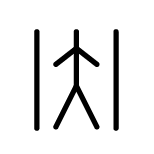 M2drawing similarity 0.70, context similarity 0.59
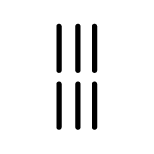 M109drawing similarity 0.91, context similarity 0.58
 M242drawing similarity 0.81, context similarity 0.07
Pairs from the prior project’s allograph model (image × distribution, signs with at least 8 uses).
Merged with other signs in alternative sign lists (used to test whether findings survive):


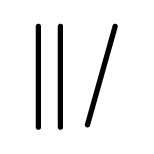

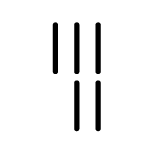
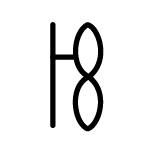
Neighbours and fixed pairs 2
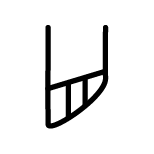




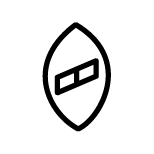
Signs read directly before or after it, counted in distinct texts, never across a line break or damage.
Fixed pairs
At least 5 texts, and one sign takes the other at least half the time.
Fixed sequences in the functional reading
Published readings 3
- Wells · 2015Not tested on its own
10 (units of volume on pots; ~9.24 L per stroke on Purana Qila vessels)
Wells 2015 The Archaeology and Epigraphy of Indus Writing, ch.4-5 (Archaeopress)
- Mukhopadhyay · 2019Not tested on its own
metrological notation (licence fee / quantity)
Yajnadevam’s sound value
- Yajnadevam · 2024Did not hold
j
Yajnadevam 2024 ‘A cryptanalytic decipherment of the Indus script’; per-sign key from yajnadevam/lipi xlits.csv via sources/field-cady_indus_valley_script_corpus/xlits.csv · test record
Part of a 714-value sound key that scores no better than keys fitted to noise (atlas 1.1).
From proposals.json and CATALOGUE.csv. A claim is listed under every sign it names.
Project tests 16
Role in the text
- Positional class
- Unclassified. Its raw label was numeral, but it did not keep that label reliably. Grammar
- Functional reading
- NUMERAL(tall) 1.00. Tall-stroke numeral 3. tall strokes count M328/M211/M60 only (F2/F8); side-2 docket formula (F15); values 2-3 favoured Functional reading
Role names such as opener or noun are labels for positions, not tested meanings.
Mentioned in 16 result files
- One-to-many substitution (X YZ): does a single sign ever trade places with a 2-3 sign spelling?7 lines. “The only “system” is a paradigm, not a syllabary. The recurring spelling is the fixed pair M336 M89. It stands in for several *different* fish signs (M59 k=8, M67 k=8, M249, M259). A phonetic spelling…”
- Functional reading: a role grammar that “reads” every Indus text without phonetics6 lines. “…appa miniature tablet). Side 1: [NOUN M343] [NOUN M162] [NOUN M343] [NUMERAL M86] [TITLE-BLOCK M336+M89+M211]. Side 2: [COUNT+MEASURE: M89 (tall 3) + M328]. The same title block that closes seal names…”
- Copper tablets: calendar series, tallies or amulets?3 lines. “Numerals do not mark positions: the same value recurs across types more than chance (58 type pairs share a value vs 54 expected, p=0.77). Tall 3 (M89, inside the M336-M89 pair) alone sits on 6 types.”
- Novel methods from other fields: results2 lines. “{M267, M391, M336, M89, M17, ...}: openers”
- Grammar of the Indus number signs (Fable 5.2 plan 3, R1: the Proto-Elamite method)2 lines. “T3+T2: 4 / 5. These are mostly the title block M336 M89 followed by tall 2.”
- Structure of the Indus texts: direction, inventory, positional classes, segmentation, grammar2 lines. “Medial core 70 4,271 0.15 / 0.79 / 0.06 M99, M59, M87, M67, M162, M336, M123, M65, M343, M89 W002, W032, W220, W240, W060, W033, W741”
- A positional grammar of the Indus seal text2 lines. “unclassified 265 0.363 M87 (191, 0.75), M176 (153, 0.70), M162 (140, 0.61), M89 (134, 0.55), M169 (111, 0.56), M86 (92, 0.53), M171 (85, 0.47), M1 (80, 0.70), M102 (77, 0.62), M17 (55, 0.41) ...”
- Administrative archaeology: relational readings without sounds1 line. “…is at null. No “son-of” sign can be identified: second lines start with tall-stroke numerals (M87, M89) and M197, not with any constant marker. The dev excess of one-line “compounds” (two complete te…”
- Three follow-up checks from the assumption audit (#27)1 line. “Other recurring pairs (M328 W033/W700 and M89, M245->W617, M155->W072) look like bridge swaps or consistent differences in how the two lists divide a sign. Those differences are what signlist_robustne…”
- Consensus corpus: the nine headline tests at the real transcription error rate1 line. “order M89+M328 W700+W033 5 2.0% 4.0%”
- Dominik 2026: “W090 follows W740 but never W520” (board task #19, M5, agent H4)1 line. “Bridge (bridge_WM.json): W090 = M1 (“man”), W740 = M342 (jar), W520 = M211 (arrow), W033 = M89, W220 = M59 (fish). W520 tokens adjacent to W033 are excluded, as in the claim.”
- Stratigraphic half-life: do name signs turn over faster than frame signs? (Fable plan 2, item 9)1 line. “…or m328_measure. The sign M328 itself does not drift (HARP p = 0.48), and neither do tall 2/3 (M87, M89) at Harappa. The period shift that m328_measure found is in *which stroke value* goes with the c…”
- Internal phonetics: does Indus spelling variation leak sound values?1 line. “The top recurrent correspondences are slot-level: M86 ↔ M267 M99 (5 families; both are openers); M294/M244/M48/M347 ↔ M171 M8; M59 ↔ M336 M89.”
- Literature map: Indus script research, with emphasis on 2015-20261 line. “…s: 1 short = *a*, 2 short (M99) = *v*, 3 short = *j*, 6 = *s*, 7 = *s*, 2 tall (M87) = *s*, 3 tall (M89) = *j*. 28 signs are blank. Cryptanalytic search for maximum Monier-Williams dictionary coverage…”
- local_repeats: what are the repeated 4+ sign seal texts?1 line. “The added sign is not always the same and lands in different positions: W400=M176 twice at the end, W033=M89 at the start, and W233, W142, W621.”
- Parpola rules 3 and 4: vēl as a fish stand-in, and Murukan’s fixed partners1 line. “…the matched pool holds real look-alike paradigms: fish variants M65/M67/M72, numerals, and the M336 M89 pair. Their overlaps reach 0.97. A planted 25% stand-in never climbs above all of them.”
Example texts 3
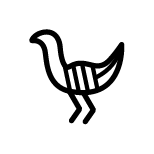
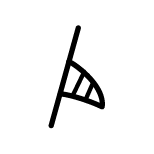

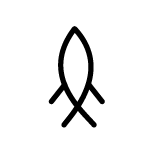
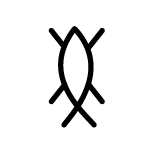

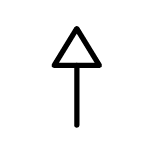
Text 1008 · Mohenjo-daro · seal · M76 M402 M87 M59 M67 M336 M89 M211
Text 1560 · Mohenjo-daro · sealing · M336 M89 M87 M373


Text 1704 · Mohenjo-daro · copper tablet · M336 M89 M296 M342 M98
Signs in reading order, first sign on the left. Text numbers are Mahadevan’s (1977). / marks a line break, … a damaged passage.