Sign
M59
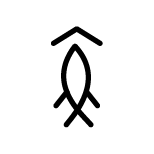
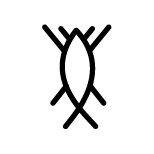
Looks like: fish
Adapted from the field-cady sign descriptions (Parpola 050). This describes the picture, not the meaning: a sign that looks like a fish may stand for a sound or another word.
Appears in 289 texts (381 uses), mostly on seals at Mohenjo-daro; usually sits inside a text. In the larger ICIT corpus its Wells equivalent W220 is in 356 texts, including at Dholavira.
Project finding: “Six” followed by “fish” is a set phrase Solid
Where it appears 289
Counts are distinct texts in the Mahadevan 1977 concordance (a text repeated on many moulded tablets counts once). 369 objects in all carry it.
| Object | Texts | Share |
|---|---|---|
| Seal | 225 | 78% |
| Sealing | 35 | 12% |
| Tablet | 7 | 2% |
| Copper tablet | 8 | 3% |
| Pottery | 11 | 4% |
| Other | 3 | 1% |
| Site | Texts | Share |
|---|---|---|
| Mohenjo-daro | 185 | 64% |
| Harappa | 65 | 22% |
| Lothal | 16 | 6% |
| Chanhu-daro | 8 | 3% |
| Kalibangan | 8 | 3% |
| West Asian finds | 4 | 1% |
| Other sites | 3 | 1% |
| Where | Uses | Share |
|---|---|---|
| First sign | 39 | 13% |
| Inside | 232 | 78% |
| Last sign | 27 | 9% |
| Whole text | 1 | 0% |
Position counts use only texts with no damaged passage (299 uses).
In the ICIT corpus (Wells numbering)
W220: 356 distinct texts, 477 uses.
By object: seals 243, tablets 57, sealings 21, pottery 19, copper tablets 9, other objects 7. Top sites: Mohenjo-daro 177, Harappa 103, Lothal 16, Dholavira 14, Kalibangan 10, Chanhu-daro 9.
Variants
Wells (ICIT) equivalent: W220.
Probably the same sign (looks alike and is used alike):
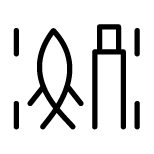
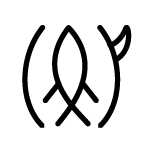
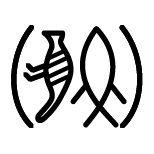
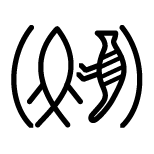
 M67drawing similarity 0.93, context similarity 0.89
 M70drawing similarity 0.96, context similarity 0.89
 M72drawing similarity 0.94, context similarity 0.91
Pairs from the prior project’s allograph model (image × distribution, signs with at least 8 uses).
Merged with other signs in alternative sign lists (used to test whether findings survive):

Neighbours and fixed pairs 5


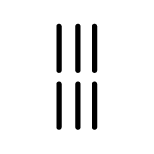


Signs read directly before or after it, counted in distinct texts, never across a line break or damage.
Fixed pairs
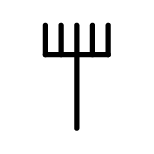 M171M5950 texts. M171 is followed by M59 57% of the time; M59 follows M171 20% of the time.
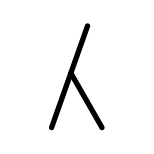 M125M5913 texts. M125 is followed by M59 76% of the time; M59 follows M125 5% of the time.
At least 5 texts, and one sign takes the other at least half the time.
Fixed sequences in the functional reading
Published readings 13
- Parpola · 2010Did not hold
mīn ‘fish’ = rebus ‘star’ -> ‘god/deity’ in names
Parpola 2010, ‘A Dravidian solution to the Indus script problem’ (Coimbatore), Parpola 1994 Deciphering the Indus Script (CUP) · test record
The fish signs form one substituting class, but the deity-name test failed on held-out texts.
- Parpola · 1994Not tested on its own
mū-mīn ‘three stars’ = Mṛgaśiras (Orion’s head)
Parpola 1994 ch.10-11 (UNVERIFIED page)
- Parpola · 2010Partly holds
aṟu-mīn ‘six stars’ = Pleiades (Kṛttikā)
Parpola 2010, ‘A Dravidian solution to the Indus script problem’ (Coimbatore), Parpola 1994 Deciphering the Indus Script (CUP) · test record
Six followed by fish is a fixed expression (finding 5); the star reading itself is not tested.
- Parpola · 2010Did not hold
eḻu-mīn ‘seven stars’ = Ursa Major (Seven Sages); whole text of seal H-9
Parpola 2010, ‘A Dravidian solution to the Indus script problem’ (Coimbatore), Parpola 1994 Deciphering the Indus Script (CUP) · test record
Seven plus fish is not a fixed pair the way six plus fish is (finding 5).
- Parpola · 2010Not tested on its own
literal ‘fish’ (offering of four pots of fish)
- Mukhopadhyay · 2025, 2023Tested, see detail
fish signs denote gemstones, beads, jewellery and shiny metals (Dravidian min/mani; Mesopotamian ‘fish-eye stones’ NA4.IGI.KU6)
papers.ssrn.com (abstract only; full text not opened) · test record
Updated 2026-11-23: experiments/bead_workshops coded bead/jeweller units blind to signs: only 4 primary units with 32 inscribed objects at unseen sites; power about 21% at 1.5x under clustering (56% at 2x), so no test was run. The western-object side prediction fails at low power (experiments/meluhha goods.py).
- Mahadevan · 2011Untestable with our data
UNVERIFIED: ties the fish sign to the Great Bath ritual
harappa.com (403 to us; content not read) · test record
Full text not reached. If it predicts fish signs near the Great Bath (Mohenjo-daro SD), experiments/administration P7 found no area effect.
- Parpola · 1994, 2010Underpowered
M87 = vel (spear/god); fills the same slot as fish (M-172 vs H-6)
Parpola 2010 Coimbatore lecture pp. 27-29 (experiments/news_read/raw/parpola-1994) · test record
Tested later (Parpola rules 3 and 4): the method found too few planted stand-ins to decide either way.
- Parpola · 1994, 2010Untestable with our data
vata-min ‘north star’
Parpola 2010 pp. 19-21 · test record
experiments/signmap/RESULTS.md: no Parpola sign number or drawing obtainable here; two blind agents mapping the fig/banyan sign by shape disagreed (M326 vs M325, both low confidence), so no fig sign can be fixed and the pair cannot be counted.
- Wells · 2015Tested, see detail
fish + number clusters as fixed units
Wells 2015 figs 3.20-3.22 (TOC only) · test record
atlas 6.9 and README #5 (six+fish fixed; M59 carries the number-name effect).
- Fairservis · 1992Tested, see detail
fish = loom-twist, used as an honorific; seal texts = names and titles of chiefs
fish gloss via Sparavigna (cogprints 6179) · test record
His key failed the shuffle bench (atlas 1.1; literature RESULTS). Book text not read: the only full copy online is an unlicensed upload.
- Laursen & Steinkeller; Parpola; others · 1977, 2017Tested, see detail
Meluhha goods in cuneiform (carnelian, ivory, ab-ba and mes wood, copper, gold dust, dar-bird, dogs) as possible sign referents
experiments/meluhha/catalogue.csv · test record
No published scholarly sign-to-good link was found outside fringe rebus work. Candidates tested on 30 western objects: none enriched; jar depleted (experiments/meluhha goods.py).
Yajnadevam’s sound value
- Yajnadevam · 2024Did not hold
m
Yajnadevam 2024 ‘A cryptanalytic decipherment of the Indus script’; per-sign key from yajnadevam/lipi xlits.csv via sources/field-cady_indus_valley_script_corpus/xlits.csv · test record
Part of a 714-value sound key that scores no better than keys fitted to noise (atlas 1.1).
From proposals.json and CATALOGUE.csv. A claim is listed under every sign it names.
Project tests 46
Established results
- “Six” followed by “fish” is a set phraseSolid
The six-stroke sign and the fish sign appear together far more than chance, like “New York”. A popular idea that “seven + fish” means “seven stars” has almost no support.
- Four small ticks move the fish sign to the endLikely
A plain fish sign can sit anywhere in a text. Add four small ticks and it usually comes last, so the ticks change how the sign is used, a bit like a word ending.
- The fish signs are variants of one signLikely
Six fish-like signs replace each other in the same places and pair with the same neighbours. They behave like forms of one word, not like names of six different gods.
- Whether M87 stands in for the fish M59 cannot be tested at this corpus sizeCan’t test yet
The method found 2% of planted stand-ins; M87 sits next to the fish rather than in its slot.
Role in the text
- Positional class
- Medial (bootstrap stability 0.98) Grammar
- Functional reading
- FISH-CLASS NOUN 1.00. Fish-class name element. fish paradigm: M65/67/70/72 swap with M59 in identical frames 10 vs 2.4 (novel_methods exp1/3) Functional reading
Role names such as opener or noun are labels for positions, not tested meanings.
Mentioned in 42 result files
- Novel methods from other fields: results13 lines. “…esult: enclosing a fish sign moves it to the end of the text. Five fish signs have bracketed forms (M59→M60, M65→M66, M67→M68, M70→M71, M72→M73). Plain fish signs end a text 5% of the time. Their brac…”
- Internal phonetics: does Indus spelling variation leak sound values?10 lines. “…fish paradigm: M65\ M72 on dev (7 independent contexts, q=0.04), M65\ M67 (7 contexts, q=0.08), and M59\ M70 and M65\ M70 (p≈0.04-0.06). These signs look alike, so if anything they are allograph-type…”
- One-to-many substitution (X YZ): does a single sign ever trade places with a 2-3 sign spelling?7 lines. “…The recurring spelling is the fixed pair M336 M89. It stands in for several *different* fish signs (M59 k=8, M67 k=8, M249, M259). A phonetic spelling belongs to one word. One pair standing for many w…”
- Red team: pair_numeral_long claims A (number-names), B (counted items), C (long texts)6 lines. “…s exactly (29/40 vs 0.325) and on ICIT new sites (15/20, p=1.6e-4). But half of it is tall-2 + fish M59, and the “number + following head” framing is post hoc: numerals are just as fixed relative to t…”
- Core semantics: head direction and meaning classes of Indus name-core signs5 lines. “One core class is solid: the fish family (M59, M65, M67, M70, M72, M75). On held-out data:”
- Parpola rules 3 and 4: vēl as a fish stand-in, and Murukan’s fixed partners5 lines. “Rule 3 (M87 substitutes for fish M59): underpowered.”
- Phonetic grid (automated Kober triplets + Ventris grid)5 lines. “M59 (fish) is an ordinary open-class sign.”
- Functional reading: a role grammar that “reads” every Indus text without phonetics4 lines. “…UMBER+NOUN M87+M244] [NOUN M28] [NOUN M162] [CONNECTIVE M99] [FISH M65] [FISH M67] [NUMBER-NAME M87+M59] [TITLE-BLOCK M51+M130+M149] [CLOSER M342]. The longest seal legend parses as a pre-opener stret…”
- Language hypotheses: results (historical-linguistics tester, 2026-11-14)4 lines. “…M103 is excluded (bound to M403, shaunmortal F7), and so is M99/100 (connective, F7). Plain fish = M59. Marked fish = M60, M65–M75.”
- Pair graph, numeral distributions, long texts (Fable 5.2 plan F1, F2, F6)4 lines. “Lexeme-like: one numeral value dominates. Examples: tall 2 + M59 fish (65/71), tall 3 + M211 (39/41), tall 2 + M60/M244/M284, short 7 + M194/M197 (100%), short 3 + M190/M403 (100%), short 3 + M15, sho…”
- Do the ranked findings survive other sign lists?4 lines. “M109 + M59: SENSITIVE. It fails only under lump_all: 7/32, p = 0.025.”
- A positional grammar of the Indus seal text4 lines. “medial 85 0.348 M59 (234, 0.98), M67 (173, 1.00), M336 (155, 0.90), M65 (129, 0.96), M343 (124, 0.82), M72 (123, 0.98), M249 (108, 0.82), M245 (105, 0.94), M53 (91, 0.99), M387 (80, 0.96), M48 (72, 0.…”
- Meaning claims from culture, archaeology and history3 lines. “M87 substitutes for M59 (Parpola’s vēl). L1.”
- Red team: attacks on the project’s positive claims3 lines. “…er six + fish is a fixed pair; 7+fish refuted (language) 6+fish survives; “7 avoided” weakened M109+M59 12/25 (10 families, 3 sites); W016+W220 13/33 (11 families, 4 sites). Sevens on seals 1/50, p=0.…”
- Roof modifier vs context: is a roofed sign a “house of X”?3 lines. “…s 7 times (M77) and 13 vs 8 times (ICIT), p = 0.13 and 0.38. That is almost entirely the bigram M65 M59 (roof fish + fish).”
- Negative atlas: Indus routes closed or found undecidable3 lines. “Result. 29/40. Without M59: 14/24. M59 gives 15/16 of the hits.”
- Open Indus: reproducible tests on the Indus script3 lines. “Corner ticks on a fish sign move it to the closing slot (M60/66/68/71/73 vs M59/65/67/70/72): a modifier inside a sign with a positional effect. The effect size is the same under every sign list, but…”
- Literature map: Indus script research, with emphasis on 2015-20262 lines. “Descriptive anchor 1, numeral directly before the plain fish M59 (distinct M77):”
- Meluhha in cuneiform: an outside anchor for the Indus script?2 lines. “…igns are four signs (M245 alone accounts for 49%), and the home pattern is “doubled sign + closer” (M59 M59 M342, M153 M153 M342). That is logographic doubling, not syllable reduplication like *na-na-…”
- Graphic modifiers: is there a paradigm beyond the corner ticks?2 lines. “…y prediction, so it is the top lead for a new pre-registered test. Most of the tokens come from M65←M59 (roof fish), whose initial share on dev is 0.31 vs 0.11.”
- Potter’s marks and the frame signs (Fable 5.2 plan 2, item 7)2 lines. “Hits under P1. Frame: M139, M177, M294, M342, M347. Core: M59, M134, M137, M214, M245, M287, M303, M328.”
- Structure of the Indus texts: direction, inventory, positional classes, segmentation, grammar2 lines. “fish M59/M65/M67/M70/M72”
- Assumption audit, Part 2: do the headline findings survive damage to the corpus?1 line. “M109+M59 holds holds holds holds holds holds holds holds”
- Three follow-up checks from the assumption audit (#27)1 line. “signlist_robustness/harness.py hard-codes the fish pairing as M59/65/67/70/72 -> W220/231/233/235/240 (and ticked M60/66/68/71/73 -> W226/232/234/236/241). The data say the plain pairs are out of orde…”
- Consensus corpus: the nine headline tests at the real transcription error rate1 line. “missing/extra M59 - 3 1.2% 18.4%”
- Dominik 2026: “W090 follows W740 but never W520” (board task #19, M5, agent H4)1 line. “Bridge (bridge_WM.json): W090 = M1 (“man”), W740 = M342 (jar), W520 = M211 (arrow), W033 = M89, W220 = M59 (fish). W520 tokens adjacent to W033 are excluded, as in the claim.”
- Is the fish tick a closer drawn inside the sign? (plan 9, story 3)1 line. “M59/60 21 / 6 / 76 -0.28 0.97 6 / 11 / 44 -0.30 1.00”
- Fish tick as a closer, v2: the better de-duplication does not rescue the test1 line. “v2 roughly doubled the planted tokens on dev (v1: 2, 2, 4, 2, 3). The M59/60 base now gets 13. The others stay at 2 to 6.”
- Forward predictions for the surviving leads (board #44)1 line. “Already frozen elsewhere and not duplicated here: ticked fish final (P3), M109+M59 (P4), M373 on bangles (BO-H1-4), and painted vessels with jar < 5% (A4b).”
- Grammar: a validated positional grammar of the Indus seal text (fable plan 6, part B)1 line. “medial 85 34.8% M59, M67, M336, ...”
- Iconography: what do the signs depict, and does it matter?1 line. “M59, M65, M67, M72 = fish;”
- Project-wide multiple-testing ledger1 line. “Six + fish (M109 M59) is a fixed expression v2 held-out 7/10 vs 3% 2.8e-9 6e-8 1e-8 1e-6”
- Logogram anchors: can any sign be given a meaning from pictures alone?1 line. “The other three pairs keep the picture: M48/M326, M59/M70, and a final M98.”
- Naming-system simulation: which real naming system produces the Indus name-core statistics?1 line. “…bers vary freely (1-13 with any day sign), which is the opposite of the fixed Indus formulas (tall2+M59) found in pair_numeral_long.”
- What kind of quantity do the short-stroke numerals count? (Fable 5.2 plan 2, item E3)1 line. “…tten numbers above 12, and whether the 12 sign is lexical (fixed partners such as jar M342 and fish M59) or a ceiling. A larger corpus (Fuls 2023) is needed for n.”
- Grammar of the Indus number signs (Fable 5.2 plan 3, R1: the Proto-Elamite method)1 line. “…ed formula. The dev 1+12 cases are 3 families. Five are one Lothal sealing text (M209 M343 M98 M121 M59), and two are M10 M97 M121. Held-out has no new short 1 + 12 pair (P1 untestable, n = 0).”
- Red team #38: does the consensus corpus result (#35, N3) hold up?1 line. “…sition. The new partners win clearly: M65=W235 22/23, M67=W240 37/38, M70=W231 9/9, M72=W233 20/23, M59=W220 40/46.”
- Red team: do ticked fish really cluster by block at Mohenjo-daro?1 line. “Texts: M152 M99 M53 M59 M87 M60, M87 M59 M71, M258 M342 M87 M60 M87 M272, M100 M17 M60.”
- Red team of #30: ticked fish close the text (README #3), complete single-line texts1 line. “B2 one ticked text per final bigram (drops 2452 = 2171 M87 M59 M71) 392 8/15 3/143 0.015 0.001 0.018”
- reg_findspot: do seals found in one house or room share signs?1 line. “Exploratory checks. The block result survives removing house 12/V (p=0.018). The plain fish bases M59, M65, M67, M70 and M72 do not cluster (block p=0.31, house p=0.87).”
- Revalidation on the leak-free family split (splits_v2)1 line. “Two-tier six + fish M109 followed by M59 in 7 of 10 vs base rate 3.1%, binomial p=2.8e-9 survives (small n)”
- Proskouriakoff test: object fate vs sign content (board #33, N1)1 line. “fish: M59-M75”
Example texts 3
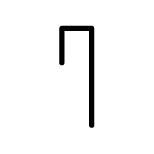


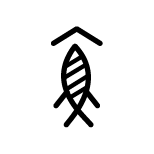
Text 1004 · Mohenjo-daro · seal · M59 M127 M245 M343 M75 M245 M245

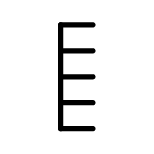
Text 1531 · Mohenjo-daro · ivory/bone rod · M171 M59 M342 M176

Text 1628 · Mohenjo-daro · sealing · M59 M403 M87 M342
Signs in reading order, first sign on the left. Text numbers are Mahadevan’s (1977). / marks a line break, … a damaged passage.