
Sign
M99
Looks like: two short vertical strokes
Adapted from the field-cady sign descriptions (Parpola 122). This describes the picture, not the meaning: a sign that looks like a fish may stand for a sound or another word.
Appears in 546 texts (649 uses), mostly on seals at Mohenjo-daro; usually sits inside a text. In the larger ICIT corpus its Wells equivalent W002 is in 723 texts, including at Dholavira.
Project finding: Validated connective: follows an opener Held up
Where it appears 546
Counts are distinct texts in the Mahadevan 1977 concordance (a text repeated on many moulded tablets counts once). 648 objects in all carry it.
| Object | Texts | Share |
|---|---|---|
| Seal | 478 | 88% |
| Sealing | 55 | 10% |
| Tablet | 2 | 0% |
| Copper tablet | 2 | 0% |
| Pottery | 4 | 1% |
| Other | 5 | 1% |
| Site | Texts | Share |
|---|---|---|
| Mohenjo-daro | 349 | 64% |
| Harappa | 106 | 19% |
| Lothal | 43 | 8% |
| Kalibangan | 22 | 4% |
| Chanhu-daro | 18 | 3% |
| Other sites | 7 | 1% |
| West Asian finds | 1 | 0% |
| Where | Uses | Share |
|---|---|---|
| First sign | 24 | 4% |
| Inside | 505 | 93% |
| Last sign | 16 | 3% |
| Whole text | 0 | 0% |
Position counts use only texts with no damaged passage (545 uses).
In the ICIT corpus (Wells numbering)
W002: 723 distinct texts, 851 uses. Wells lumps it with M100, so these counts cover both.
By object: seals 576, tablets 53, sealings 47, pottery 29, other objects 14, copper tablets 4. Top sites: Mohenjo-daro 394, Harappa 153, Lothal 45, Dholavira 33, Kalibangan 31, Chanhu-daro 18.
Variants
Wells (ICIT) equivalent: W002.
Probably the same sign (looks alike and is used alike):
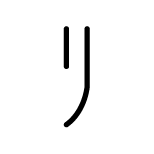 M123drawing similarity 0.71, context similarity 0.85
Pairs from the prior project’s allograph model (image × distribution, signs with at least 8 uses).
Merged with other signs in alternative sign lists (used to test whether findings survive):

Neighbours and fixed pairs 6
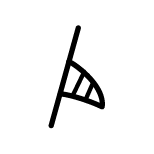


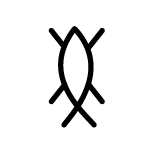
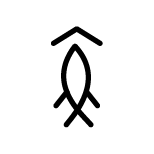

Signs read directly before or after it, counted in distinct texts, never across a line break or damage.
Fixed pairs
 M267M99225 texts. M267 is followed by M99 82% of the time; M99 follows M267 43% of the time.
 M180M9918 texts. M180 is followed by M99 51% of the time; M99 follows M180 3% of the time.
 M286M996 texts. M286 is followed by M99 55% of the time; M99 follows M286 1% of the time.
- M99
 M95 texts. M99 is followed by M9 1% of the time; M9 follows M99 56% of the time.
 M395M995 texts. M395 is followed by M99 83% of the time; M99 follows M395 1% of the time.
At least 5 texts, and one sign takes the other at least half the time.
Fixed sequences in the functional reading
Published readings 3
- Parpola · 2010Not tested on its own
oru, iru, mū, nāl, cay/aintu, aṟu, eḻu (Proto-Dravidian numerals)
- Mahadevan · 2010Not tested on its own
oblique / genitive / locative case marker (-attu?)
Yajnadevam’s sound value
- Yajnadevam · 2024Did not hold
v
Yajnadevam 2024 ‘A cryptanalytic decipherment of the Indus script’; per-sign key from yajnadevam/lipi xlits.csv via sources/field-cady_indus_valley_script_corpus/xlits.csv · test record
Part of a 714-value sound key that scores no better than keys fitted to noise (atlas 1.1).
From proposals.json and CATALOGUE.csv. A claim is listed under every sign it names.
Project tests 37
Established results
- Validated connective: follows an openerHeld up
Kept its class in 100% of bootstrap resamples; the Wells-list grammar agrees.
Role in the text
- Positional class
- Connective (bootstrap stability 1.00) Grammar
- Functional reading
- CONNECTIVE 1.00. Connective after opener (personal-seal grammar). 91% medial, after M267/M391; never dropped (phonetic_grid §5); seal-enriched, absent from copper/tablets, replicated ICIT (context Q2) Functional reading
Role names such as opener or noun are labels for positions, not tested meanings.
Mentioned in 36 result files
- Functional reading: a role grammar that “reads” every Indus text without phonetics13 lines. “…s shuffled coverage* in 5-fold CV within dev. It kept two: noun→connective (pre-opener nouns before M99, e.g. M219 M381 M99 …) and noun→clitic. The template was then frozen. Probabilities were fit by…”
- Novel methods from other fields: results13 lines. “…ves). These are separate signs, not “jar + numeral”. The two parts also never occur as a sequence (“M99 M342”: 0 cases), so the ligature is not an abbreviated bigram. This confirms and sharpens shaunm…”
- Closer and connective: red team of the “son of” match, and a pre-registered test of “closer = ownership/title”12 lines. “It replicates when the grammar’s own slots are used: M99/M123 lands on dumu in 100% of bootstraps.”
- Internal phonetics: does Indus spelling variation leak sound values?11 lines. “…planted pairs (23/80) 0.6 slot-paradigm pairs per corpus 2 pairs at q<0.05: M65\ M72 (look alike), M99\ M402 (do not look alike) neither replicates (k=1, p=0.23; k=0) inconclusive. No homophone sets”
- Red team: attacks on the project’s positive claims10 lines. ““M99 is seal-specific””
- Negative atlas: Indus routes closed or found undecidable10 lines. “Result. No pair passed. The candidate M99 M402 did not replicate.”
- M99 relator test (board #42): untestable at Indus size6 lines. “M99 relator test (board #42): untestable at Indus size”
- A positional grammar of the Indus seal text6 lines. “Connective: M99 and M123, almost always right after an opener (an opener is followed by a connective 62%”
- Phonetic grid (automated Kober triplets + Ventris grid)5 lines. “M99 never alternates and is never dropped (0 of 115 held-out uses vs a 5.5% peer rate). It is the fixed closing member of the opener units M267-M99 and M391-M99, not an ending that varies with its ste…”
- Literature map: Indus script research, with emphasis on 2015-20264 lines. “Openers: M267 + M99, and M391.”
- reg_chrono: does sign use change with decimal depth inside one site?4 lines. “Connective M99: flat (p = 0.99 and 0.18; power 0.72 and 0.36).”
- Structure of the Indus texts: direction, inventory, positional classes, segmentation, grammar4 lines. “…differ at p<0.01): includes M342 vs M343/M344/M345/M348 (jar closer vs handled jar), M149 vs M150, M99 vs M100, M403 vs M406/M407, M124 vs M125. We disagree with shaunmortal M3 on M97~M98: the one-st…”
- Bench of two more 2026 claims: Kriger & Hunt “registration codes” and Adelman “convergent Dravidian” (board task #6, H5)3 lines. “The numeral claims fail. Numerals do not concentrate in the penultimate slot. Their “digit 2 dominates” result is mostly the M99 connective, not counting.”
- Project-wide multiple-testing ledger3 lines. “M99 enriched on seals, W002 on seals null p=0.07, 0.23”
- Potter’s marks and the frame signs (Fable 5.2 plan 2, item 7)3 lines. “Hits under P2. Frame: M99, M169, M177, M342, M347. Core: M59, M134, M162, M287, M328.”
- Red team of local_repeats: the travelling numeral formula (R1) and “texts grow, never shrink” (R2)3 lines. “R1 “the formula M267/M391 + M99 + 3/4/6 strokes + M161 is ~40% of the excess; null 0.15” weakened The frame is far beyond chance under every null: 14 objects vs 0.06-1.14 expected under trigram, slot…”
- Red team: pair_numeral_long claims A (number-names), B (counted items), C (long texts)3 lines. “…re a non-numeral sign, inside a break-free run. The stroke values come from stroke_signs.json, with M99/M101 excluded. A head counts as lexeme-like if it has at least 8 dev tokens, a modal share of at…”
- reg_harappa: do the Mohenjo-daro findspot results hold at Harappa?3 lines. “M99 has power 0.69 and p = 0.12, so it is a weaker null.”
- One-to-many substitution (X YZ): does a single sign ever trade places with a 2-3 sign spelling?3 lines. “M99 = M402 M123 2 0.009 0.005 7054 M267 M99 M102 \ \ 2635 M267 M402 M123 M102 M15 opener formula (cf. M99\ M402, internal_phonetics)”
- Context and meaning: which signs go with non-textual context?2 lines. “W002 / M99 (two short strokes) Element of personal-seal legends (name/title grammar), absent from labels and dockets Enriched on seals (M77 480 vs 438, q=1e-6; ICIT 584 vs 542, q=3e-4) and ICIT sealin…”
- Genre alignment: matching Indus seal slots to Mesopotamian seal-legend slots2 lines. “One mapping is supported: the connective (M99 after M267/M391, M123 after M293/M150) is distributed like the kinship relator dumu “son of”. This holds for both references, on dev and held-out: chosen…”
- local_repeats: what are the repeated 4+ sign seal texts?2 lines. “About 40% of the excess is one travelling formula. The formula is opener M267/M391 + M99 + 3, 4 or 6 short strokes + M161 (in Wells numbering, W817/W861/W820 W002 W003/W004/W016 W390).”
- M342 (jar sign) off Mohenjo-daro: vessel marker or not? (board #45)2 lines. “consensus H/L/K (primary) 65 / 432 0.465 0.98 0.045 M99: 0.045 (median R 0.97)”
- Grammar of the Indus number signs (Fable 5.2 plan 3, R1: the Proto-Elamite method)2 lines. “connective M99 (two short strokes) 547”
- Red team: do ticked fish really cluster by block at Mohenjo-daro?2 lines. “Texts: M152 M99 M53 M59 M87 M60, M87 M59 M71, M258 M342 M87 M60 M87 M272, M100 M17 M60.”
- Space and sealing: what small seals leave out, and whether sealings differ from seals (Fable plan 5, T4 and T6)2 lines. “One sign class loses share faster than the text shrinks: the connective (M99/M123), +0.013 per doubling, Holm p = 0.016. The effect is almost all M99; without it the slope is +0.004.”
- Open Indus: reproducible tests on the Indus script2 lines. “…ry permutation of its own signs far above chance, and still does with the jar, M176, M267, M391 and M99 deleted. It fits a grammar or a fixed formula equally: the test shows sequential structure, not…”
- Chanhu-daro follow-up: results1 line. “M99 −0.011 +0.004”
- Grammar: a validated positional grammar of the Indus seal text (fable plan 6, part B)1 line. “connective 2 7.6% M99, M123”
- Stratigraphic half-life: do name signs turn over faster than frame signs? (Fable plan 2, item 9)1 line. “…datable innovation (P4). None of 302 sign x dataset tests reaches q < 0.05 (best: Lothal connective M99, p = 0.0024, q = 0.46; MD tall-2 M87 later, p = 0.004, q = 0.46). Power is the limit: a sign see…”
- Language hypotheses: results (historical-linguistics tester, 2026-11-14)1 line. “…7, M114 = 8, M115–117 = 9, M121 = 12). M103 is excluded (bound to M403, shaunmortal F7), and so is M99/100 (connective, F7). Plain fish = M59. Marked fish = M60, M65–M75.”
- Line breaks as constituent boundaries (Fable plan 6, test 1)1 line. “Slot rule: a boundary falls after a closer or jar, or before an opener. Never after a stroke numeral, and never next to M99/M123. 19% of positions qualify.”
- What kind of quantity do the short-stroke numerals count? (Fable 5.2 plan 2, item E3)1 line. “Indus (M77): short-stroke signs from stroke_signs.json. Value 2 (M99/M100/M101) is excluded, because M99 is the connective. Pooled counts: 1:157, 3:139, 4:65, 5:39, 6:35, 7:69, 8:7, 9:4, 10:1, 12:52 (…”
- Pair graph, numeral distributions, long texts (Fable 5.2 plan F1, F2, F6)1 line. “Values:* the stroke count of the numeral sign directly before the head. Short 2 = M100 only, because M99 is the connective.”
- Red team of #15: final numerals on foreign Indus texts (board task #21, agent H7)1 line. “…effect. Of the 9 numeral endings abroad, 5 are signs that may not be counts: W002 (the short-2 sign M99, which works as a connective at home) 3 times, W001 (one short stroke) once and W031 (one tall s…”
- redteam_size: is the “small seals keep their closers” omission order just “texts have one closer”?1 line. “Example: M267 M99 M67 M205 M245 M342 = T4’s W817 W002 W240 W495 W615 W740.”
Example texts 3

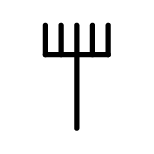
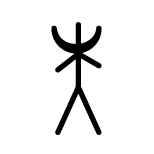

Text 1010 · Mohenjo-daro · seal · M391 M99 M48 M171 M8 M342


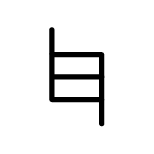
Text 1559 · Mohenjo-daro · sealing · M397 M99 M216 M254
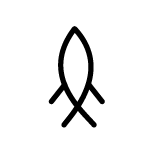


Text 2434 · Mohenjo-daro · ivory/bone rod · M59 M99 M102 M36 M384 M384
Signs in reading order, first sign on the left. Text numbers are Mahadevan’s (1977). / marks a line break, … a damaged passage.