
Sign
M86
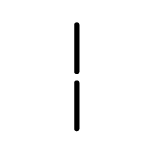
Looks like: one long vertical stroke
Adapted from the field-cady sign descriptions (Parpola 144). This describes the picture, not the meaning: a sign that looks like a fish may stand for a sound or another word.
Appears in 132 texts (149 uses), mostly on seals at Mohenjo-daro; found at the start, middle and end of texts. In the larger ICIT corpus its Wells equivalent W031 is in 216 texts, including at Dholavira.
Where it appears 132
Counts are distinct texts in the Mahadevan 1977 concordance (a text repeated on many moulded tablets counts once). 148 objects in all carry it.
| Object | Texts | Share |
|---|---|---|
| Seal | 101 | 77% |
| Sealing | 16 | 12% |
| Tablet | 9 | 7% |
| Pottery | 4 | 3% |
| Other | 2 | 2% |
| Site | Texts | Share |
|---|---|---|
| Mohenjo-daro | 85 | 64% |
| Harappa | 27 | 20% |
| Chanhu-daro | 7 | 5% |
| Lothal | 6 | 5% |
| Kalibangan | 5 | 4% |
| Other sites | 2 | 2% |
| Where | Uses | Share |
|---|---|---|
| First sign | 54 | 41% |
| Inside | 64 | 48% |
| Last sign | 14 | 11% |
| Whole text | 1 | 1% |
Position counts use only texts with no damaged passage (133 uses).
In the ICIT corpus (Wells numbering)
W031: 216 distinct texts, 258 uses.
By object: seals 133, tablets 36, pottery 31, other objects 10, sealings 6. Top sites: Mohenjo-daro 92, Harappa 61, Chanhu-daro 16, Dholavira 14, Kalibangan 9, Lothal 9.
Variants
Wells (ICIT) equivalent: W031.
Looks alike but used differently (probably a separate sign):
 M190drawing similarity 0.71, context similarity 0.20
 M193drawing similarity 0.68, context similarity 0.58
 M215drawing similarity 0.67, context similarity 0.54
Pairs from the prior project’s allograph model (image × distribution, signs with at least 8 uses).
Merged with other signs in alternative sign lists (used to test whether findings survive):



Neighbours and fixed pairs 1




Signs read directly before or after it, counted in distinct texts, never across a line break or damage.
Fixed pairs
At least 5 texts, and one sign takes the other at least half the time.
Published readings 2
- Wells · 2015Not tested on its own
10 (units of volume on pots; ~9.24 L per stroke on Purana Qila vessels)
Wells 2015 The Archaeology and Epigraphy of Indus Writing, ch.4-5 (Archaeopress)
Yajnadevam’s sound value
- Yajnadevam · 2024Did not hold
a
Yajnadevam 2024 ‘A cryptanalytic decipherment of the Indus script’; per-sign key from yajnadevam/lipi xlits.csv via sources/field-cady_indus_valley_script_corpus/xlits.csv · test record
Part of a 714-value sound key that scores no better than keys fitted to noise (atlas 1.1).
From proposals.json and CATALOGUE.csv. A claim is listed under every sign it names.
Project tests 14
Role in the text
- Positional class
- Unclassified. Its raw label was medial, but it did not keep that label reliably. Grammar
- Functional reading
- NUMERAL(tall) 1.00. Tall-stroke numeral 1. tall strokes count M328/M211/M60 only (F2/F8); side-2 docket formula (F15); values 2-3 favoured Functional reading
Role names such as opener or noun are labels for positions, not tested meanings.
Mentioned in 14 result files
- Functional reading: a role grammar that “reads” every Indus text without phonetics3 lines. “(Harappa miniature tablet). Side 1: [NOUN M343] [NOUN M162] [NOUN M343] [NUMERAL M86] [TITLE-BLOCK M336+M89+M211]. Side 2: [COUNT+MEASURE: M89 (tall 3) + M328]. The same title block that closes seal n…”
- Novel methods from other fields: results3 lines. “{M99, M87, M67, M65, M72, M86, M389, M171, M70, ...}: connective, tall strokes and fish variants”
- Internal phonetics: does Indus spelling variation leak sound values?2 lines. “After the opener+connective: M387, M389, M67, M65, M102, M86, M87 after M99. M267 and M391 before M99.”
- Proskouriakoff test: object fate vs sign content (board #33, N1)2 lines. “numerals: M86-M121, minus M90, M92 and M93”
- Structure of the Indus texts: direction, inventory, positional classes, segmentation, grammar2 lines. “Opener 37 1,496 0.47 / 0.44 / 0.08 M267, M391, M86, M293, M389, M17, M216, M197, M150, M28 W861, W820, W031, W817, W003, W920”
- A positional grammar of the Indus seal text2 lines. “unclassified 265 0.363 M87 (191, 0.75), M176 (153, 0.70), M162 (140, 0.61), M89 (134, 0.55), M169 (111, 0.56), M86 (92, 0.53), M171 (85, 0.47), M1 (80, 0.70), M102 (77, 0.62), M17 (55, 0.41) ...”
- Consensus corpus: the nine headline tests at the real transcription error rate1 line. “missing/extra M86 - 3 1.2% 10.0%”
- Genres from scratch: unsupervised text types checked against objects (board #34, N2)1 line. “an “M86/M336 opener … M211” type;”
- Grammar of the Indus number signs (Fable 5.2 plan 3, R1: the Proto-Elamite method)1 line. “tall M86 (1), M87 (2), M88/89/92/93/94 (3), M95 (4), M96 (5) 133 / 248 / 182 / 9 / 16”
- Parpola rules 3 and 4: vēl as a fish stand-in, and Murukan’s fixed partners1 line. “To separate “M403 + numeral 2” from “Muruka-vēl”, test whether M403 takes other tall-stroke counts (M86, M88/89, M95) in the same slot more than a matched null does. If M403 also takes 1, 3 and 4 tall…”
- Phonetic grid (automated Kober triplets + Ventris grid)1 line. “…ormulae followed by an open slot. M267-M99 is followed by 20 different signs (M102, M104, M59, M65, M86, …), M391-M99 by 11, and M293-M123-M343 by 7. Kober triplets have 2–4 alternants.”
- Potter’s marks and the frame signs (Fable 5.2 plan 2, item 7)1 line. “M86 M97: 3 jars.”
- Red team: the shape-only merge list (board #40, attacks #36 / experiments/signlist_shape)1 line. “The numeral rule removed 8 merges: M105+M87, M116+M118, M114+M189, M107+M109, M246+M96, M109+M239, M154+M86, M88+M95. The gain went up slightly. The numeral merges were costing likelihood.”
- Self-labelling objects: do signs depict the object they are written on?1 line. “Rod-like stroke on rods M86 3 vs 2.3 refuted / low power”
Example texts 3
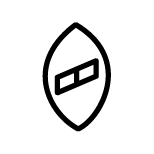

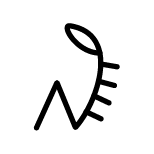
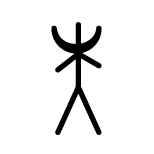

Text 1028 · Mohenjo-daro · seal · M86 M381 M99 M48 M8 M342

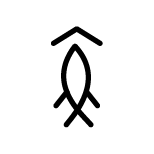


Text 1602 · Mohenjo-daro · sealing · M134 M86 M99 M65 M192 M347 M342
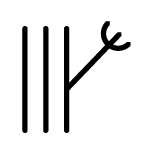
Text 2931 · Mohenjo-daro · pottery graffito · M90 M86
Signs in reading order, first sign on the left. Text numbers are Mahadevan’s (1977). / marks a line break, … a damaged passage.