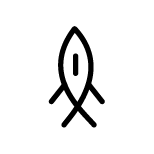
Sign
M70
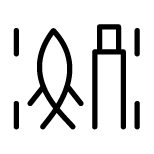
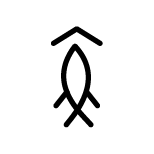
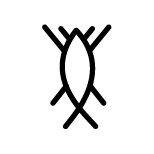
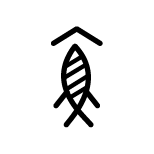
Looks like: fish with a small vertical stroke in the body
From the field-cady sign descriptions (Parpola 056). This describes the picture, not the meaning: a sign that looks like a fish may stand for a sound or another word.
Appears in 69 texts (73 uses), mostly on seals at Mohenjo-daro; usually sits inside a text. In the larger ICIT corpus its Wells equivalent W231 is in 83 texts, including at Dholavira.
Project finding: The fish signs are variants of one sign Likely
Where it appears 69
Counts are distinct texts in the Mahadevan 1977 concordance (a text repeated on many moulded tablets counts once). 73 objects in all carry it.
| Object | Texts | Share |
|---|---|---|
| Seal | 58 | 84% |
| Sealing | 5 | 7% |
| Tablet | 1 | 1% |
| Copper tablet | 3 | 4% |
| Pottery | 2 | 3% |
| Site | Texts | Share |
|---|---|---|
| Mohenjo-daro | 42 | 61% |
| Harappa | 18 | 26% |
| Lothal | 4 | 6% |
| Kalibangan | 3 | 4% |
| Chanhu-daro | 1 | 1% |
| Other sites | 1 | 1% |
| Where | Uses | Share |
|---|---|---|
| First sign | 13 | 19% |
| Inside | 51 | 75% |
| Last sign | 4 | 6% |
| Whole text | 0 | 0% |
Position counts use only texts with no damaged passage (68 uses).
In the ICIT corpus (Wells numbering)
W231: 83 distinct texts, 95 uses.
By object: seals 64, tablets 8, copper tablets 6, pottery 3, sealings 2. Top sites: Mohenjo-daro 44, Harappa 25, Dholavira 5, Kalibangan 4, Lothal 3, Chanhu-daro 1.
Variants
Wells (ICIT) equivalent: W231.
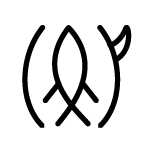
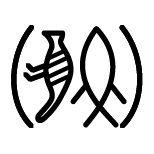
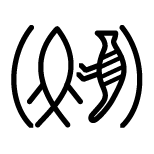
Probably the same sign (looks alike and is used alike):
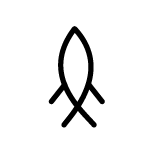 M59drawing similarity 0.96, context similarity 0.89
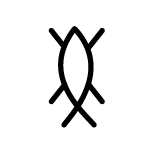 M67drawing similarity 0.90, context similarity 0.96
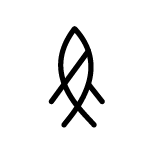 M72drawing similarity 0.94, context similarity 0.97
Pairs from the prior project’s allograph model (image × distribution, signs with at least 8 uses).
Merged with other signs in alternative sign lists (used to test whether findings survive):

Neighbours and fixed pairs


Published readings 2
- Mukhopadhyay · 2025, 2023Tested, see detail
fish signs denote gemstones, beads, jewellery and shiny metals (Dravidian min/mani; Mesopotamian ‘fish-eye stones’ NA4.IGI.KU6)
papers.ssrn.com (abstract only; full text not opened) · test record
Updated 2026-11-23: experiments/bead_workshops coded bead/jeweller units blind to signs: only 4 primary units with 32 inscribed objects at unseen sites; power about 21% at 1.5x under clustering (56% at 2x), so no test was run. The western-object side prediction fails at low power (experiments/meluhha goods.py).
Yajnadevam’s sound value
- Yajnadevam · 2024Did not hold
Yajnadevam 2024 ‘A cryptanalytic decipherment of the Indus script’; per-sign key from yajnadevam/lipi xlits.csv via sources/field-cady_indus_valley_script_corpus/xlits.csv · test record
Part of a 714-value sound key that scores no better than keys fitted to noise (atlas 1.1).
From proposals.json and CATALOGUE.csv. A claim is listed under every sign it names.
Project tests 20
Established results
- The fish signs are variants of one signLikely
Six fish-like signs replace each other in the same places and pair with the same neighbours. They behave like forms of one word, not like names of six different gods.
Role in the text
- Positional class
- Medial (bootstrap stability 0.99) Grammar
- Functional reading
- FISH-CLASS NOUN 1.00. Fish-class name element. fish paradigm: M65/67/70/72 swap with M59 in identical frames 10 vs 2.4 (novel_methods exp1/3) Functional reading
Role names such as opener or noun are labels for positions, not tested meanings.
Mentioned in 19 result files
- Novel methods from other fields: results9 lines. “…n moves it to the end of the text. Five fish signs have bracketed forms (M59→M60, M65→M66, M67→M68, M70→M71, M72→M73). Plain fish signs end a text 5% of the time. Their bracketed forms end it 60% of t…”
- Internal phonetics: does Indus spelling variation leak sound values?6 lines. “…paradigm: M65\ M72 on dev (7 independent contexts, q=0.04), M65\ M67 (7 contexts, q=0.08), and M59\ M70 and M65\ M70 (p≈0.04-0.06). These signs look alike, so if anything they are allograph-type or pa…”
- Red team: the shape-only merge list (board #40, attacks #36 / experiments/signlist_shape)3 lines. “Half of the gain is one merge: the fish signs M67 = M70 = M72, worth +0.008 (CI +0.001 to +0.015). No other class is significant on its own.”
- A positional grammar of the Indus seal text3 lines. “c5 medial 0.104 0.12 0.01 0.25 / 0.75 / 0.00 M67 0.22, M65 0.16, M72 0.16, M53 0.12, M387 0.10, M389 0.09, M70 0.07”
- Three follow-up checks from the assumption audit (#27)2 lines. “The four largest are plain fish: M67->W240 (39 times), M65->W235 (24), M72->W233 (22), M70->W231 (11). Ticked M66->W236 adds 3.”
- Core semantics: head direction and meaning classes of Indus name-core signs2 lines. “One core class is solid: the fish family (M59, M65, M67, M70, M72, M75). On held-out data:”
- One-to-many substitution (X YZ): does a single sign ever trade places with a 2-3 sign spelling?2 lines. “M216 = M70/M65 M222 2 0.012 0.006 1096 M267 M99 M67 M216 M254 \ \ 1447 M53 M67 M70 M222 M254 M222 is M216 with an inner mark; fish + marked form ≈ plain form. Held-out k=1, q=0.02; ICIT W550 = W231 W5…”
- Consensus corpus: the nine headline tests at the real transcription error rate1 line. “The plain fish were cross-wired. The correct pairs are M65=W235, M67=W240, M70=W231, M72=W233 (22/23, 37/38, 9/9 and 20/23 same-position). Mahadevan’s drawings match: roofed, cross-headed, inner-strok…”
- Copper tablets: calendar series, tallies or amulets?1 line. “T06 8/10/10 goat-antelope, twirled horns M70 M112 M194 M18 M211 M87 M169 horned-U x9”
- Is the fish tick a closer drawn inside the sign? (plan 9, story 3)1 line. “M70/71 3 / 7 / 18 -0.15 0.93 3 / 5 / 7 0.00 1.00”
- Fish tick as a closer, v2: the better de-duplication does not rescue the test1 line. “P1’s dev rule cannot pass at this size by design. Two bases (M65/66, M70/71) get only 2 planted tokens. A base needs 3 to be tested. The rule needs 4 of 5 bases.”
- Forward predictions for the surviving leads (board #44)1 line. “F5 plain fish M67 = M70 = M72 are one sign: merged class trigram beats plain gain > 0 and CI lower > 0 CI upper < 0 30 fish tokens live”
- Language hypotheses: results (historical-linguistics tester, 2026-11-14)1 line. “…fish = compounds sharing fish’s slot neighbour similarity to M59 above frequency-matched signs M67, M70, M72 at the 100th percentile, M60 97th, M65 88th (all texts); held-out: M60 100th, others 51st–7…”
- Logogram anchors: can any sign be given a meaning from pictures alone?1 line. “…re tablets of this exact legend (7 incl. the M48 variant) n/a W749 also faces two legends beginning M70-M51 (M-1548, M-1549, ICIT 2465). Neither has a picture version; the related legend 51-130-149-34…”
- Red team #38: does the consensus corpus result (#35, N3) hold up?1 line. “…lls sign stands at the same position. The new partners win clearly: M65=W235 22/23, M67=W240 37/38, M70=W231 9/9, M72=W233 20/23, M59=W220 40/46.”
- reg_findspot: do seals found in one house or room share signs?1 line. “Exploratory checks. The block result survives removing house 12/V (p=0.018). The plain fish bases M59, M65, M67, M70 and M72 do not cluster (block p=0.31, house p=0.87).”
- Scene element x sign on narrative tablets and seals (Fable 5.2 plan 3, R3)1 line. “Weaker, at q ≥ 0.49: W231 (M70, a fish variant) with buffalo on 3 seal types, and W401 with horned figures on 2 types.”
- Sign list from shape plus context: 400 or 700 signs?1 line. “fish M70 = M72 and M67 = M70;”
- Open Indus: reproducible tests on the Indus script1 line. “The fish family (M59, M65, M67, M70, M72, M75) is a class of signs that substitute for each other. It substitutes as a set, forms more compounds than frequency predicts, compounds with itself, and kee…”
Example texts 3

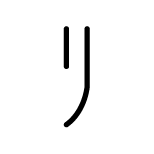


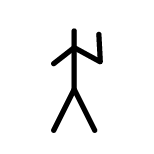
Text 1095 · Mohenjo-daro · seal · M150 M123 M70 M389 M342


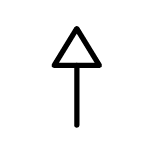


Text 1803 · Mohenjo-daro · copper tablet · M70 M112 M194 M18 M211 M87 M169


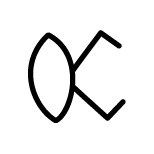

Text 4016 · Harappa · seal · M391 M97 M53 M67 M70 M327 M342
Signs in reading order, first sign on the left. Text numbers are Mahadevan’s (1977). / marks a line break, … a damaged passage.