
Sign
M209
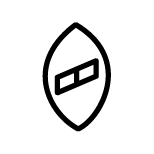
Looks like: tall triangle with vertical divider, either isosceles or more horn-shaped
From the field-cady sign descriptions (Parpola 208). This describes the picture, not the meaning: a sign that looks like a fish may stand for a sound or another word.
Appears in 17 texts (24 uses), mostly on sealings at Lothal and Mohenjo-daro; usually sits inside a text. In the larger ICIT corpus its Wells equivalent W500 is in 14 texts, including at Dholavira.
Where it appears 17
Counts are distinct texts in the Mahadevan 1977 concordance (a text repeated on many moulded tablets counts once). 24 objects in all carry it.
| Object | Texts | Share |
|---|---|---|
| Seal | 6 | 35% |
| Sealing | 10 | 59% |
| Pottery | 1 | 6% |
| Site | Texts | Share |
|---|---|---|
| Lothal | 8 | 47% |
| Mohenjo-daro | 5 | 29% |
| Harappa | 4 | 24% |
| Where | Uses | Share |
|---|---|---|
| First sign | 3 | 19% |
| Inside | 11 | 69% |
| Last sign | 2 | 12% |
| Whole text | 0 | 0% |
Position counts use only texts with no damaged passage (16 uses).
In the ICIT corpus (Wells numbering)
W500: 14 distinct texts, 24 uses.
By object: seals 8, tablets 3, sealings 1, other objects 1, pottery 1. Top sites: Mohenjo-daro 6, Harappa 4, Chanhu-daro 1, Lothal 1, Dholavira 1, Nuhato 1.
Variants
Wells (ICIT) equivalent: W500.
Looks alike but used differently (probably a separate sign):
 M204drawing similarity 0.81, context similarity 0.51
 M210drawing similarity 0.90, context similarity 0.54
Pairs from the prior project’s allograph model (image × distribution, signs with at least 8 uses).
Merged with other signs in alternative sign lists (used to test whether findings survive):

Neighbours and fixed pairs 2






Signs read directly before or after it, counted in distinct texts, never across a line break or damage.
Fixed pairs
At least 5 texts, and one sign takes the other at least half the time.
Fixed sequences in the functional reading
Published readings 1
Yajnadevam’s sound value
- Yajnadevam · 2024Did not hold
a
Yajnadevam 2024 ‘A cryptanalytic decipherment of the Indus script’; per-sign key from yajnadevam/lipi xlits.csv via sources/field-cady_indus_valley_script_corpus/xlits.csv · test record
Part of a 714-value sound key that scores no better than keys fitted to noise (atlas 1.1).
From proposals.json and CATALOGUE.csv. A claim is listed under every sign it names.
Project tests 2
Role in the text
- Positional class
- Unclassified. Its raw label was numeral, but it did not keep that label reliably. Grammar
- Functional reading
- NOUN 1.00. Unknown noun. dev n=14 texts; initial 0.29 final 0.14 Functional reading
Role names such as opener or noun are labels for positions, not tested meanings.
Mentioned in 2 result files
- Grammar of the Indus number signs (Fable 5.2 plan 3, R1: the Proto-Elamite method)1 line. “…13” lead was a fixed formula. The dev 1+12 cases are 3 families. Five are one Lothal sealing text (M209 M343 M98 M121 M59), and two are M10 M97 M121. Held-out has no new short 1 + 12 pair (P1 untesta…”
- A positional grammar of the Indus seal text1 line. “c11 numeral 0.035 0.02 0.08 0.09 / 0.81 / 0.10 M89 0.50, M403 0.18, M149 0.18, M209 0.05, M321 0.02, M189 0.01, M297 0.01”
Example texts 3
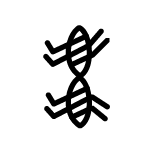

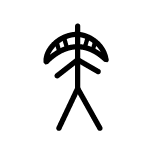
Text 1182 · Mohenjo-daro · seal · M57 M209 M343 M5
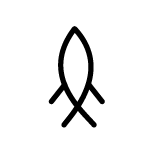




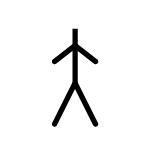
Text 4046 · Harappa · seal · M59 M209 M211 M100 M273 M87
 /

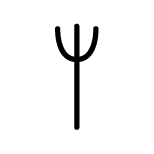
Text 4386 · Harappa · sealing · M1 M1 M209 M343 | M102 M162
Signs in reading order, first sign on the left. Text numbers are Mahadevan’s (1977). / marks a line break, … a damaged passage.