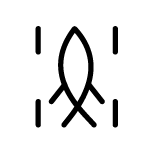
Sign
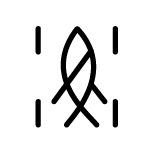
M60
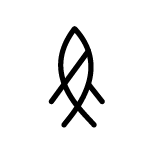
Looks like: fish with four small vertical strokes around the four corners
From the field-cady sign descriptions (Parpola 051). This describes the picture, not the meaning: a sign that looks like a fish may stand for a sound or another word.
Appears in 27 texts (29 uses), mostly on seals at Mohenjo-daro; usually ends a text. In the larger ICIT corpus its Wells equivalent W226 is in 38 texts, including at Dholavira.
Project finding: Four small ticks move the fish sign to the end Likely
Where it appears 27
Counts are distinct texts in the Mahadevan 1977 concordance (a text repeated on many moulded tablets counts once). 29 objects in all carry it.
| Object | Texts | Share |
|---|---|---|
| Seal | 24 | 89% |
| Sealing | 1 | 4% |
| Tablet | 2 | 7% |
| Site | Texts | Share |
|---|---|---|
| Mohenjo-daro | 19 | 70% |
| Chanhu-daro | 3 | 11% |
| Harappa | 2 | 7% |
| Lothal | 2 | 7% |
| Other sites | 1 | 4% |
| Where | Uses | Share |
|---|---|---|
| First sign | 2 | 7% |
| Inside | 9 | 33% |
| Last sign | 15 | 56% |
| Whole text | 1 | 4% |
Position counts use only texts with no damaged passage (27 uses).
In the ICIT corpus (Wells numbering)
W226: 38 distinct texts, 41 uses.
By object: seals 27, tablets 5, sealings 3, pottery 2, other objects 1. Top sites: Mohenjo-daro 22, Harappa 4, Lothal 4, Chanhu-daro 2, Dholavira 2, Bala-kot 1.
Variants
Wells (ICIT) equivalent: W226.
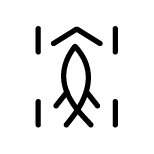
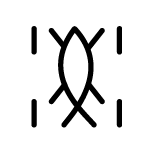
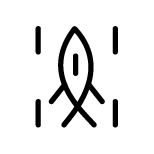
Merged with other signs in alternative sign lists (used to test whether findings survive):
Neighbours and fixed pairs 2
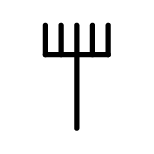
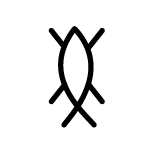

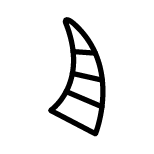


Signs read directly before or after it, counted in distinct texts, never across a line break or damage.
Fixed pairs
At least 5 texts, and one sign takes the other at least half the time.
Fixed sequences in the functional reading
Published readings 2
- Mukhopadhyay · 2025, 2023Tested, see detail
fish signs denote gemstones, beads, jewellery and shiny metals (Dravidian min/mani; Mesopotamian ‘fish-eye stones’ NA4.IGI.KU6)
papers.ssrn.com (abstract only; full text not opened) · test record
Updated 2026-11-23: experiments/bead_workshops coded bead/jeweller units blind to signs: only 4 primary units with 32 inscribed objects at unseen sites; power about 21% at 1.5x under clustering (56% at 2x), so no test was run. The western-object side prediction fails at low power (experiments/meluhha goods.py).
Yajnadevam’s sound value
- Yajnadevam · 2024Did not hold
Yajnadevam 2024 ‘A cryptanalytic decipherment of the Indus script’; per-sign key from yajnadevam/lipi xlits.csv via sources/field-cady_indus_valley_script_corpus/xlits.csv · test record
Part of a 714-value sound key that scores no better than keys fitted to noise (atlas 1.1).
From proposals.json and CATALOGUE.csv. A claim is listed under every sign it names.
Project tests 18
Established results
- Four small ticks move the fish sign to the endLikely
A plain fish sign can sit anywhere in a text. Add four small ticks and it usually comes last, so the ticks change how the sign is used, a bit like a word ending.
Role in the text
- Positional class
- Unclassified. Its raw label was medial, but it did not keep that label reliably. Grammar
- Functional reading
- BRACKETED-FISH CLOSER 1.00; FISH-CLASS NOUN 0.00. Fish-class element in the closer slot (bracketed fish). final 60% vs 5% for plain fish; replicated held-out p=0.03 (novel_methods T6) Functional reading
Role names such as opener or noun are labels for positions, not tested meanings.
Mentioned in 17 result files
- Novel methods from other fields: results8 lines. “…t: enclosing a fish sign moves it to the end of the text. Five fish signs have bracketed forms (M59→M60, M65→M66, M67→M68, M70→M71, M72→M73). Plain fish signs end a text 5% of the time. Their brackete…”
- Red team: do ticked fish really cluster by block at Mohenjo-daro?3 lines. “Texts: M152 M99 M53 M59 M87 M60, M87 M59 M71, M258 M342 M87 M60 M87 M272, M100 M17 M60.”
- Internal phonetics: does Indus spelling variation leak sound values?2 lines. “fish ticks (M60, M66, M68, M71, M73) 2 / 1.50 (0.44) 0 / 0”
- Language hypotheses: results (historical-linguistics tester, 2026-11-14)2 lines. “…bound to M403, shaunmortal F7), and so is M99/100 (connective, F7). Plain fish = M59. Marked fish = M60, M65–M75.”
- Red team: attacks on the project’s positive claims2 lines. “M60 W226 W220 / M59”
- Three follow-up checks from the assumption audit (#27)1 line. “…tness/harness.py hard-codes the fish pairing as M59/65/67/70/72 -> W220/231/233/235/240 (and ticked M60/66/68/71/73 -> W226/232/234/236/241). The data say the plain pairs are out of order: M65=W235, M…”
- fish_marshall: do ticked-fish seals cluster by block outside Mackay’s register?1 line. “Primary test, null. Ticked fish (M60/M66/M68/M71/M73) were tested against block, permuting within area x 5-ft depth band and collapsing text families:”
- Functional reading: a role grammar that “reads” every Indus text without phonetics1 line. “(Chanhu-daro seal, HO). [OPENER M267+M99] [NUMBER+CLOSER: tall-2 M87 + bracketed fish M60]. The bracketed fish fills the closer slot (novel_methods T6). No jar is needed.”
- Pair graph, numeral distributions, long texts (Fable 5.2 plan F1, F2, F6)1 line. “…: one numeral value dominates. Examples: tall 2 + M59 fish (65/71), tall 3 + M211 (39/41), tall 2 + M60/M244/M284, short 7 + M194/M197 (100%), short 3 + M190/M403 (100%), short 3 + M15, short 1 + M25.…”
- Red team: the shape-only merge list (board #40, attacks #36 / experiments/signlist_shape)1 line. “M60 = M71 = M73 (ticked fish) 21, 3, 5 +0.0027 (−0.0002, +0.0065)”
- Red team of #30: ticked fish close the text (README #3), complete single-line texts1 line. “survives. On complete single-line held-out texts, ticked fish (M60/66/68/71/73) are text-final in 9 of 16 tokens (0.56, 95% CI 0.30-0.80). Plain fish are final in 3 of 144 (0.02). Every attack leaves…”
- reg_findspot: do seals found in one house or room share signs?1 line. “seals carry a ticked fish (M60, M66, M68, M71 or M73). Block 12 has 4 of its 19 seals, all in house 12/V (0.65 expected). Blocks 6, 3 and 18 have 2 each. Blocks 1 and 7, the two largest, have 1 of 151…”
- Do the ranked findings survive other sign lists?1 line. “…devan’s drawings. They are sensible: jar with jar+strokes; plain fish M59/M70/M72 apart from ticked M60/M71/M73. At the coarsest cut M267 merges with 9 other diamonds and M391 with 9 ovals.”
- Sign list from shape plus context: 400 or 700 signs?1 line. “ticked fish M60 = M71 = M73;”
- Structure of the Indus texts: direction, inventory, positional classes, segmentation, grammar1 line. “Closer 17 1,719 0.07 / 0.22 / 0.69 M342, M176, M211, M169, M1, M15, M12, M254, M328, M60 W740, W400, W390, W520, W090, W151, W700”
- A positional grammar of the Indus seal text1 line. “c0 medial 0.053 0.04 0.10 0.15 / 0.73 / 0.12 M59 0.57, M197 0.11, M287 0.09, M284 0.06, M60 0.05, M326 0.04, M190 0.03”
- Open Indus: reproducible tests on the Indus script1 line. “Corner ticks on a fish sign move it to the closing slot (M60/66/68/71/73 vs M59/65/67/70/72): a modifier inside a sign with a positional effect. The effect size is the same under every sign list, but…”
Example texts 3

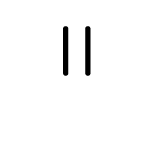

Text 1048 · Mohenjo-daro · seal · M150 M162 M100 M87 M60
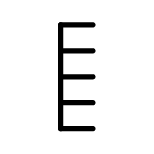
Text 4556 · Harappa · miniature tablet · M87 M60 M176

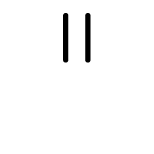
Text 6211 · Chanhu-daro · seal · M267 M99 M87 M60
Signs in reading order, first sign on the left. Text numbers are Mahadevan’s (1977). / marks a line break, … a damaged passage.