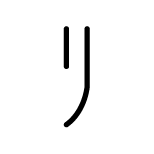
Sign
M123
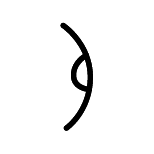
Looks like: short stroke beside a longer stroke that curves under it
Adapted from the field-cady sign descriptions (Parpola 120). This describes the picture, not the meaning: a sign that looks like a fish may stand for a sound or another word.
Appears in 178 texts (193 uses), mostly on seals at Mohenjo-daro; usually sits inside a text. In the larger ICIT corpus its Wells equivalent W060 is in 208 texts, including at Dholavira.
Project finding: Validated connective: follows an opener Held up
Where it appears 178
Counts are distinct texts in the Mahadevan 1977 concordance (a text repeated on many moulded tablets counts once). 191 objects in all carry it.
| Object | Texts | Share |
|---|---|---|
| Seal | 153 | 86% |
| Sealing | 18 | 10% |
| Tablet | 3 | 2% |
| Copper tablet | 1 | 1% |
| Pottery | 3 | 2% |
| Site | Texts | Share |
|---|---|---|
| Mohenjo-daro | 113 | 63% |
| Harappa | 30 | 17% |
| Lothal | 18 | 10% |
| Chanhu-daro | 9 | 5% |
| Kalibangan | 4 | 2% |
| Other sites | 3 | 2% |
| West Asian finds | 1 | 1% |
| Where | Uses | Share |
|---|---|---|
| First sign | 4 | 2% |
| Inside | 170 | 94% |
| Last sign | 6 | 3% |
| Whole text | 0 | 0% |
Position counts use only texts with no damaged passage (180 uses).
In the ICIT corpus (Wells numbering)
W060: 208 distinct texts, 222 uses.
By object: seals 171, tablets 25, sealings 6, pottery 3, other objects 3. Top sites: Mohenjo-daro 109, Harappa 51, Lothal 13, Chanhu-daro 8, Dholavira 6, Kalibangan 4.
Variants
Wells (ICIT) equivalent: W060.
Probably the same sign (looks alike and is used alike):
 M99drawing similarity 0.71, context similarity 0.85
Looks alike but used differently (probably a separate sign):
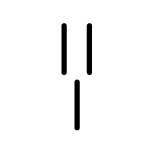 M103drawing similarity 0.67, context similarity 0.32
Pairs from the prior project’s allograph model (image × distribution, signs with at least 8 uses).
Neighbours and fixed pairs 2



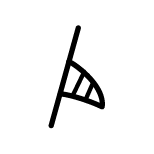
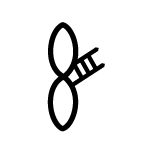



Signs read directly before or after it, counted in distinct texts, never across a line break or damage.
Fixed pairs
At least 5 texts, and one sign takes the other at least half the time.
Fixed sequences in the functional reading
Published readings 1
Yajnadevam’s sound value
- Yajnadevam · 2024Did not hold
m
Yajnadevam 2024 ‘A cryptanalytic decipherment of the Indus script’; per-sign key from yajnadevam/lipi xlits.csv via sources/field-cady_indus_valley_script_corpus/xlits.csv · test record
Part of a 714-value sound key that scores no better than keys fitted to noise (atlas 1.1).
From proposals.json and CATALOGUE.csv. A claim is listed under every sign it names.
Project tests 12
Established results
- Validated connective: follows an openerHeld up
Kept its class in 90% of bootstrap resamples; the Wells-list grammar agrees.
Role in the text
- Positional class
- Connective (bootstrap stability 0.91) Grammar
- Functional reading
- CONNECTIVE 0.83; NOUN 0.17. Connective after opener. 92% medial; follows M293 42x, M150 32x in dev; HMM connective slot (novel_methods exp2) Functional reading
Role names such as opener or noun are labels for positions, not tested meanings.
Mentioned in 11 result files
- Chanhu-daro follow-up: results6 lines. “vs Mohenjo-daro (M93 + M123): +0.134 to +0.057, which meets the “accounts for” rule;”
- A positional grammar of the Indus seal text6 lines. “Connective: M99 and M123, almost always right after an opener (an opener is followed by a connective 62%”
- Functional reading: a role grammar that “reads” every Indus text without phonetics3 lines. “Role grade B: 23 (fish paradigm, bracketed fish, M123, M293, M150, M347, M8, M162, M15, M254, M12, M190, M407, M18, M387).”
- Closer and connective: red team of the “son of” match, and a pre-registered test of “closer = ownership/title”2 lines. “R1 sign lists (M99, M123 as one class; rest CORE) lexicon only yes on dev; weaker on held-out held-out boot Ur III 0.91, OB 0.68 (SERV 0.32); M99 alone 1.00 / 0.94”
- Novel methods from other fields: results2 lines. “% M99 .54, M123 .19, M343 .09, M97 .06 CONNECTIVE”
- Genre alignment: matching Indus seal slots to Mesopotamian seal-legend slots1 line. “One mapping is supported: the connective (M99 after M267/M391, M123 after M293/M150) is distributed like the kinship relator dumu “son of”. This holds for both references, on dev and held-out: chosen…”
- Grammar: a validated positional grammar of the Indus seal text (fable plan 6, part B)1 line. “connective 2 7.6% M99, M123”
- M99 relator test (board #42): untestable at Indus size1 line. “The Indus test was not run on dev or held-out data, for M99 or M123.”
- Grammar of the Indus number signs (Fable 5.2 plan 3, R1: the Proto-Elamite method)1 line. “…of 24, it is the only stroke group above 12 in the corpus, and it occurs only in one formula (M171 M123 M67 M348 M342 / M336 M197 / M99 M172 M304 M307). Freeze as a prediction: no new 13+ stroke bloc…”
- Structure of the Indus texts: direction, inventory, positional classes, segmentation, grammar1 line. “Medial core 70 4,271 0.15 / 0.79 / 0.06 M99, M59, M87, M67, M162, M336, M123, M65, M343, M89 W002, W032, W220, W240, W060, W033, W741”
- One-to-many substitution (X YZ): does a single sign ever trade places with a 2-3 sign spelling?1 line. “M99 = M402 M123 2 0.009 0.005 7054 M267 M99 M102 \ \ 2635 M267 M402 M123 M102 M15 opener formula (cf. M99\ M402, internal_phonetics)”
Example texts 3

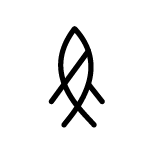
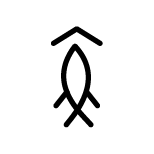
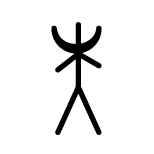

Text 1024 · Mohenjo-daro · seal · M293 M123 M343 M72 M65 M8 M342
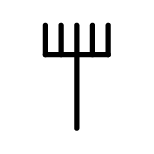
Text 1630 · Mohenjo-daro · sealing · M293 M123 M343 M171 M8 M342
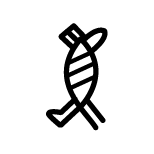
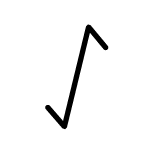


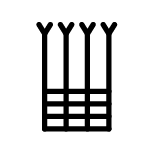
Text 1713 · Mohenjo-daro · copper tablet · M51 M130 M149 M342 M123 M102 M190
Signs in reading order, first sign on the left. Text numbers are Mahadevan’s (1977). / marks a line break, … a damaged passage.