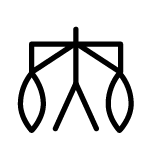
Sign
M12
Looks like: person carrying two loads from a pole
Adapted from the field-cady sign descriptions (Parpola 001). This describes the picture, not the meaning: a sign that looks like a fish may stand for a sound or another word.
Appears in 64 texts (80 uses), mostly on seals at Mohenjo-daro; usually ends a text. In the larger ICIT corpus its Wells equivalent W151 is in 77 texts, including at Dholavira.
Project finding: Validated closer: ends texts Held up
Where it appears 64
Counts are distinct texts in the Mahadevan 1977 concordance (a text repeated on many moulded tablets counts once). 80 objects in all carry it.
| Object | Texts | Share |
|---|---|---|
| Seal | 52 | 81% |
| Sealing | 5 | 8% |
| Tablet | 4 | 6% |
| Pottery | 1 | 2% |
| Other | 2 | 3% |
| Site | Texts | Share |
|---|---|---|
| Mohenjo-daro | 36 | 56% |
| Harappa | 13 | 20% |
| Chanhu-daro | 5 | 8% |
| Kalibangan | 5 | 8% |
| Lothal | 3 | 5% |
| Other sites | 1 | 2% |
| West Asian finds | 1 | 2% |
| Where | Uses | Share |
|---|---|---|
| First sign | 1 | 2% |
| Inside | 9 | 14% |
| Last sign | 53 | 83% |
| Whole text | 1 | 2% |
Position counts use only texts with no damaged passage (64 uses).
In the ICIT corpus (Wells numbering)
W151: 77 distinct texts, 94 uses.
By object: seals 56, tablets 14, pottery 3, sealings 2, other objects 2. Top sites: Mohenjo-daro 35, Harappa 21, Dholavira 6, Chanhu-daro 5, Kalibangan 4, Lothal 4.
Variants
Wells (ICIT) equivalent: W151.
Probably the same sign (looks alike and is used alike):
 M14drawing similarity 0.89, context similarity 0.96
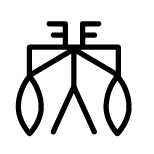 M15drawing similarity 0.73, context similarity 0.90
Pairs from the prior project’s allograph model (image × distribution, signs with at least 8 uses).
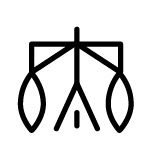
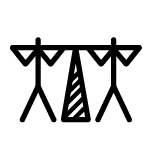
Merged with other signs in alternative sign lists (used to test whether findings survive):
Neighbours and fixed pairs







Published readings 4
- MahadevanNot tested on its own
poṟai ‘burden’ -> poṟaiyan (Chera royal title) ‘bearer/ruler’
Mahadevan (1970s-1990s; UNVERIFIED exact paper)
- Mahadevan · 2009Tested, see detail
one who carries a sacrificial vessel (priestly officiant); jar = priestly elite (Agastya, ‘jar-born’)
harappa.com (403 to us; summarised from search result and Jyothibabu review) · test record
Priest vs warrior predicts different precincts: experiments/administration P6-P7 (final M342 and M211 vs area: 0/12 held-out) and reg_findspot (jar null at 3x in two cities).
- Mahadevan (via Jyothibabu review) · 2009Untestable with our data
officer title (Tamil kaviti ‘yoke-bearer’); later Sanskrit bhartr ‘lord’
A title needs an external role record. Positional behaviour is L1 and is in experiments/functional_reading.
Yajnadevam’s sound value
- Yajnadevam · 2024Did not hold
y
Yajnadevam 2024 ‘A cryptanalytic decipherment of the Indus script’; per-sign key from yajnadevam/lipi xlits.csv via sources/field-cady_indus_valley_script_corpus/xlits.csv · test record
Part of a 714-value sound key that scores no better than keys fitted to noise (atlas 1.1).
From proposals.json and CATALOGUE.csv. A claim is listed under every sign it names.
Project tests 23
Established results
- Validated closer: ends textsHeld up
Kept its class in 88% of bootstrap resamples; the Wells-list grammar agrees.
Role in the text
- Positional class
- Closer (bootstrap stability 0.88) Grammar
- Functional reading
- CLOSER 0.84; POST-CLOSER CLITIC 0.16. Closer/post-closer. final 88% dev; probable allograph M14 (structure §2c) Functional reading
Role names such as opener or noun are labels for positions, not tested meanings.
Mentioned in 22 result files
- Internal phonetics: does Indus spelling variation leak sound values?4 lines. “Ligature decomposition 3/50 planted triples (16/50) 2.9 (5.0) spurious triples per corpus 1 triple (M12 ↔ M342 M176) against 6.7 in Indus-bigram corpora. 0 events for every graphic candidate M12 tripl…”
- Phonetic grid (automated Kober triplets + Ventris grid)4 lines. “…r these formulae. One community holds what follows M267-M99, another what follows M391-M99 and M293-M123-M343. A third is a closer block (M342, M211, M347, M169, M162, M15, …) and a fourth a post-clos…”
- Space and sealing: what small seals leave out, and whether sealings differ from seals (Fable plan 5, T4 and T6)4 lines. “Non-jar closers (M211, the M169 family, M12/M15, M254...): -0.021 share per doubling, Holm p = 0.004.”
- Structure of the Indus texts: direction, inventory, positional classes, segmentation, grammar3 lines. “M14→M12 (person; contexts p=0.98)”
- Negative atlas: Indus routes closed or found undecidable3 lines. “Question. Are complex signs (M343-345, M348, M190, M12) ligatures of their visible parts, read like sequences?”
- Functional reading: a role grammar that “reads” every Indus text without phonetics2 lines. “Role grade B: 23 (fish paradigm, bracketed fish, M123, M293, M150, M347, M8, M162, M15, M254, M12, M190, M407, M18, M387).”
- Novel methods from other fields: results2 lines. “{M176, M1, M12, ...}: post-closers”
- Red team: Harappa relative chronology (half_life P3)2 lines. “M12 early -1.3 / -1.2 0.078 6/11 both”
- Red team: the shape-only merge list (board #40, attacks #36 / experiments/signlist_shape)2 lines. “M12 = M14 42, 7 +0.0024 (−0.0006, +0.0062)”
- A positional grammar of the Indus seal text2 lines. “closer 7 0.141 M342 (776, 1.00), M211 (142, 1.00), M15 (58, 1.00), M254 (47, 0.80), M12 (42, 0.88), M14 (7, 0.95), M388 (4, 0.76)”
- Chanhu-daro follow-up: results1 line. “M12 +0.028 +0.001”
- Checking the foreign readings against published images (board task #12, H1)1 line. “…he water-carrier “hieroglyphic” seal, not Gadd 3. Mahadevan read the pictorial device as signs M175-M12-M182; M12 is the water-carrier sign. Gadd treats it as a picture, not an ordinary inscription. I…”
- Stratigraphic half-life: do name signs turn over faster than frame signs? (Fable plan 2, item 9)1 line. “Signs that run late in both Harappa excavations: M127, M387, M197, M341, M72, M173, opener M293. Early in both: closer M12, M375, opener M205, M1, title element M347.”
- Language hypotheses: results (historical-linguistics tester, 2026-11-14)1 line. “…igns (94th percentile; dev and held-out 100th); (c) alternates in only 49 of 688 stems, mostly with M12/M15 (a, b) supported; (c) weak. Any closing word (title, genitive, “seal of”) predicts the same,…”
- Literature map: Indus script research, with emphasis on 2015-20261 line. “…ty’ M373 = *akam* (alternative) Quartered circle = *pāḻi* ‘city’ (number UNVERIFIED) Burden-carrier M12 = *poṟai* → *poṟaiyan* (Chera title) (paper UNVERIFIED) 2014: a four-sign sequence = ‘merchant o…”
- Graphic modifiers: is there a paradigm beyond the corner ticks?1 line. “Pre-register “roof → text-initial” (M65←M59, M163←M162, M334←M333, M14←M12, W391←W390, W361←W360) and test it on new finds or the Fuls corpus. Also check whether roof fish M65 is a separate opener-cla…”
- reg_chrono: does sign use change with decimal depth inside one site?1 line. “half_life’s Harappa markers, applied to Mohenjo-daro depth, point the wrong way: late signs M127, M387, M197, M341, M72, M293 vs early signs M12, M375, M205, M347 give p = 0.83.”
- reg_harappa: do the Mohenjo-daro findspot results hold at Harappa?1 line. “Numerals: p = 0.064, top square M12 with 14 of 17 families”
- Proskouriakoff test: object fate vs sign content (board #33, N1)1 line. “closers: 7 signs (M342, M211, M15, M254, M12, M14, M388)”
- Sign list from shape plus context: 400 or 700 signs?1 line. “M12 = M14 and M180 = M181;”
- T5 Site signal in non-repeated seal texts (Fable plan 5, test 5)1 line. “W154 is a Wells variant of the M12/M15 person sign; W405 is in the ambiguous W390/W405 cup group.”
- One-to-many substitution (X YZ): does a single sign ever trade places with a 2-3 sign spelling?1 line. “M12 = M342 M176 4 – 0.02 5123 \ \ 8201 closer ↔ closer + post-closer (internal_phonetics T3); held-out k=3, q=0.01”
Example texts 3
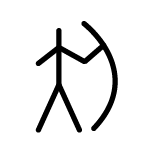

Text 1043 · Mohenjo-daro · seal · M27 M297 M12



Text 1532 · Mohenjo-daro · ivory/bone rod · M95 M328 M2 M12





Text 4073 · Harappa · seal · M267 M99 M102 M59 M347 M12
Signs in reading order, first sign on the left. Text numbers are Mahadevan’s (1977). / marks a line break, … a damaged passage.