
Sign
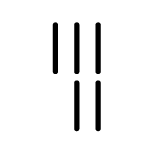
M104
Looks like: four short vertical strokes
Adapted from the field-cady sign descriptions (Parpola 124). This describes the picture, not the meaning: a sign that looks like a fish may stand for a sound or another word.
Appears in 50 texts (70 uses), mostly on seals at Mohenjo-daro; usually sits inside a text. In the larger ICIT corpus its Wells equivalent W004 is in 78 texts, including at Dholavira.
Where it appears 50
Counts are distinct texts in the Mahadevan 1977 concordance (a text repeated on many moulded tablets counts once). 69 objects in all carry it.
| Object | Texts | Share |
|---|---|---|
| Seal | 35 | 70% |
| Sealing | 4 | 8% |
| Tablet | 3 | 6% |
| Copper tablet | 1 | 2% |
| Pottery | 3 | 6% |
| Other | 4 | 8% |
| Site | Texts | Share |
|---|---|---|
| Mohenjo-daro | 32 | 64% |
| Harappa | 12 | 24% |
| Chanhu-daro | 2 | 4% |
| Lothal | 2 | 4% |
| Other sites | 1 | 2% |
| West Asian finds | 1 | 2% |
| Where | Uses | Share |
|---|---|---|
| First sign | 15 | 29% |
| Inside | 32 | 63% |
| Last sign | 3 | 6% |
| Whole text | 1 | 2% |
Position counts use only texts with no damaged passage (51 uses).
In the ICIT corpus (Wells numbering)
W004: 78 distinct texts, 99 uses. Wells lumps it with M105, so these counts cover both.
By object: seals 40, tablets 20, pottery 8, other objects 4, sealings 3, copper tablets 3. Top sites: Mohenjo-daro 36, Harappa 27, Lothal 3, Ur 2, Dholavira 2, Allahdino 1.
Variants
Wells (ICIT) equivalent: W004.
Looks alike but used differently (probably a separate sign):
 M95drawing similarity 0.97, context similarity 0.54
 M193drawing similarity 0.71, context similarity 0.52
 M201drawing similarity 0.74, context similarity 0.53
Pairs from the prior project’s allograph model (image × distribution, signs with at least 8 uses).
Merged with other signs in alternative sign lists (used to test whether findings survive):

Neighbours and fixed pairs



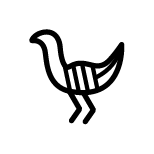
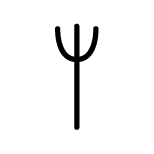


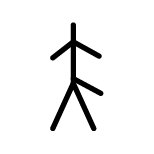
Published readings 3
- Parpola · 2010Not tested on its own
oru, iru, mū, nāl, cay/aintu, aṟu, eḻu (Proto-Dravidian numerals)
- Wells · 2015Not tested on its own
1
Wells 2015 ch.5
Yajnadevam’s sound value
- Yajnadevam · 2024Did not hold
c
Yajnadevam 2024 ‘A cryptanalytic decipherment of the Indus script’; per-sign key from yajnadevam/lipi xlits.csv via sources/field-cady_indus_valley_script_corpus/xlits.csv · test record
Part of a 714-value sound key that scores no better than keys fitted to noise (atlas 1.1).
From proposals.json and CATALOGUE.csv. A claim is listed under every sign it names.
Project tests 10
Role in the text
- Positional class
- Unclassified. Its raw label was medial, but it did not keep that label reliably. Grammar
- Functional reading
- NUMERAL(short) 1.00. Short-stroke numeral 4. two stroke systems with complementary heads (shaunmortal F2/F5/F8, ICIT replicated); numeral precedes head Functional reading
Role names such as opener or noun are labels for positions, not tested meanings.
Mentioned in 10 result files
- R4: do numerals on an object track a measurable property of that object?2 lines. “…described as “four and seven digits”, restored length 11.4 in = 289.6 mm. That is M-2124, M77 2926, M104 M110, ICIT length 289.6. ICIT’s implement and rod dimensions turn out to be copied from these r…”
- Consensus corpus: the nine headline tests at the real transcription error rate1 line. “identity M104 W034 3 1.2% 12.4%”
- Functional reading: a role grammar that “reads” every Indus text without phonetics1 line. “…: an opener that is not first (M267 16, M391 9, M150 5: “pre-opener” material such as M238 M267 M99 M104 M169), M99 at text start (4), and bare numerals. The noun→opener edge would recover these, but…”
- Language hypotheses: results (historical-linguistics tester, 2026-11-14)1 line. “Sign sets: short numerals (M97/98 = 1, M102 = 3, M104/105 = 4, M106/107 = 5, M108/109 = 6, M110–112 = 7, M114 = 8, M115–117 = 9, M121 = 12). M103 is excluded (bound to M403, shaunmortal F7), and so is…”
- Novel methods from other fields: results1 line. “M267 M99 [M104 M59 M65 M87] M59 M211”
- Grammar of the Indus number signs (Fable 5.2 plan 3, R1: the Proto-Elamite method)1 line. “short M97/98 (1), M100/101 (2), M102/103 (3), M104/105 (4), M106/107 (5), M108/109 (6), M110-113 (7), M114 (8), M115-117 (9), M118 (10), M121/122 (12). No 11 1: 157, 2: 28, 3: 114, 4: 53, 5: 33, 6: 31…”
- Phonetic grid (automated Kober triplets + Ventris grid)1 line. “…es” are opener formulae followed by an open slot. M267-M99 is followed by 20 different signs (M102, M104, M59, M65, M86, …), M391-M99 by 11, and M293-M123-M343 by 7. Kober triplets have 2–4 alternants…”
- Red team: attacks on the project’s positive claims1 line. “M104 (4) 3/34”
- Structure of the Indus texts: direction, inventory, positional classes, segmentation, grammar1 line. “…ral-like. Stroke signs, identified by drawing, are spread over core (M99, M87, M89, M102, M97, M98, M104, M112, M121) and opener (M86, M106, M109, M103). With context features (PPMI neighbour profiles…”
- A positional grammar of the Indus seal text1 line. “c15 medial 0.062 0.10 0.04 0.34 / 0.62 / 0.04 M249 0.23, M17 0.12, M204 0.09, M175 0.08, M124 0.08, M104 0.07, M25 0.05”
Example texts 3


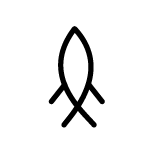
Text 1019 · Mohenjo-daro · seal · M267 M99 M104 M59 M211

 /

Text 1471 · Mohenjo-daro · miscellaneous · M240 M302 M156 | M104 M205 M107


Text 3236 · Mohenjo-daro · sealing · M345 M104 M169
Signs in reading order, first sign on the left. Text numbers are Mahadevan’s (1977). / marks a line break, … a damaged passage.