Preprint · 5 Oct 2026
Where Indus texts wrap to a new line can be ranked, but carries little information
Zenil and Uthamacumaran · arXiv 2610.08861
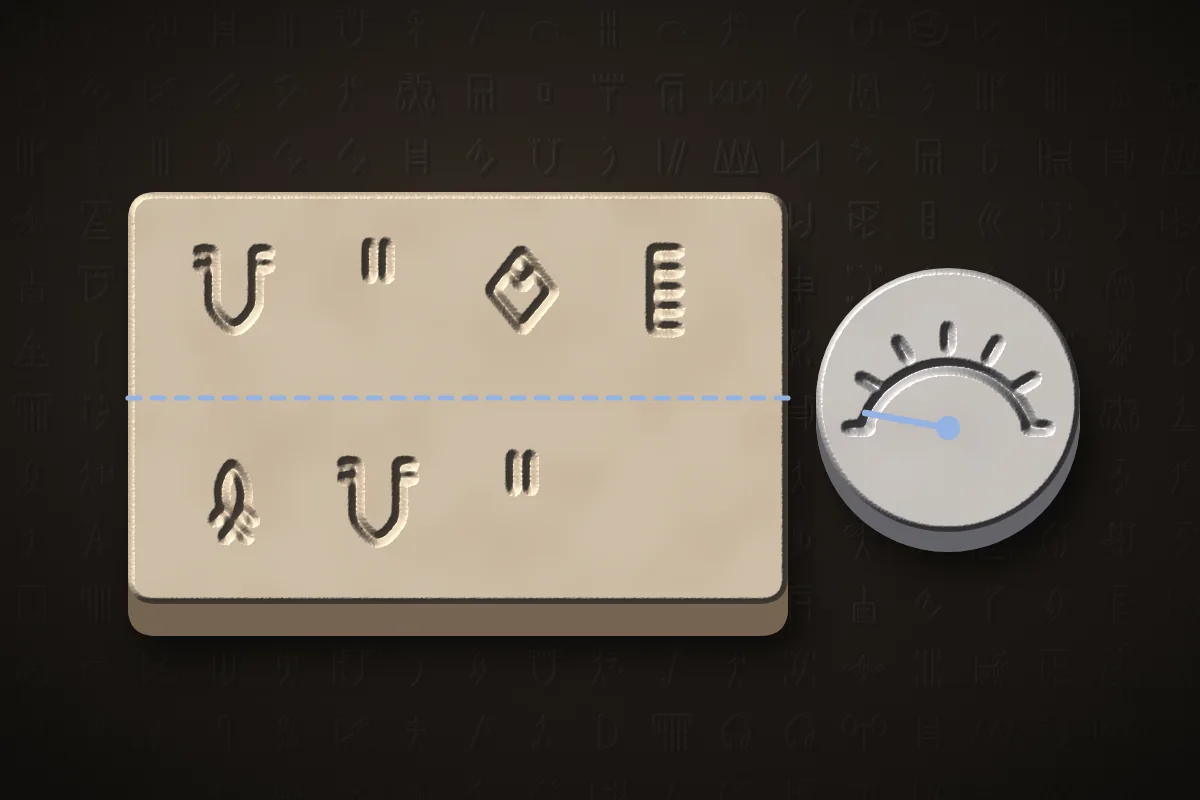
In a sentence
A study of five undeciphered records finds Indus line breaks are predictable in rank but weak in bits.
In plain words
The authors asked what can be learned about undeciphered records without reading them: layout, word division, reading direction. They tested Indus texts, the Phaistos disc, rongorongo, khipu and the Voynich manuscript, with Egyptian as a control. For Indus, a model could often tell which gap was a line break. But the amount of information in that prediction was tiny.
Technical detail
Algorithmic-information and predictive-coding measures with held-out records and 999 null draws. Indus: 292 gaps in 47 multi-line inscriptions from a derivative CSV, 49 of them row breaks, Mohenjo-daro held out. Row-break AUC 0.812 (bootstrap 0.742-0.871) but a code gain of only 0.0092 bits per gap; rongorongo AUC 0.51, Egyptian 0.95. The Indus test is small and uses slash delimiters, not measured positions. Preprint.
What we take from it
BackgroundIt touches our line_breaks test, which asks whether breaks fall at slot boundaries. Their gap between a good ranking and almost no information is a warning for our attacks too: report both accuracy and bits. They also say any search over languages and settings must sit inside the train/test split, which is how the mismatch study is sealed.