Preprint · 12 Oct 2026
One sign that never follows another
Dominik · Zenodo 23307028
In a sentence
A paper on sign grammar makes one sharp claim that can be checked in minutes.
In plain words
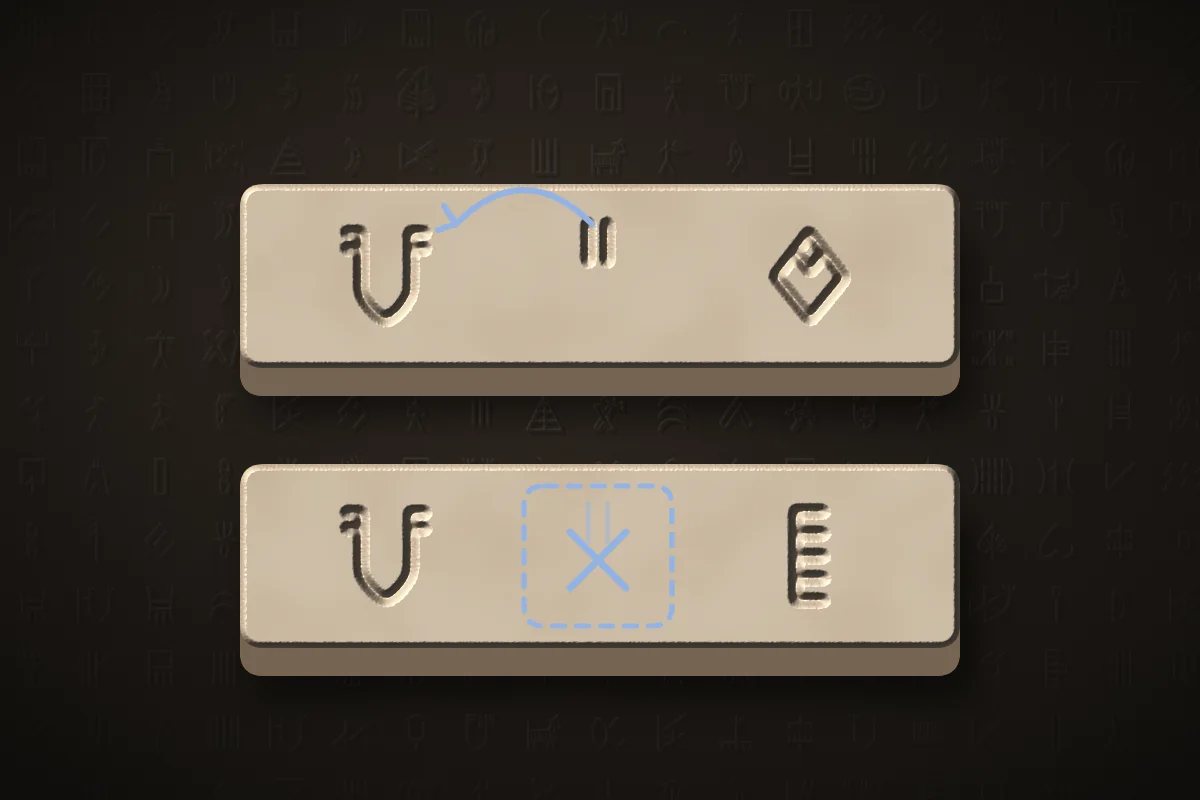
Most of the paper’s grammar gain is tiny. But it makes one clear claim: a certain sign never comes right after the arrow sign, yet often comes right after the jar sign. A rule that sharp is easy to test on texts the author did not use.
Technical detail
Held-out gain of only 0.014 nats per sign (CI 0.010 to 0.018) on 6,778 tokens, and the author notes the contexts were chosen in advance. Sharp claim, in Wells numbers: W090 never follows W520 (0 of 136) but follows W740 in 69 of 994 cases (7%). The corpus inputs are withheld.
How we read it
Read: full text. Sources opened: zenodo.org/api/records/23307028, zenodo.org/api/records/23307028/files/Dominik_2026_Indus_Constructiona.
What they did
- The author collapsed a Wells-coded working corpus into 2,022 distinct sequence families with 9,302 sign occurrences, so repeated texts are not counted twice.
- He added nine fixed two-sign contexts to a bigram model and tested whether they improve prediction on held-out sites, leaving out test families seen in training.
- He screened for frames that hold in both Harappa and Mohenjo-daro, using one city to find them and the other to check them.
- He recounted specific contrasts, such as which signs follow W520 and W740, and the order of numerals and nouns by object type.
- He kept a ledger that assigns a functional role to each token and reports its coverage, while calling these roles interpretations, not translations.
What they found
- Adding the nine contexts lowers held-out negative log-likelihood from 4.33935 to 4.32551 over 6,778 predictions, a gain of 0.01384 nats with 95% interval 0.00979 to 0.01789 (abstract; section 4.1, p. 5).
- Three of five archived construction tasks survived correction, the strongest being W590 frame completion with a gain of 0.3056 over 199 events (Table 1, p. 5).
- Two new cross-city frames passed: W920-W060-W741 (Harappa 3/6, Mohenjo-daro 18/30) and W840-W032-W740 (6/6, 10/11) (section 4.1, p. 5).
- Excluding W033-led cases, W090 follows W520 in 0 of 136 cases and W740 in 69 of 994, two-sided Fisher p = 0.00017674; without W220 families it is 0/86 against 52/876, p = 0.01099 (section 4.2, Table 2, p. 6).
- Numerals precede nouns 277 times and follow them 59 times; postnominal order is 11.0% of seal pairs, 31.1% of tablet pairs and 64.3% of pottery pairs (section 4.3, p. 6).
- W590 before the W390 family goes on to W740 in 33 of 46 cases on square seals against 0 of 128 without W590 (Table 3, p. 7).
- The role ledger covers 7,846 of 9,302 tokens (84.347%) and fully assigns 1,004 of 2,022 families (section 4.6).
- Base sign forms are followed by a resolver in 74 of 692 cases against 0 of 50 for caged forms, but this weakens to nominal p = 0.0974 once terminal cases are dropped (section 5, p. 9).
Strengths and limits
- The author is frank: he says the contexts were chosen during earlier work, so the held-out gain is not an independent test, and the p values are uncorrected.
- The overall gain over a bigram is tiny, and he notes it has not been compared with a tuned trigram or four-gram model.
- The corpus files are withheld, so nobody else can rerun the corpus-level numbers; only the code and aggregates are public.
- Many results are sharp zero cells such as 0/136; our own test found such zero cells common in Indus sign order (24 of 57 similar triples), so sharpness alone is weak evidence.
- Semantic labels such as FISH, TREE and POT rest on sign shape and are not tested against anything external.
What the authors say comes next
- Compare the constructional model with a well-tuned unrestricted trigram or four-gram model. (Section 5, p. 8)
- Verify that rule selection was separated from evaluation before claiming independent generalisation. (Section 5, p. 9)
- Seek an external phonetic anchor, such as a securely identified name, commodity or bilingual relation, with object-level provenance, including western seals. (Section 5, p. 9)
- Check the graphic descriptions of W220, W390 and W700 against the original sign plates. (Section 4.5, p. 8)
- Use the model’s constraints as targets for lexical and phonetic testing. (Abstract; section 6)
Ideas it gives us
- Test the two cross-city frames (W920-W060-W741 and W840-W032-W740) and the W590-W390-W740 frame on our family-clean held-out M77 split and on ICIT sites outside Harappa and Mohenjo-daro, translated through the Wells-to-Mahadevan bridge. These were found with a city-split procedure and are the author’s most portable claims; we only tested the W090 contrast so far. Open data enough: yes. Needs: M77 held-out split v2, ICIT, bridge_WM.json.
- Replicate the numeral-noun order shift by object type (postnominal 11% on seals, 31% on tablets, 64% on pottery) on M77 held-out texts with a family-level permutation null. If word order follows the object, that is a register effect worth separating from grammar, and it fits the project’s finding that each object type has its own vocabulary. Open data enough: yes. Needs: M77 numeral and object-type codes; a fixed list of numeral signs and counted nouns frozen before the run.
- Score his nine-context model against our trigram on our clean split, the comparison he says is missing. It settles whether the constructional contexts carry anything a plain n-gram does not. Open data enough: no. Needs: His public replay code is enough to re-implement the contexts, but his exact sign units need the withheld corpus or a careful mapping to M77.
What we take from it
TestedWe tested it. The pattern shows in reading order on the main texts, but not on texts kept aside, and gaps this sharp are common: 24 of 57 similar sign pairs have one. So it is real but not special.
The idea we are borrowing
Check a sharp grammar rule: one sign that supposedly never follows the arrow sign
Where it stands: Tested.