Preprint · Mar 2025
Do Indus signs look more like scripts from the Himalayas than from Mesopotamia?
ivc2tyc project · arXiv 2503.21074
In a sentence
An image-AI comparison claims Tibetan-Yi corridor scripts resemble Indus signs most.
In plain words
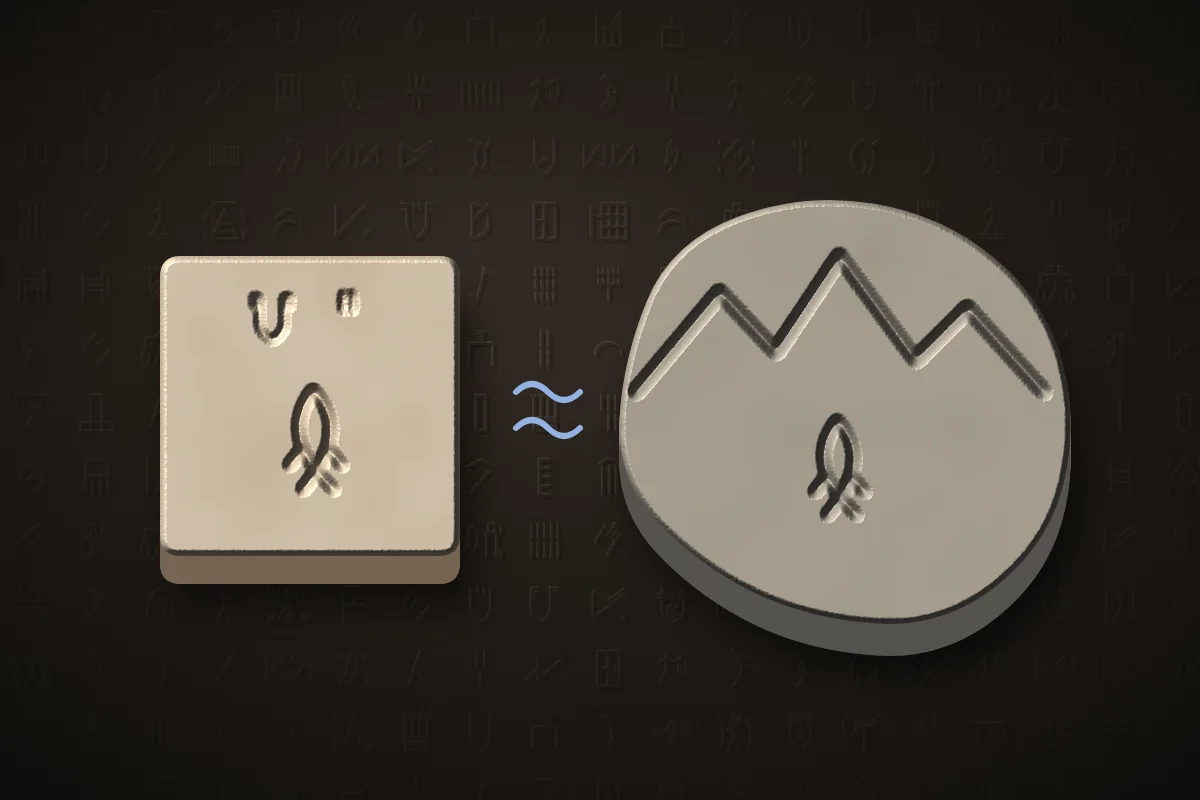
Using image AI, the authors compare sign shapes and report that scripts from the Tibetan-Yi corridor, such as Naxi Dongba and Yi, look more like Indus signs than proto-cuneiform or Proto-Elamite do. Looking alike does not mean sounding alike, but their open sign images are useful.
Technical detail
Hybrid vision embeddings over glyph image sets for Indus, proto-cuneiform, Proto-Elamite and five Tibetan-Yi scripts (GitHub oohalakkadi/ivc2tyc, MIT; recommended by PCI Archaeology). Shape similarity carries no sound values: Linear Elamite look-alikes failed blind (p = 0.83).
How we read it
Read: full text. Sources opened: arxiv.org/pdf/2503.21074.
What they did
- The author compared sign images from the Indus script, proto-cuneiform and proto-Elamite with signs from newer Dongba, old Naxi and a mixed Tibetan-Yi corridor set of Ba-Shu, Classical Yi and old Naxi signs (section 3.1).
- She trained contrastive CNN-Swin image encoders with an NT-Xent loss at temperature 0.1 (section 3.5).
- For each target script she trained five models, fifteen in all, each in its own embedding space (section 3.4, Table 3.1).
- She compared glyph-level and script-level cosine similarity between the target scripts and the corridor set.
What they found
- Mean glyph-level cosine similarity with the corridor set is 0.635 for Indus, 0.102 for proto-cuneiform and 0.078 for proto-Elamite (Table 4.1, p. 31).
- Script-level similarity is 0.930 for Indus (interval 0.917 to 0.942), 0.887 for proto-cuneiform and 0.855 for proto-Elamite (section 4.1.1).
- Effect sizes (Cohen’s d) are 7.13 to 8.36, which the author says are inflated by low variance (Table 4.3; section 5.1.1).
- Several ensemble members stopped at epoch 1, and validation losses lie roughly between 8.7 and 10.2 (Table 3.1, pp. 23-24).
- The author lists independent origin, common ancestry and convergent evolution as alternative explanations (section 5.4).
Strengths and limits
- The code is public (github.com/oohalakkadi/ivc2tyc, section 6.3) and the author is open about inflated effect sizes.
- Similarities from separate embedding spaces, trained per target script, cannot be compared across target scripts.
- Several models barely trained, so the embeddings may reflect image style more than sign form.
- Our own red-team run found the Indus advantage disappears when the Ba-Shu signs are removed (experiments/redteam_ivc2tyc).
What the authors say comes next
- Study Tibetan rock art and archaeology along the Shu-Shendu road. (Section 6.2, p. 43)
- Add linguistic and semantic constraints to the embeddings and include more Central and East Asian scripts as controls. (Section 6.2, p. 43)
Ideas it gives us
- Retrain one shared embedding space on all scripts together, then compare Indus-to-corridor similarity against a null of shuffled script labels and against unrelated control scripts drawn in a similar style. This removes the cross-space comparison that makes the published numbers incomparable. Open data enough: no. Needs: The ivc2tyc code and sign images (public), plus open sign images for several unrelated control scripts.
- Report the corridor similarity sign by sign and check whether the Indus advantage comes from a handful of simple shapes such as strokes, circles and crosses. Simple geometric signs recur in unrelated scripts and could drive the result alone. Open data enough: yes. Needs: The ivc2tyc repository outputs and our existing red-team run.
What we take from it
TestedWe red-teamed it. The claim technically survives, but its whole edge comes from one small script, Ba-Shu. Proto-cuneiform is closer to Indus than four of the five Himalayan scripts.
The idea we are borrowing
Test the claim that Indus signs look most like Himalayan scripts
Where it stands: Tested.