Paper · May 2025
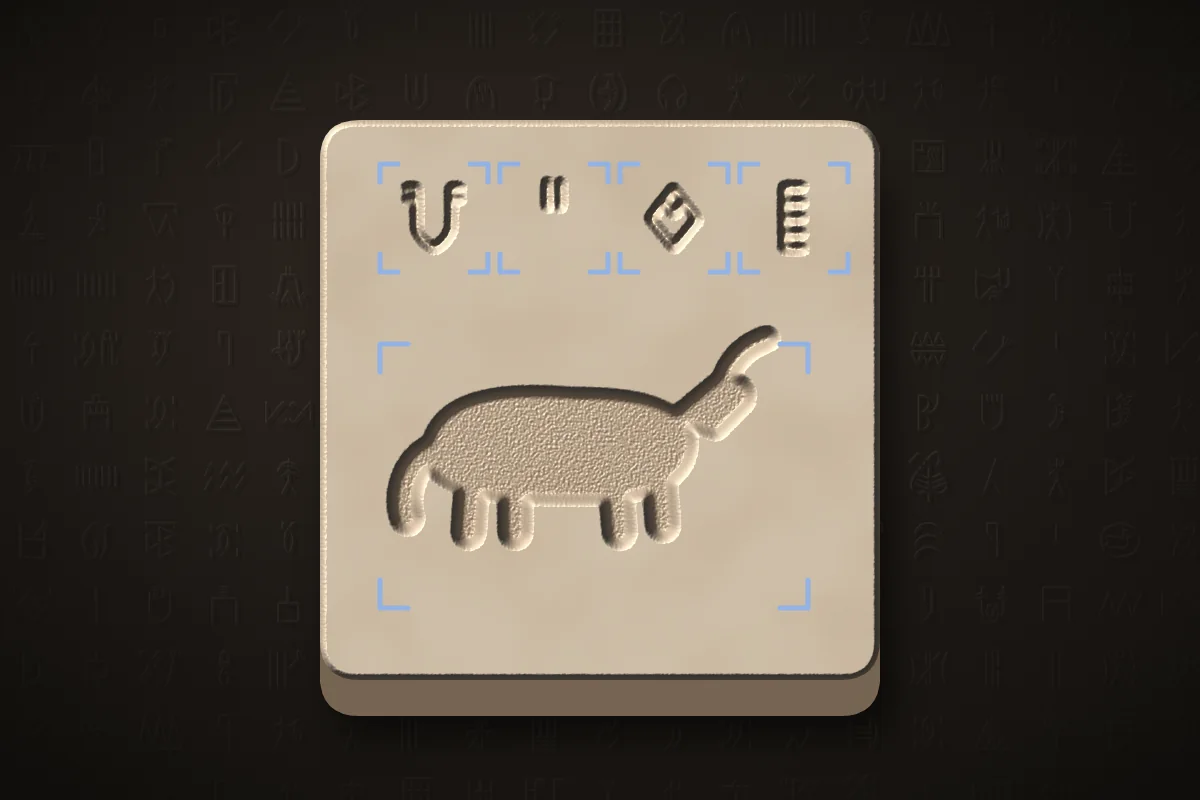
Teaching computers to find signs and animals in seal photos
Dixit and colleagues · Journal of Computer Applications in Archaeology 8(1):156–169
In a sentence
Image models that spot signs and animal motifs on photographs of seals.
In plain words
The team trained image models to find the signs on a seal photo, name each one, and recognise the animal. Only sample data is public. The full set is available from the authors on request.
Technical detail
YOLOv3 sign detection, MobileNet sign classification and motif identification on seal photographs. The repository (DM-BiCLab) holds sample data only.
How we read it
Read: full text. Sources opened: journal.caa-international.org/articles/10.5334/jcaa.175, journal.caa-international.org/articles/175/files/682af66155357.pdf, github.com/DM-BiCLab/Deep-Learning-in-Archiving-Indus-Script-and-Motif.
What they did
- The authors collected 1,004 seal images from the CISI volumes and Mahadevan 1977, leaving 963 after removing duplicates.
- They trained a YOLOv3 detector to find signs on 232 annotated images and tested it on 13.
- They trained a MobileNet classifier on 40 classes, 39 Mahadevan signs plus an ‘Other’ class, using 12,264 augmented crops.
- They also trained a motif classifier (MI-net) on 11 animal and field motifs.
What they found
- The sign classifier reaches 94.5% validation accuracy and an F1 score of 95% (results section).
- Five-fold cross-validation gives 85.28% accuracy (plus or minus 1.51) and F1 85.22% (plus or minus 1.53) (Table I).
- The final test used a class-balanced set of 200 unaugmented crops (results section).
- The motif classifier reaches a mean fold accuracy of 0.85 (results section).
Strengths and limits
- Automatic sign reading from images could speed corpus building and check transcriptions.
- Only 40 classes are covered out of several hundred signs, and broken seals were excluded (section VI).
- The detector test set of 13 images is very small.
- The full datasets are available only on request, per the repository README.
What the authors say comes next
- Handle class imbalance with zero-shot or transfer learning, and include broken seals. (Section VI)
- Add Wells and Fuls 2024 images, label by consensus, move to YOLOv5, add metadata, and extend to other scripts. (Section VII)
Ideas it gives us
- Use a sign classifier’s confusion matrix as an independent measure of which signs look alike, and check whether visually confusable pairs are also distributionally similar in M77. It tests whether look-alike signs behave as allographs with a source of similarity that is not our own judgement. Our look-alike tests (atlas 8.1/8.2) used shape judgement; this would only add an outside measure, so it is low priority. Open data enough: no. Needs: Seal images or the authors’ trained model and data, available only on request.
- Score a sign detector’s errors against the M77 versus ICIT reading disagreements for the same objects: where the two corpora disagree, does an image model side with one? It gives a third witness on contested sign readings, which affect every statistic. Open data enough: no. Needs: Seal images (CISI scans are not openly licensed) or the authors’ model; M77 to ICIT object concordance.
What we take from it
Idea, needs dataReading signs straight from photos could settle the 1-in-8 disagreements between the two main transcriptions. We need open images first.
The idea we are borrowing
Read signs straight from seal photos, to fix the 1-in-8 disagreements between transcriptions
Where it stands: Idea, needs data.