Open Indus, part of Open Citizen Science

Decipher the Indus script by 2027

An open-source effort, run in public. All our code and data are free.

NOWLatest updates

What we did this week, and what came out

  1. ResultOur refutations mostly survive other sign lists

    We had checked our positive findings under 12 other ways of dividing the signs and under the second edition of the texts, but never our refutations. Now we have. Four of the six hold everywhere they can be tested, including the ‘tablets are licences’ and ‘animal emblems name organisations’ readings. Two cannot be checked this way: the stroked-jar result rests on one edition, and the cup-fee result has only one alternative test, which shows a drift over time that was already known. On a fresh look, three blind raters moved the claim by Laursen and Parpola that ‘Gulf seals write another language’ from refuted to untestable: our test ruled out only a stricter version of the claim.

  2. ResultTesting our own test on a script we can read

    Before trusting our meaning tests on Indus, we ran one of them on Linear B, cut to Indus size. One agent who reads Linear B wrote 30 true claims, another invented 30 claims without being able to read it. The test never passed an invented claim and never rejected a true one, but it gave no answer on 27 of the 30 true claims. So a pass means something, but it confirms a sign pair, not a reading. With that in view, two blind raters moved Parpola’s ‘names of the god Murukan’ from supported to untestable: the sign pair is real, but it fits other readings just as well.

  3. ClosedJar signs with strokes are not volume units on pots

    Mukhopadhyay read jar signs with one to three strokes inside as units of volume. If so, they should turn up more often on pottery. Two agents, working blind, matched her drawings to the standard sign numbers and agreed. The signs appear on fewer pots than chance predicts (17 against 23 expected), in a test that would have seen a twofold excess. Parpola’s fig + fish ‘north star’ could not be tested: his fig sign has no number we can check, and the two agents disagreed on it.
01The script

The writing of a vast early civilisation is still unread

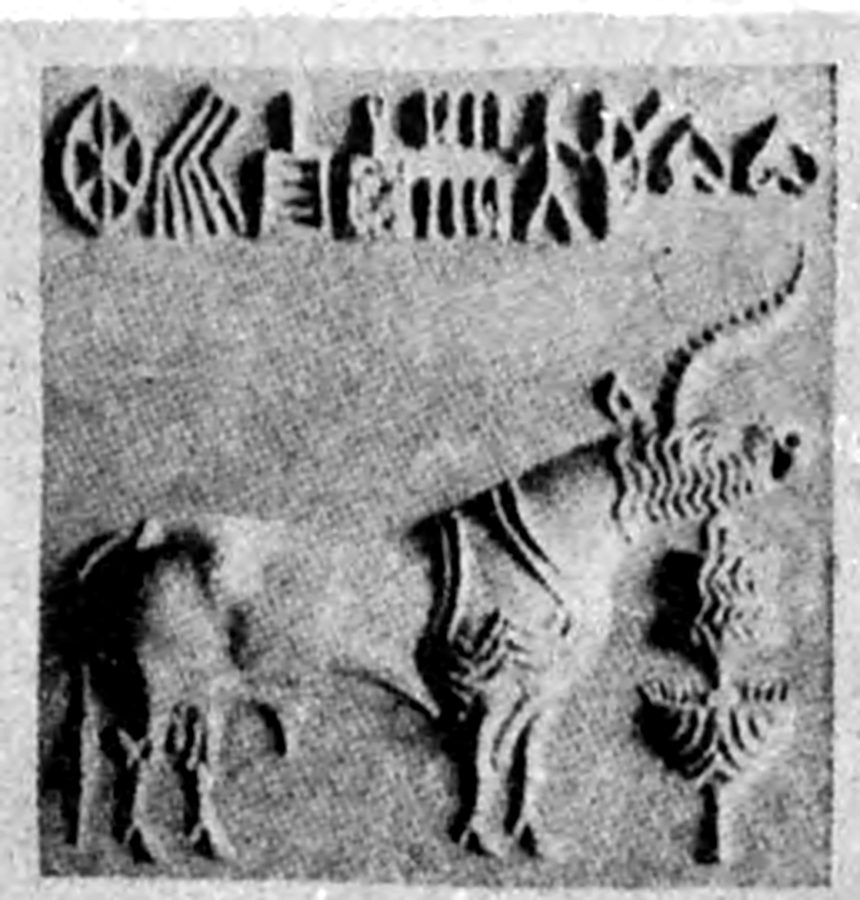
About four thousand short texts survive from the Indus cities, 2600 to 1900 BCE, most on stone seals.

The cities rivalled those of Egypt and Mesopotamia in size and planning, yet left nothing we can read.

So we do not know their language, what they called their cities, or who ruled them. The script is the only direct evidence.

Square stamp seal from Harappa: a line of Indus signs above a one-horned bull standing before a feeding trough
Pl. 1 · Harappa · 56 × 56 mmSeal. Vats, Excavations at Harappa (1940), seal no. 3.

02Where we are

We know how the signs are arranged, but not what they say

  1. Structureorder, slots
  2. Sign rolesopeners, closers
  3. Topicwhat a sign is about
  4. Meaningone sign, one thing
  5. Sounda reading

03Found so far

What we have found so far

  • There are rules. The signs appear in a fixed order, the way words do in a sentence. So these are not random marks.
  • Some seals don’t follow them. A few round seals, mostly found around the Persian Gulf, break the usual order. They might be written in a foreign language.
  • No one has cracked it. Many people have claimed to read the script. We tested five of those claims, and none did better than guessing.

04How we work

How we try to read it

Nobody can read these signs yet. We look for patterns, make a guess about what the signs mean, and check it on texts we kept hidden, so we cannot fool ourselves.

  1. Find the patternsWhich signs start texts, end them, or travel together.
  2. Make a guessSuggest what a sign might mean or sound like.
  3. Check it fairlyTest the guess on texts we never looked at while building it.
  4. Try to break itIf it survives, we publish. If it fails, we publish that too.

The missing piece. Most lost scripts were finally read through an outside clue, such as a name written in a script we can already read. None has been found for the Indus script yet, so we are looking for one.

05Open data

All the Indus data, free in one place

We gathered every source we use: excavation reports, the inscription lists, seal records, find spots, pottery marks and objects found abroad.

Our own tables are free to download, and one script fetches the rest from public sources.

EXCAVATIONS AT HARAPPA Vats, 1940 Fig. 1, 2 · seal impressions SEAL REGISTER Mohenjo-daro, 1938 NO.FINDSPOT DEPTH FTIN 1279 / VIII / 10−6.71.012699 / XI / 75−9.31.203879 / VI / 78−12.20.9864512 / V / 95−20.21.248514 / II / 8−5.91.25 POTTERY MARKS HarappaMohenjo-daroDholaviraUrDilmun FIND SITES

06Help

The fastest help is an AI agent working an open task

Point a Claude Fable or Opus class agent at an open task, or bring data, photographs or a careful eye. To follow along, get results by email.