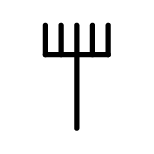
Sign
M171
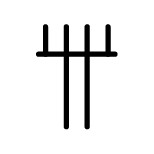
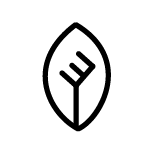
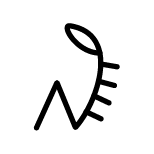
Looks like: rake or comb with tines
Adapted from the field-cady sign descriptions (Parpola 092). This describes the picture, not the meaning: a sign that looks like a fish may stand for a sound or another word.
Appears in 91 texts (132 uses), mostly on seals at Mohenjo-daro; usually sits inside a text. In the larger ICIT corpus its Wells equivalent W415 is in 125 texts.
Where it appears 91
Counts are distinct texts in the Mahadevan 1977 concordance (a text repeated on many moulded tablets counts once). 131 objects in all carry it.
| Object | Texts | Share |
|---|---|---|
| Seal | 74 | 81% |
| Sealing | 12 | 13% |
| Tablet | 2 | 2% |
| Copper tablet | 2 | 2% |
| Other | 1 | 1% |
| Site | Texts | Share |
|---|---|---|
| Mohenjo-daro | 65 | 71% |
| Harappa | 18 | 20% |
| Kalibangan | 3 | 3% |
| Lothal | 2 | 2% |
| Chanhu-daro | 1 | 1% |
| Other sites | 1 | 1% |
| West Asian finds | 1 | 1% |
| Where | Uses | Share |
|---|---|---|
| First sign | 20 | 22% |
| Inside | 66 | 73% |
| Last sign | 5 | 5% |
| Whole text | 0 | 0% |
Position counts use only texts with no damaged passage (91 uses).
In the ICIT corpus (Wells numbering)
W415: 125 distinct texts, 176 uses.
By object: seals 83, tablets 30, sealings 5, other objects 3, pottery 3, copper tablets 1. Top sites: Mohenjo-daro 67, Harappa 38, Lothal 5, Unknown 2, Allahdino 1, Altyn Depe 1.
Variants
Wells (ICIT) equivalent: W415.
Looks alike but used differently (probably a separate sign):
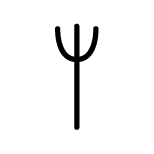 M162drawing similarity 0.69, context similarity 0.57
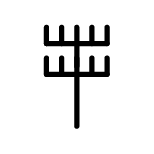 M173drawing similarity 0.69, context similarity 0.58
Pairs from the prior project’s allograph model (image × distribution, signs with at least 8 uses).
Merged with other signs in alternative sign lists (used to test whether findings survive):
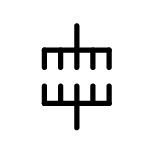
Neighbours and fixed pairs 2
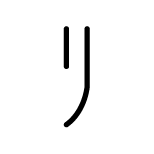
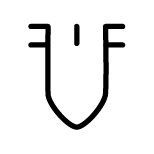
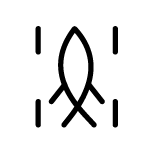

Signs read directly before or after it, counted in distinct texts, never across a line break or damage.
Fixed pairs
At least 5 texts, and one sign takes the other at least half the time.
Fixed sequences in the functional reading
Published readings 1
Yajnadevam’s sound value
- Yajnadevam · 2024Did not hold
t
Yajnadevam 2024 ‘A cryptanalytic decipherment of the Indus script’; per-sign key from yajnadevam/lipi xlits.csv via sources/field-cady_indus_valley_script_corpus/xlits.csv · test record
Part of a 714-value sound key that scores no better than keys fitted to noise (atlas 1.1).
From proposals.json and CATALOGUE.csv. A claim is listed under every sign it names.
Project tests 11
Role in the text
- Positional class
- Unclassified. Its raw label was numeral, but it did not keep that label reliably. Grammar
- Functional reading
- NOUN 1.00. Unknown noun. dev n=67 texts; initial 0.19 final 0.06 Functional reading
Role names such as opener or noun are labels for positions, not tested meanings.
Mentioned in 11 result files
- Core semantics: head direction and meaning classes of Indus name-core signs5 lines. “fish keep a stable set of partners, M53, M387, M343, M171, M389 (24% of fish-partner tokens vs a 13% baseline, p = 0.0003).”
- One-to-many substitution (X YZ): does a single sign ever trade places with a 2-3 sign spelling?4 lines. “M87 = M53 M171 4 0.09 0.001 2429 \ \ 1429 core sign ↔ lexicalised pair; held-out k=2, q=0.004”
- Internal phonetics: does Indus spelling variation leak sound values?3 lines. “M171 before M59/M8; M211 after fish; M249/M162.”
- A positional grammar of the Indus seal text2 lines. “unclassified 265 0.363 M87 (191, 0.75), M176 (153, 0.70), M162 (140, 0.61), M89 (134, 0.55), M169 (111, 0.56), M86 (92, 0.53), M171 (85, 0.47), M1 (80, 0.70), M102 (77, 0.62), M17 (55, 0.41) ...”
- Administrative archaeology: relational readings without sounds1 line. “Offices are not tied to precincts. Title blocks (M336-M89, M51-M130-M149, M249-M161, M387-M59, M171-M59), openers (M267, M293, M391, M150, M216) and register signs (M176, final M342, final M211) were…”
- Functional reading: a role grammar that “reads” every Indus text without phonetics1 line. “(MD copper tablet, HO, 2 lines). [NOUN M171] [TITLE M8] [CLOSER M342] [FORMULA M171+M59] [REGISTER M407+M169]. A seal-type line (title + jar) plus a copper-register line.”
- Novel methods from other fields: results1 line. “{M99, M87, M67, M65, M72, M86, M389, M171, M70, ...}: connective, tall strokes and fish variants”
- Grammar of the Indus number signs (Fable 5.2 plan 3, R1: the Proto-Elamite method)1 line. “…block of 24, it is the only stroke group above 12 in the corpus, and it occurs only in one formula (M171 M123 M67 M348 M342 / M336 M197 / M99 M172 M304 M307). Freeze as a prediction: no new 13+ stroke…”
- Phonetic grid (automated Kober triplets + Ventris grid)1 line. “M59 0.11 / 0.88 / 0.02 3.8% (3.4%) 2 / 45 19 (6.0, z +2.4) 3.9 / 5.1 M87 43, M171 30”
- Typology: are Indus name cores spelled with syllables or built from whole-word signs?1 line. “Fixed partners. partner_rel is below 1 on dev and held-out; no reference falls below 0.95. Signs come in recurrent pairs such as M171-M59, M178-M389 and M67-M244.”
- Open Indus: reproducible tests on the Indus script1 line. “…ds than frequency predicts, compounds with itself, and keeps a stable partner set (M53, M387, M343, M171, M389). Parpola’s “fish = deity name” is not supported: it failed held-out, and fish pairing wi…”
Example texts 3


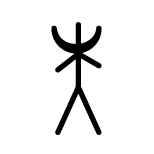
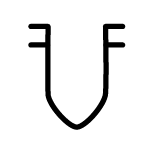
Text 1010 · Mohenjo-daro · seal · M391 M99 M48 M171 M8 M342
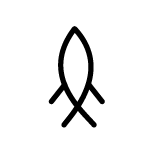
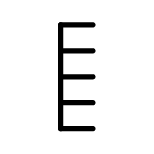
Text 1531 · Mohenjo-daro · ivory/bone rod · M171 M59 M342 M176
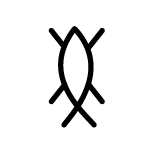
Text 1616 · Mohenjo-daro · sealing · M67 M171 M8 M342
Signs in reading order, first sign on the left. Text numbers are Mahadevan’s (1977). / marks a line break, … a damaged passage.