Other scripts · 2022
Letting the computer decide which shapes are the same sign
Corazza and colleagues · PLOS ONE (Cypro-Minoan)
In a sentence
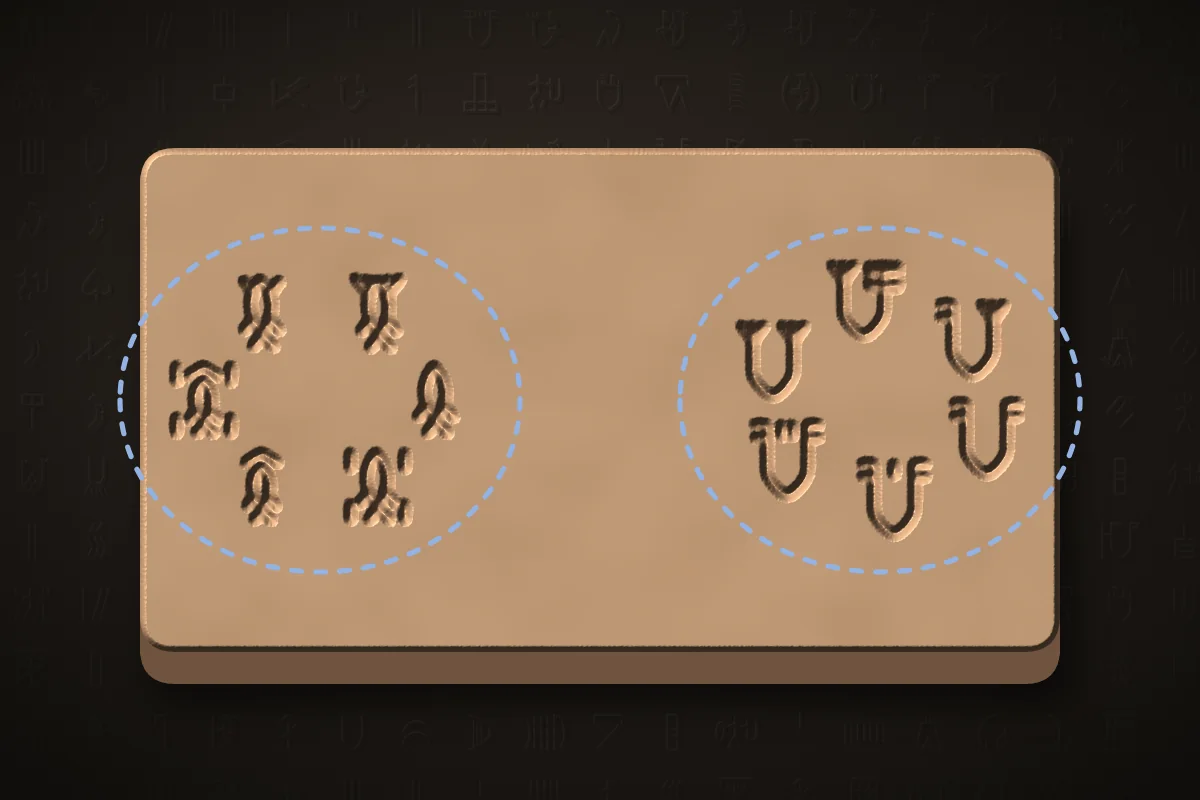
Images plus context sorted Cypro-Minoan’s variant shapes into signs.
In plain words
Scholars disagree about whether two similar shapes are one sign or two. For Cypro-Minoan, this team let a model look at each sign’s picture and where it appears, and group them. The Indus script has the same problem: the two main sign lists count about 400 and about 700 signs.
Technical detail
Sign2Vec: unsupervised clustering on image features plus distributional context, validated on Cypro-Minoan with known-answer checks.
How we read it
Read: full text. Sources opened: journals.plos.org/plosone/article/file?id=10.1371/journal.pone.0269544.
What they did
- Corazza, Tamburini, Valério and Ferrara built an image dataset of Cypro-Minoan signs cropped from the published drawings, each labelled by inscription, position and published reading.
- They trained DeepCluster-v2, an unsupervised image clustering network, and a context-aware version they call Sign2Vec-d that also learns to predict, from the left and right neighbour images, whether the middle sign is a word divider.
- They trained 20 copies of each model from different random starts and concatenated the outputs into one 2,560-dimension vector per sign image.
- They computed a ‘paleographic vector’: the average shift from a sign’s shape on non-tablet objects to its shape on clay tablets, learned from signs everyone agrees on.
- They then applied that vector to disputed signs found only on one kind of object, to see whether it points to a proposed variant on the other kind, with a leave-one-out check and binomial nulls.
What they found
- The dataset holds 2,899 usable sign images from 213 inscriptions, after removing 600 damaged or excluded images from a start of 3,499 (Materials, The dataset).
- In the embedding, signs from clay tablets sit at the periphery and signs from other objects at the core; this tracks writing medium more than the traditional CM1/CM2/CM3 split (Results, Fig. 6).
- Single clusters often did not match graphemes; instead each grapheme formed a ‘filament’ running from core to periphery (Results).
- On 32 agreed graphemes, the leave-one-out paleographic vector found the right tablet form first for 69% with Sign2Vec-d (top-2 81%) and 66% with DeepCluster-v2 (Table 3).
- On 13 proposed merges of signs in complementary distribution it scored 8/13 top-1 and 9/13 top-2 (Poisson binomial p = 1.0e-7), and on 3 more merges 2/3 (p = 1.7e-3) (Results, S7-S8 Tables).
- The model also flagged 27 sign images whose published labels looked wrong; tests relabelled 26 (DeepCluster-v2) and 20 (Sign2Vec-d) of 31 cases (Results, Preliminary relabelling).
- They conclude Cypro-Minoan is one script whose signs vary by medium, not three scripts (Conclusions).
Strengths and limits
- The key validation is sound in design: the vector is learned on agreed signs and tested on held-out signs, with an explicit chance rate.
- The chance rate (1 in 64) is generous to the model because it ignores that frequent signs and similar shapes are easier to match.
- The context part of the model relies on word dividers, which are 57% of Cypro-Minoan trigrams; Indus has no dividers, so that part does not transfer.
- Drawings, not photographs, were used, so the editors’ own choices are baked into the images.
What the authors say comes next
- Study Cypro-Minoan’s relationship with Linear A and with the later Cypro-Greek syllabary using the same tools. (Conclusions)
- Any neural method for an undeciphered script must be built for that script, since no general method works alone. (Conclusions)
- The failed merge tests (e.g. 013-078, 019-079) may reflect real shape or distribution differences and deserve a closer look. (Conclusions)
Ideas it gives us
- Build an Indus ‘medium vector’: learn the average shape shift between carved seal forms and incised or moulded tablet and pot forms from agreed signs, then test whether Wells signs that are split from a Mahadevan sign and are restricted to one medium land on their partner. The project tried shape plus context and shape alone, but not the medium-shift idea that worked best for Cypro-Minoan; many Wells splits may be the same sign carved versus scratched. Open data enough: no. Needs: Per-token sign images tagged by object type (ICIT has object type; the project’s sign_images are per sign type, not per token), so a token-level crop set from CISI photos is needed.
- Use the leave-one-out validation design itself: on proto-cuneiform and Proto-Elamite, learn a variant-shift vector from known allograph pairs and score held-out pairs at top-1, as a known-answer bar before any Indus run. This gives a cleaner known-answer test than the merge-precision bar used in signlist_shape, and it is cheap with the glyph sets already on disk. Open data enough: yes. Needs: The proto-cuneiform and Proto-Elamite glyph and variant lists already used in signlist_shape and ivc2tyc.
- Run a label-audit pass like their relabelling step: flag M77 tokens whose image sits far from its sign’s other images and close to another sign, then check them against photos. Transcription errors in M77 and ICIT feed every test; the paper found 20-26 of 31 suspect labels in a much smaller corpus. Open data enough: no. Needs: Token-level images of inscriptions (CISI photographs), not available as open per-token crops.
What we take from it
TestedWe tried it on two older scripts whose sign lists are known. Shape plus context merged too many signs that are not the same, and context alone was almost always wrong. Shape alone did best. On the Indus texts, a shape-only list fits unseen texts a little better than the 400-sign list, but a second team found half of that gain is one choice (three fish shapes counted as one sign) and it did not repeat on texts found after 1977. So the texts do not settle the count. The 700 side cannot be tested at all: most of those extra signs appear once or twice.
The idea we are borrowing
Build the sign list from pictures plus context, to settle about 400 vs about 700 signs
Where it stands: Tested.