Preprint · Aug 2026
An invented symbol system with no sounds looks just like the Indus script
Raghavendra · arXiv 2608.02999 (SIGIL)
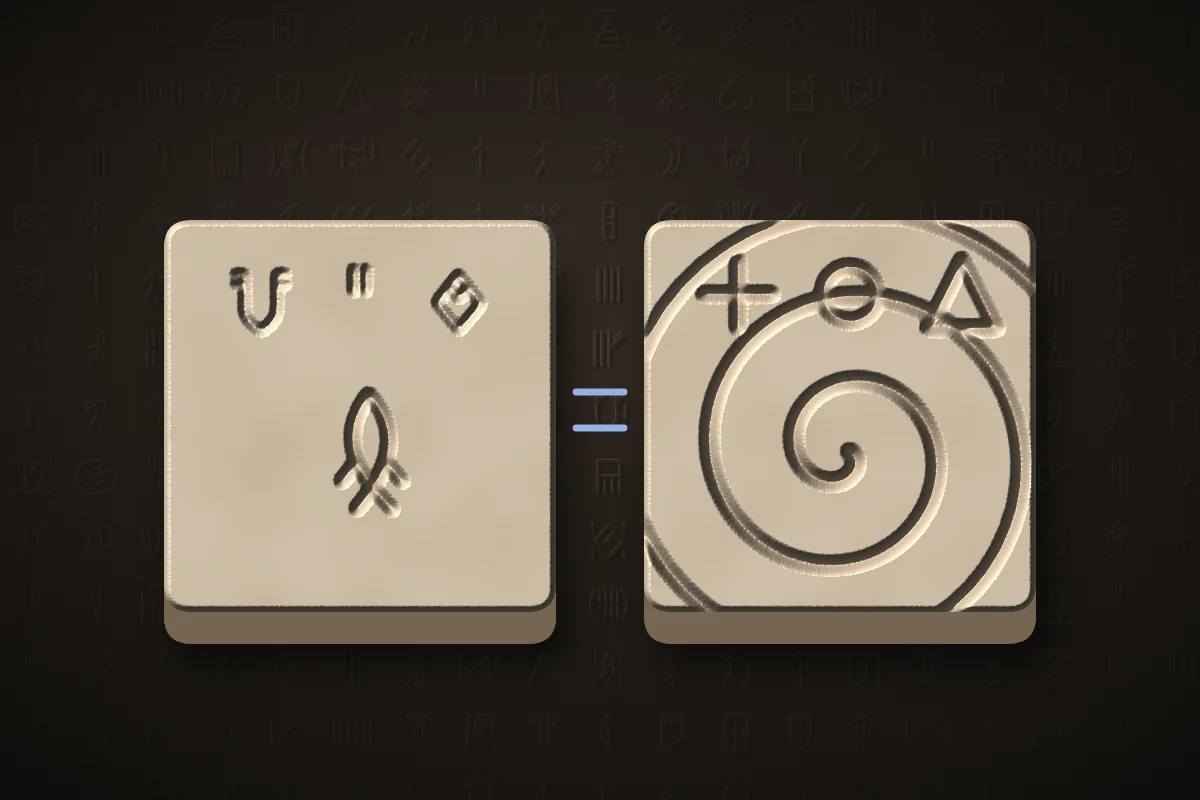
In a sentence
If a made-up emblem system matches every statistic, statistics alone cannot prove the signs are writing.
In plain words
He built an artificial system of emblems with no language behind it. It matched the Indus script on every measure he could compute exactly. Programs that “decode” by matching dictionaries happily read it as English, Sanskrit or Tamil. So those numbers cannot settle whether the Indus signs write a language.
Technical detail
SIGIL is a sound-free emblem generator matched to Indus on every exactly scorable statistic (entropy, Zipf, n-grams, positional concentration). Dictionary-hit decoders produce fluent readings of it in several languages. This closes entropy- and Zipf-style arguments in both directions.
How we read it
Read: partial (main text, sections 1-8 and Limitations read in full; appendices not read). Sources opened: arxiv.org/pdf/2608.02999.
What they did
- The author built SIGIL, a generator of seal-like inscriptions for a made-up administrative world, where every text has a stored meaning but no sign has a sound.
- Texts are assembled from optional opener, dedication, office, ledger and terminal blocks, with urn processes giving a few frequent and many rare signs, licensed deity-epithet pairs, tally marks, ligatures and a trading outpost.
- Before scoring, he closed a registry of 54 published methods and scored exactly only those whose Indus result and decision rule he could reproduce.
- He also rebuilt the wider battery of entropy, Zipf, positional, prediction, restoration, classifier and network measures.
- He ran a dictionary-matching decipherment engine on SIGIL to read it as English, Sanskrit and Tamil, with grouped held-out tests and random-key controls.
What they found
- The canonical corpus has 3,000 core texts, 13,717 tokens, 419 attested core types and a mean length of 4.572 signs (Table 1, p. 4).
- SIGIL gets the same category as Indus on all six exactly scored outcomes; for example the repetition ratio is 0.646 for SIGIL and 0.575 for Indus, both on the non-linguistic side of 0.10 (Table 2, section 6.1).
- Its Zipf-Mandelbrot exponent is 2.574 against the published EBUDS value of 2.59 (section 6.2, Figure 2).
- 39 SIGIL signs cover 80% of text-initial tokens and 10 cover 80% of final tokens, paralleling 82 against 23 for Indus (section 6.2, Figure 5).
- The Lee classifier calls SIGIL ‘writing: syllables’ in all 27 sensitivity settings (section 6.2).
- Restoration puts the true sign inside the 90% candidate set in 84.88% of 275,300 trials, against a published Indus figure of 74% (section 6.2).
- Dictionary coverage of SIGIL reaches 83.0% for English, 88.13% for Sanskrit and 67.73% for Tamil in sample, against random-key means of 6.50%, 5.77% and 9.48% (section 6.3).
- Six bootstrap Sanskrit-script keys agree on only 9.30% of sign values although each parses over 93.5% of the corpus (section 6.3).
Strengths and limits
- A single explicit non-language that passes the tests is enough to show those tests are not sufficient for language, and the registry and public generator make this checkable.
- The paper is careful to claim only existence: it gives no likelihood ratio and no estimate of how common such systems are.
- SIGIL was built with the published statistics in view and is not a held-out sample, so it shows compatibility, not that emblem systems usually look like this.
- Only six dependent outcomes from three method families are in the exact score; the other 48 methods are reconstructions or excluded.
- The fictional setting is not a model of Harappan society.
What the authors say comes next
- A feature may still be informative if calibrated populations of languages produce it far more often than a weighted family of non-languages; no study supplies that family yet. (Section 7, ‘What it leaves open’, p. 8)
- Persuasive decipherment should commit to sign values and semantic predictions before testing, succeed on held-out inscriptions, prefer one language over matched alternatives, recover stable values across resamples, and predict external facts. (Section 7, ‘Stronger evidence for decipherment’, p. 8)
- Claims that regularity shows language need a discriminative comparison against structured non-linguistic alternatives, or predictions those alternatives cannot meet. (Section 8, Conclusion)
Ideas it gives us
- Make bootstrap key agreement a gate for any reopened phonetic key: refit the key on resampled texts and require value agreement well above SIGIL’s 9.30%. Coverage alone is reached on a corpus that encodes nothing; stability of values across resamples is something SIGIL fails and a real key should pass. Open data enough: yes. Needs: The proposed key’s fitting code, M77, and the project’s SIGIL rebuild as a negative control.
- Use SIGIL’s outpost as the control for our Gulf round-seal result: compare the bits-per-sign penalty of the Gulf seals under a core-trained model with the penalty SIGIL’s outpost texts get under a SIGIL core model. SIGIL’s outpost scores near zero likelihood purely from regional emblem events, so a Gulf ‘foreign dialect’ reading must exceed what an emblem system already produces. Open data enough: yes. Needs: The project’s foreign-seal corpus, the grammar model behind the +1.80 bits result, and the SIGIL rebuild with its outpost texts.
- Build a small population of SIGIL variants across the 27-cell parameter grid and a matched population of short-label language corpora, and estimate how often each population produces the Indus value of the few statistics still in play. This is the calibrated comparison the author says is missing, and it turns ‘compatible’ into a likelihood ratio. Open data enough: no. Needs: SIGIL generator parameters (public per the paper), plus enough genre-matched short-label language corpora; atlas 3.2 found the current reference set too small.
What we take from it
Using itEvery new claim we test must also fail on SIGIL-style emblem data. We use it as a standing negative control.