Preprint · 17 Aug 2026
A calibrated attack finds no language behind the Voynich manuscript’s units
Rozanova and Temerev · arXiv 2608.17096
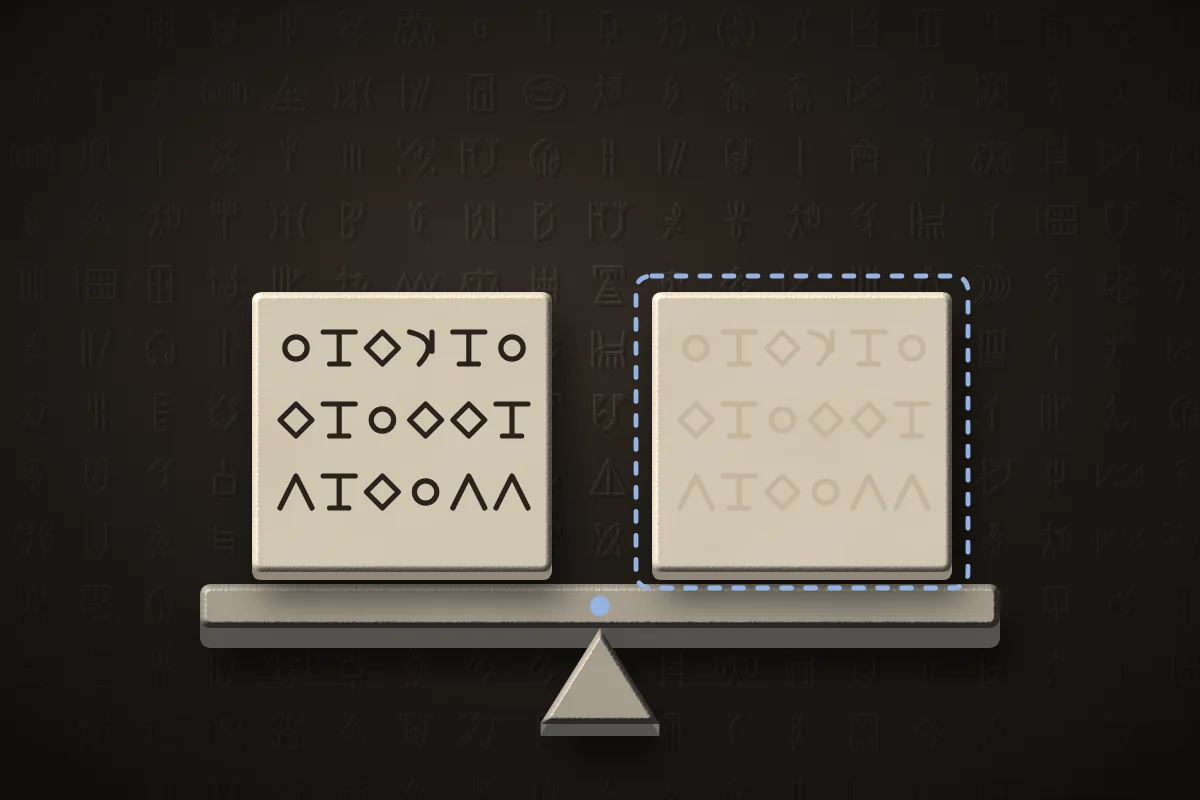
In a sentence
Tested first on ciphers with a known answer, the attack recovers Latin with the right model and little with a wrong one, and Voynich looks like the wrong-language case.
In plain words
Before attacking the Voynich text, the authors built ciphers of Latin where they knew the answer. With a Latin model their attack recovered most of the key. With a German model it recovered little. They also compared each real text with a fake one that copies its letter patterns. The Voynich text scored no better than its fake, like the wrong-language case.
Technical detail
Multi-glyph units learned by BPE and class merging, then a class-to-letter substitution attack against seven language models, with eight restarts. On synthetic Latin homophonic ciphers it recovers 73.7-92.6% of the frequency-weighted mapping with the right model and 0-23.4% with the wrong (German) one. The real-minus-surrogate differential is positive in all 25 right-language runs (+0.13 to +0.52); Voynich gives a mean of -0.0085. Wrong-language arm is one language; calibrated for concatenative ciphers only.
What we take from it
BackgroundThis is close to our mismatch study. Their wrong-language result is one more point on our curve: low recovery when the model is the wrong language. Their fake-text comparison (a generator fitted to the same corpus) is a stronger null than our shuffled negative, and we should add it next to planted check PC3.