Preprint · 27 Nov 2026
“Indus script cracked” with AI: we reran the paper’s own code
Siva Raj, with Claude (Anthropic) · Zenodo 24383779 (v0.7, not peer reviewed)
A preprint going viral says AI has read the Indus script as early Tamil. We ran its own code on its own data. The code works exactly as published, but its key test cannot tell which language the seals write. The score follows the list of names fed in, not the language: a Japanese list built from the sign pictures beats the paper’s Tamil list, and Tamil lists rebuilt from the same sources fall far short. The Indus script has not been deciphered.
The short version
- The score follows the name list, not the language. Japanese scores anywhere from +134 to +235 depending on which Japanese names go in. Old Tamil scores +223 with the paper’s list but only +4 and +49 with lists rebuilt from the same sources.
- The pictures do not matter. Put each sign’s picture words on the wrong signs and Tamil scores the same.
- Most readings are sound-alikes, not the picture’s own word, so almost any language can find a fit.
- The object “proof” rests on copies of the same few inscriptions.
- One test went the paper’s way: on fake seals the score drops to zero, so it does pick up real patterns in the seals. Those patterns just are not specific to Tamil.
What the paper claims
The preprint is by Siva Raj, working with Claude, Anthropic’s AI model (Zenodo, version 0.7, not peer reviewed). It gives an Old Tamil word to 150 Indus signs, covering 86% of all signs written, and says Tamil fits the seals far better than Sanskrit.
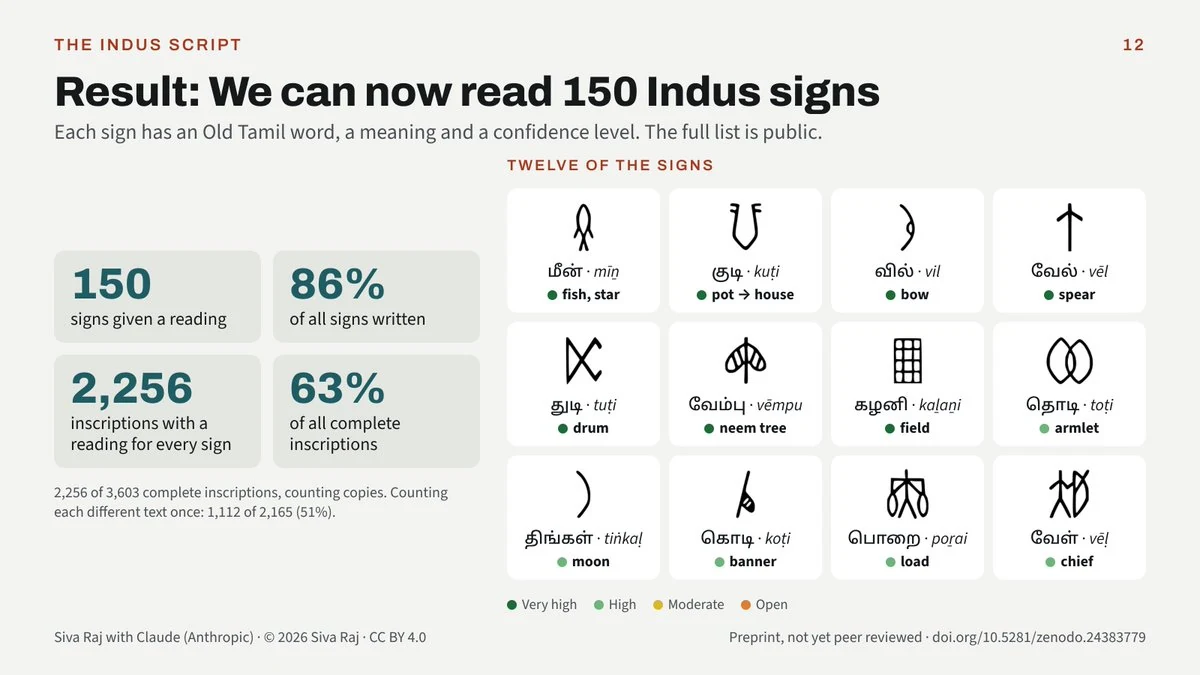
Credit where it is due: this is the most open decipherment claim we have seen. The author published the data, the code, plans fixed before the tests, a register of 494 tests and a frank list of limits. That is why we could check it in a day. Most claims never make that possible.
How the method reads a sign
An AI describes each sign in English (“pot”, “fish”, “bow”). An AI translator turns those words into Old Tamil. Then every part of a Tamil name that sounds like one of those words is added as a possible reading. A solver picks whichever readings make the seals look most like a list of Tamil names. The result is scored on seals the solver has not seen, against scrambled versions of the same names.
So the score depends on two inputs besides the seals: the picture words, and the list of names. We tested each. Every test below was fixed in advance, before its runs, and the paper’s code was never changed.
1. The pictures do not drive the score
If the signs really depict Tamil words, the score should drop when each sign gets another sign’s picture words. We moved the picture words onto random wrong signs, 50 times. The score did not move: 223 with the right pictures, a median of 224 with the wrong ones (p = 0.51). A test that cannot tell right pictures from wrong ones cannot show that the pictures are right.
The reason is the sound-alike step. In the paper’s own runs, most final readings are not the picture’s word at all.
What the score does pick up. One test went the paper’s way, and we say so. On fake seals, with their signs shuffled or made of random signs, the score falls to zero or below. So the score tracks something real. The seals have repeated sign pairs, and names in many languages are built from short parts that repeat. The method maps one onto the other. That works whatever the signs depict, and, as the next section shows, whatever language the names come from.
2. The score depends on which names are in the list
If the test detects a language, any fair list of that language’s names should score about the same. It does not. For both Tamil and Japanese, changing the list moves the score more than changing the language.
| Name list | Score | Runs above chance |
|---|---|---|
| Old Tamil, the paper’s list | +223 | 10 of 10 |
| Old Tamil, people’s names only | +3 | 4 of 10 |
| Old Tamil, rebuilt with the paper’s prompt | +49 | 6 of 10 |
| Old Tamil, rebuilt by another agent | +4 | 4 of 10 |
| Japanese, most common surnames | +134 | 7 of 10 |
| Japanese, built from the sign pictures | +186 | 8 of 10 |
| Japanese, sign pictures, in the paper’s mix of name kinds | +235 | 10 of 10 |
Old Tamil: the paper’s list is not typical
The paper’s 1,125 Tamil names are not only people. 532 are people; the rest are places, gods, groups, hills, stars and rivers from the Sangam poems. With people’s names only, Tamil scores +3, no better than chance. That is not because the list is shorter: random mixed lists of the same size score a median of +178. Tamil’s score comes from its place, hill, river, god and group names, yet the paper reads the seals as names of people with their titles and clans. Spelling is not the reason: written in plain letters, the paper’s list still scores +206.
Next we had fresh AI agents, which knew nothing about this project, build new Old Tamil lists from the same kinds of sources: the Sangam poems and the oldest Tamil inscriptions. Another agent spot-checked each list against the Tamil Lexicon and the Dravidian Etymological Dictionary before anything was run. The list built with the paper’s own prompt scores +49. A second list, whose prompt also asked to keep endings like -ār as separate parts, scores +4.
We took the lists apart to find the cause. The picture words are not it: the paper’s names with new picture words score +276. The endings are not it: with them removed, the paper’s list still scores +198. It is which names are in the list. About 430 names appear in both the paper’s list and the second one. The paper’s other names score +218 on their own; the new list’s other names score −96. The paper’s archive does not say how its list was compiled.
Japanese: the right list beats Tamil
Japanese has no proposed link to the Indus, but its names are built from drawable things, like Tamil’s: Yamada is “mountain” + “rice field”. We ran three Japanese lists, each with the paper’s code unchanged.
- The most common surnames, chosen by nobody: +134. This was our first control. It beats Tamil in 4 of 10 runs, but is above chance in only 7 of 10. Before running it we set the bar at 8, so by our own rule the paper passed this test, narrowly.
- Built from the sign pictures: +186. A fresh agent listed real Japanese names that each contain a word for something drawn on the signs, like yama “mountain” or ya “arrow”. No scores were used to build it.
- The same idea, in the paper’s mix of name kinds: +235. We gave the list the same mix as the paper’s Tamil list: 532 family names, 124 clans, 98 gods and shrines, 33 mountains, 14 rivers, the rest places. It beats the paper’s +223 and is above chance in all 10 runs.
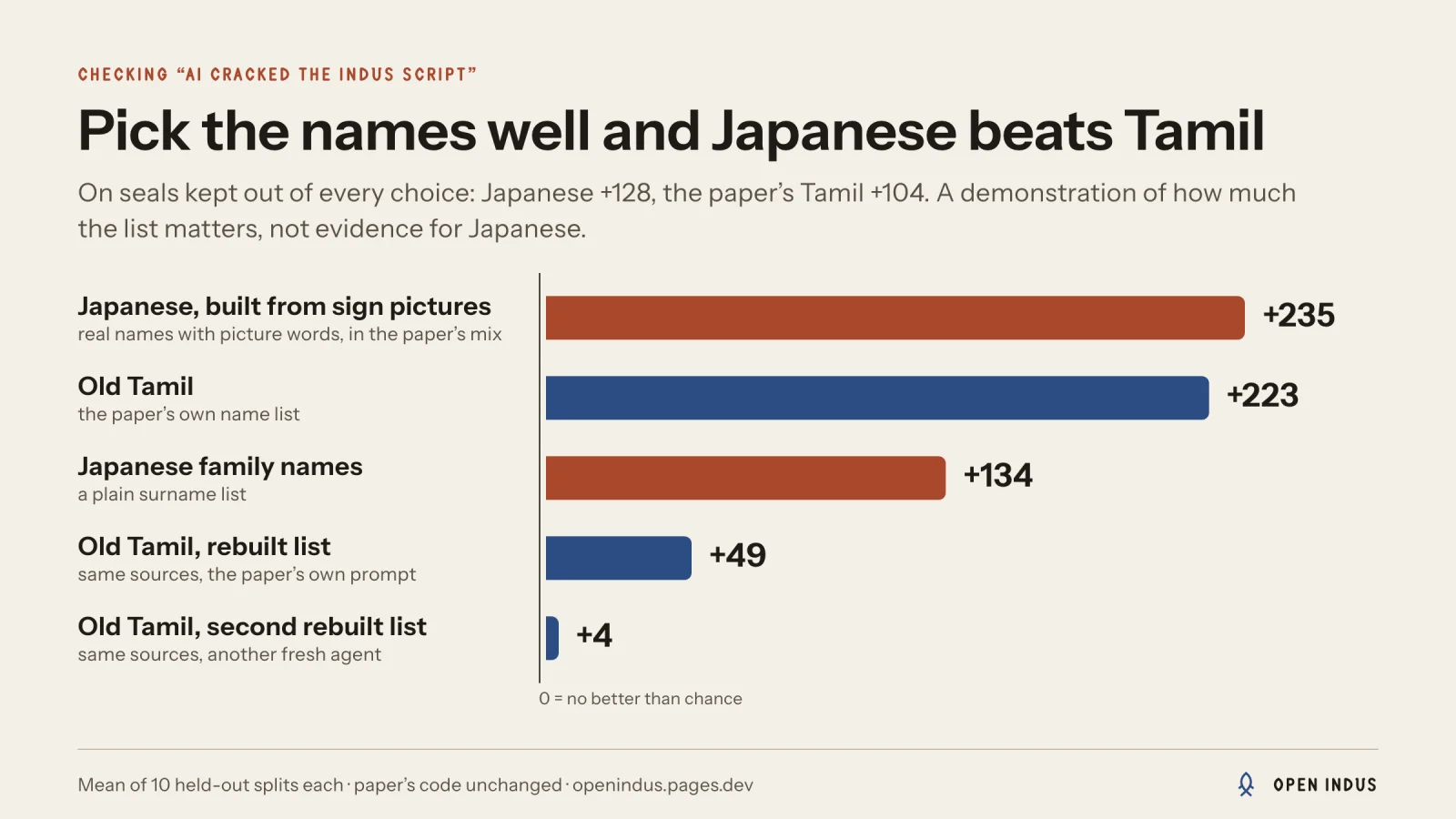
Could the list just be tuned to these particular seals? We checked by splitting the seals in two and holding one half back from every choice. On the held-back half, the list in the paper’s mix scores +128 against +104 for the paper’s Tamil list (scores on half the seals are about half as big). A computer search that tuned the list on the first half reached +156 on the second half. Picture words alone are not the trick: keeping only the common surnames that contain a picture word gives +52. The mix of kinds of names is what lifts a list, just as for Tamil.
This is a demonstration of how much the list matters, not evidence for Japanese. We built these lists deliberately and in the open, and we make no claim about how the paper’s list was made.
Every run we made, side by side
3. Other languages: real names beat chance almost everywhere
We also ran one list each for three more languages, again fixing the rules in advance. Sumerian, from Mesopotamia, the Indus cities’ trading partner, was once proposed as the Indus language. Egyptian is the other great early script of the time. Finnish is a placebo: its surnames are built from nature words (Mäkinen, “hill”), much like Japanese ones.
With one list each, the paper’s Tamil list comes out on top, and none of the others reaches half its score. That is a point for the paper, but a weak one, because section 2 shows the ranking belongs to the lists, not the languages. The stronger pattern is in the right-hand column: every list of real names except Sanskrit beats chance most of the time, Finnish in all 10 runs. Beating chance is what real names do on these seals, whatever the language. The paper’s wins over Sanskrit and Akkadian are mostly about naming style: their names are mostly single words, gods and verbs, with little to fit.
Tamil’s sister languages, and Brahui, turned out to be weak tests. Fresh agents built a list for each, checked against standard dictionaries. Old Telugu, Old Kannada and Brahui are void: most of their name parts are borrowed (from Sanskrit, or for Brahui from Balochi, Persian and Arabic), so once loans are dropped the method reads fewer than three signs. Brahui, still spoken in Balochistan near the Indus cities, has a native word for only 28 of the 171 pictured things, and the method reads no signs at all. Old Malayalam, from texts 600 to 1,400 years after the Sangam poems, does not beat its control (−92). So the test does not favour the Dravidian languages, but with three of four runs void, that says little either way.
4. The object “proof” rests on copies
The paper’s most striking evidence is signs that name the object they are written on: a sign read “armlet” turns up on bangles, and a sign read “copper” on copper tablets. But copper tablets were made in sets that carry the same inscription, and the paper counts every copy.
“Copper” sign on copper tablets
p = 6×10⁻¹¹ → p = 0.19
“Armlet” sign on bangles
p = 1.5×10⁻⁷ → p = 0.017
The author’s reply
Siva Raj replied on X on 27 November. Some of his points are fair. None of them changes the main finding: the score follows the name list, not the language.
The underlying problem is overfitting. Each sign can be read about four ways, most seals carry only about five signs, and the name list is a choice. With that much freedom and that little text, many languages can be made to fit, so a good fit cannot identify the language.
- Old Japanese. He says the fair comparison is Old Japanese, not modern names, and reports that his Old Japanese list scores +81, below Tamil. We agree it is a fairer comparison. But his own list still beats scrambled names in 9 of 10 runs, and so do most other languages we tried. Passing cannot single out Tamil. His Old Japanese list is not yet in his public files, so we could not rerun it.
- The test is only a filter. He says the language test only screens languages, and the readings come from pictures, structure and meaning. But if the screen cannot pick out Tamil, the readings built on it rest on a weak base. He also agrees the pictures do not drive the score, so the score cannot support the picture-based readings.
- Word order. He explains Japanese’s good score by its head-final names, like Tamil’s. That means the test detects a name structure that many languages share. It is not evidence for Tamil.
- Not addressed. Two Old Tamil name lists, rebuilt independently, score +4 and +49 against the paper’s +223. If Tamil were the answer, other Tamil lists should work too.
- Objects. He says our copper count was too broad and that copper alone gives p = 0.14. We take the point. Neither count passes the paper’s own bar, and the armlet result (p = 0.017) is one subgroup picked from several.
- A blind test. He says the readings are frozen and a test on unseen inscriptions is registered. That is exactly the right test, and we will check it when it is out.
Is any of this new?
The idea is not. Reading the script as early Dravidian through picture-puns goes back to Henry Heras (1953), Yuri Knorozov’s team (1965), Asko Parpola (1969 onward) and Iravatham Mahadevan (1977 onward). The best-known readings on the slide, such as fish = mīṉ = “star”, are theirs, and the paper credits them.
What is new is the scale (one key for 150 signs), the speed of working with AI, and the openness. That openness is the best part of the paper, and it is exactly what let us show that its main test does not tell right from wrong.
It also shares a problem with the Sanskrit reading by Yajnadevam, which uses the same corpus file: a key fitted to the inscriptions is judged by how well they then read. Each method crowns its own language on the same data. That alone shows that a fluent reading does not settle the language.
What would settle it
Real decipherments are proven by a test that could have failed. Linear B was accepted when a newly dug-up tablet read correctly with sign values fixed in advance. For the Indus script that could be:
- reading new or unpublished inscriptions blind, with the values fixed first;
- specialists in Dravidian languages rating, blind, readings of real inscriptions mixed with readings of fake ones;
- running the whole method on a script we can already read, and on a planted wrong language.
Until a reading passes a test like that, the Indus script remains undeciphered.
Read the full analysis. Our preprint: doi:10.5281/zenodo.24579268 (always the latest version). Plans fixed before the tests, code and every number: the results in our repository.
Want to do research like this? Every test we run is open, and anyone can help, with or without an AI agent. Contribute to Open Indus.
Our full reading notes on the paper
How we read it
Read: full (Methodology v0.7, 75 pages; Reading Rules v0.7; README; test-archive README, MISSING and AUDIT; the REP-1, REP-3 and REP-7 test folders with code and outputs). All files downloaded from the Zenodo record, checksums equal to Zenodo’s. Sources opened: zenodo.org/records/24383779, x.com/jaravis/status/2125302028062822491, github.com/yajnadevam/lipi.
What they did
- Characterised the script from its own patterns: a logographic script with one fixed frame (opener, middle, count, closer).
- Ran a language contest: blind AI judges described 69 signs in English; AI translators gave Old Tamil and Vedic Sanskrit words; a solver chose a word per sign on half the seals to fit real names (1,125 Tamil, 1,367 Sanskrit), scored on the other half against the same names scrambled.
- Graded 150 sign readings by structural fit, a blind AI picture test and a blind AI meaning test; all judges were Claude models.
- Looked for ‘object marks’: signs whose reading names the object they are written on.
What they found
- Tamil +223 ± 103 against scrambled names (10 of 10 splits); Sanskrit −13; Akkadian −2; Munda village names +7 against Tamil +89.
- 150 signs read, 86% of sign uses; 51% of distinct complete texts read in full (63% counting duplicate copies).
- Three object marks: ‘armlet’ on bangles, ‘copper’ and ‘smith’ on copper tablets.
- The paper itself states there is no outside confirmation of the kind a new Pylos tablet gave Linear B.
Strengths and limits
- Strength: unusually open. Data, code, preregistered plans with hashes, a register of 494 tests, wrong-word rates per confidence group and a frank limitations section. Their code reproduces exactly.
- Our check: with the picture words moved onto the wrong signs at random, Tamil scores the same (median +224 over 50 permutations, p = 0.51). The language result does not depend on what the signs depict.
- Our check: Japanese family names, which like Tamil names are built from drawable things, score +134.5 (60% of Tamil) and beat Tamil in 4 of 10 splits. By our preregistered bar (8 of 10 seeds above control) Japanese narrowly fails at 7 of 10, so the contest passes this control; the paper’s wins over Sanskrit and Akkadian are mainly about naming style.
- Our check: 59% of Tamil readings in their own runs are sound-alike name parts rather than picture words.
- Our check: the copper-tablet result counts copies. The 21 tablet faces with the ‘copper’ sign carry 3 distinct texts (p = 0.19 counted once each); the armlet sign is on 4 distinct bangle texts (p = 0.017, short of their own multiple-test line). Reassigning their readings at random matches objects as often (p = 0.10).
- Our check: on fake seals the score falls to zero, so it does reflect real order in the inscriptions; that order is long known and fits many readings.
- From the paper: no reading was fixed before the data used to test it; structural fit was scored on the texts that chose the readings; the AI judges could see notes that the project holder knows Tamil.
- Like Yajnadevam’s Sanskrit reading, it uses the same corpus file and the same kind of evidence: a key fitted to the corpus, judged by how well it reads. The two crown different languages on the same data.
What the authors say comes next
- Outside review by Tamil and Dravidian specialists, and checking the corpus copy against the ICIT (§15–16)
Ideas it gives us
- A blind reading test Real inscriptions mixed with sign strings that look like Indus texts, read by the method, rated blind by Dravidianists; values fixed in advance. Open data enough: yes. Needs: Specialist raters
What we take from it
TestedCredit where due: open code, data, preregistered plans and frank limits made this check possible in a day. What their tests show is that the score tracks how a name list was built, not which language it is: rebuilt Tamil lists fall far short, and a Japanese list built from the pictures passes Tamil. A real test needs values fixed in advance and read blind on new inscriptions.
The idea we are borrowing
Check the claimed Tamil decipherment with its own code, plus the controls it did not run
Where it stands: Tested.