Paper · 2025
How computers are opening up Proto-Elamite, the Indus script’s unread neighbour
Monroe, Kelley, Born and Sarkar · Near Eastern Archaeology 88(4):316–323, building on Born et al. 2019–2023
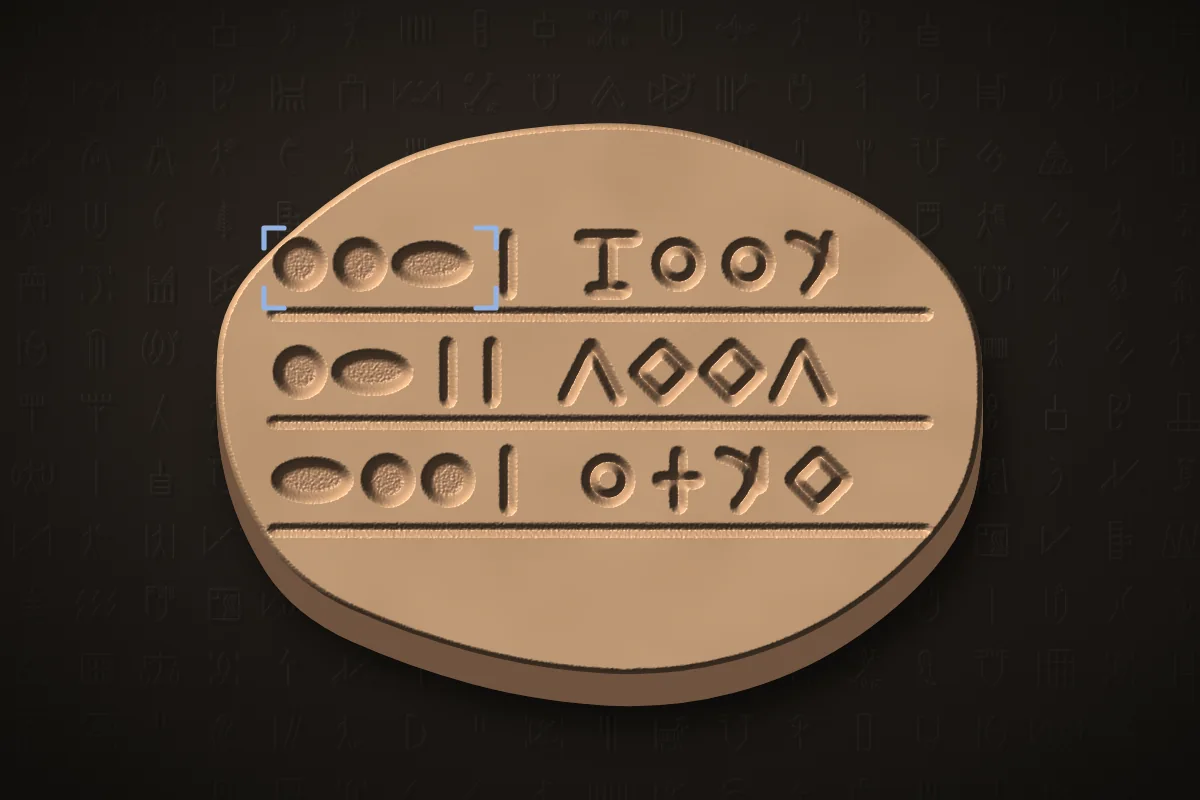
In a sentence
Without knowing the language, they found which signs head an entry, which are built from parts, and which number system each count uses.
In plain words
Proto-Elamite, from Iran, is unread and about as old as the Indus script. Teams have used computers to learn how its texts are organised: which signs start an entry, which complex signs are made of simpler ones, and which counting system each number belongs to, by looking at what is being counted. None of this needs the language.
Technical detail
Born et al. (2019, 2021, 2023): topic models (LDA) for genres, “header” signs, complex-sign compositionality, and disambiguation of numerals by number system. These are the methods that worked on an undeciphered administrative script without a language. They have not been applied as a set to the Indus texts.
How we read it
Read: partial (Born et al. 2021 ACL Findings paper read in full; Born 2019 and Born 2023 abstracts and conclusions read; the 2025 Near Eastern Archaeology article, doi 10.1086/738240, returned 403 at the publisher and was not read). Sources opened: aclanthology.org/2021.findings-acl.362.pdf, aclanthology.org/W19-2516.pdf, aclanthology.org/2023.cawl-1.9.pdf, www.journals.uchicago.edu/doi/10.1086/738240 (403, not read).
What they did
- Born et al. 2021 trained image-aware BiLSTM language models on the proto-Elamite corpus to test whether complex signs are built from simpler ones.
- They tested whether a complex sign’s embedding is close to the sum of its parts and measured a pairing consistency score for inner and outer components.
- Born 2019 used hierarchical clustering, n-grams and LDA topic models to find structure in proto-Elamite tablets.
- Born 2023 disambiguated numeral systems from summation structure with a bootstrapped classifier and cautious rule selection.
What they found
- The corpus has 1,399 tablets, 33,778 tokens, 7,508 broken tokens, 11,364 numerals, 14,906 non-numeric signs and 1,107 complex-grapheme tokens (Born 2021, data section).
- In the additive test at k = 15, the image-aware model with 64 dimensions finds 61 compositional complex graphemes (Born 2021, Table 2).
- The pairing consistency score is 0.760 for inner and 0.536 for outer components, so inner signs specialise the outer sign (Born 2021, Table 4).
- Containment forms a strict hierarchy: no two signs contain each other (Born 2021, Figure 2).
- The authors warn that conventional sign names act as distractors and suggest relabelling signs from context and shape (Born 2021, discussion).
- Born 2019 reports that perplexity drops above 80 topics and coherence peaks near 110 (conclusion).
- Born 2023 finds correlations between tablet content and numeral magnitude, evaluated only on a hand-disambiguated subset (conclusion).
Strengths and limits
- Proto-Elamite is a close methodological cousin of Indus: undeciphered, with complex signs and numerals, and these papers release code (github.com/sfu-natlang/pe-compositionality).
- Proto-Elamite tablets are long administrative texts with numerals, so methods may lose power on short Indus seals.
- The NEA 2025 synthesis was not reachable, so this record does not cover its claims.
What the authors say comes next
- Train the compositional models on proto-cuneiform, study the order of the containment hierarchy, and examine M342 compounds. (Born 2021, conclusion)
- Investigate larger topic models. (Born 2019, conclusion)
Ideas it gives us
- Test whether Indus framed and compound signs form a strict containment hierarchy: list every ‘sign inside or attached to sign’ relation in M77 and check for cycles against a random-pairing null. An acyclic hierarchy is a structural fact that both writing and emblem systems might show, but it is untested for Indus and is distinct from the closed ligature-decomposition route. Open data enough: yes. Needs: M77 sign list with component annotations for compound signs.
- Compute a pairing consistency score for Indus compounds: does the inner or attached element vary with the base sign’s contexts more than the base varies with the element’s? Born 2021 found inner elements specialise the outer sign; the same asymmetry in Indus would say which component carries the modifying role. Open data enough: yes. Needs: M77 compound annotations and text contexts.
What we take from it
TestedWe tried the pieces that fit. Indus signs that look like Proto-Elamite or proto-cuneiform signs do not behave like them (0 of 5 tests), complex signs do not split into their parts, and no known number system matches the Indus counts. Still untried: letting a model find genres from scratch.
The idea we are borrowing
Use the Proto-Elamite toolkit: look-alikes, compound signs and number systems
Where it stands: Tested.