Preprint · Apr 2026
The Indus script sits between coats of arms and paperwork
Nair · arXiv 2604.17828
In a sentence
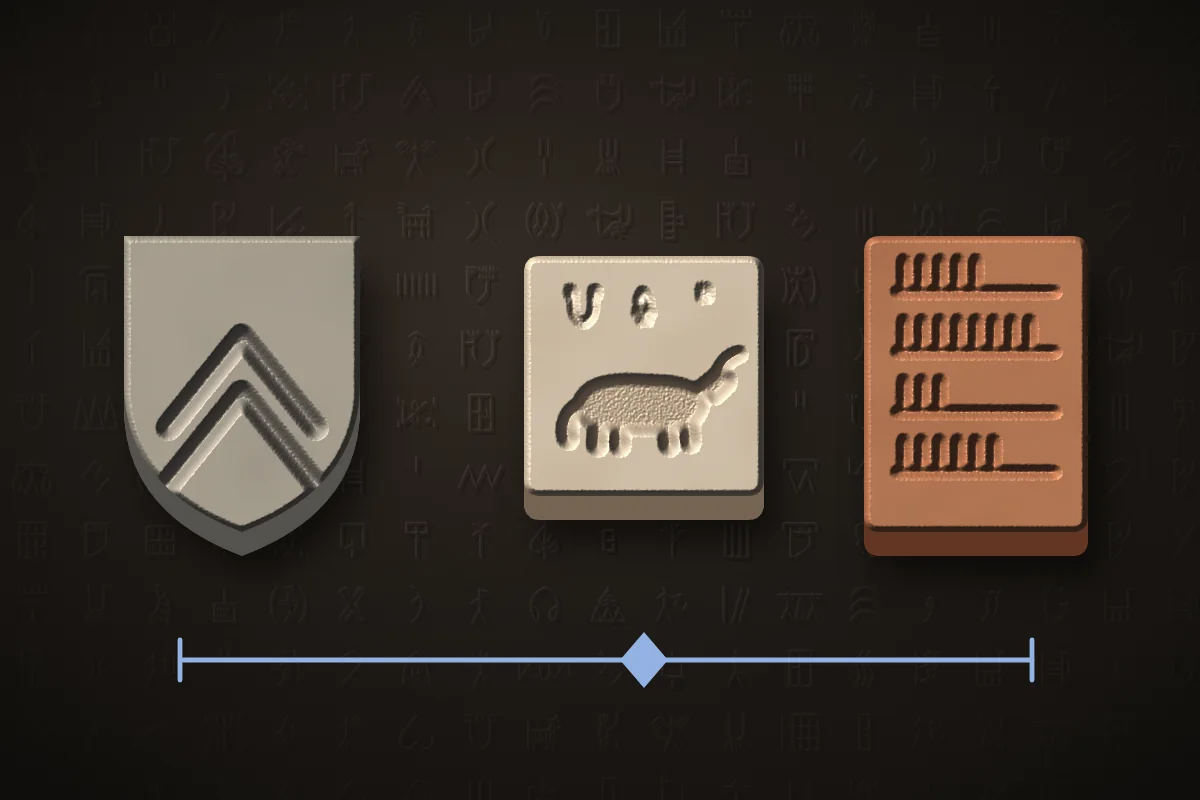
Compared with made-up systems of known kinds, Indus falls between heraldry and administrative records.
In plain words
The author built artificial sign systems of different kinds, such as coats of arms and office records, and compared their statistics with the Indus texts. The Indus script lands between the two.
Technical detail
A synthetic-baseline scorecard: generated heraldic, administrative and linguistic corpora scored on shared statistics. Indus sits between heraldic and administrative baselines.
How we read it
Read: full text. Sources opened: arxiv.org/pdf/2604.17828.
What they did
- The authors took the ICIT sign codes through the Yajnadevam digitization and removed exact duplicate texts.
- They built two synthetic non-linguistic baselines, a heraldic system and an administrative system, with generators tuned to Indus-like length and frequency.
- They scored Indus and both baselines on a five-measure scorecard: text length, repeated phrases, hapax rate, positional rigidity and related statistics.
- They ran sensitivity checks over generator settings, merged likely allographs, and compared Indus with real non-linguistic corpora such as heraldic blazons.
What they found
- The corpus has 2,511 texts, of which 595 (24%) are exact duplicates, leaving 1,916 texts with 11,110 tokens, 584 sign types and a mean length of 4.4 (section 3).
- Conditional entropy is 3.232 bits against a shuffle mean of 4.613, and the Zipf slope is -1.49 (section 5.2).
- On the scorecard, Indus, heraldic and administrative values are: length 4.42, 4.01 and 4.02; repeated 3+ sign phrases 565, 310 and 339; repeated 5+ sign phrases 43, 25.7 and 9.0 (Table 4, section 5.3).
- Hapax rate is 0.33, 0.10 and 0.44, and positional rigidity is 0.15, 0.08 and 0.23, so Indus lies between the two baselines only on these two measures (Table 4).
- Against the administrative baseline the result holds in 10 of 11 settings for hapax rate, 5 of 11 for rigidity and 8 of 11 for repetition (Table 5).
- Merging 200 likely allographs lowers the hapax rate from 33.2% to 21.1% (Table 6).
- Real heraldic blazons (SCA) match Indus rigidity at 0.149, but no real non-linguistic system matches all measures (Table 8, section 5.7).
- The heraldic generator misses its own Zipf target, giving -0.97 against -1.46 (Table 2).
Strengths and limits
- Using two different non-linguistic baselines and real heraldic data is a fair design, and the sensitivity tables are reported.
- Indus is above both baselines on length and on repeated phrases, so the ‘intermediate’ reading holds only for two of five measures.
- Only exact duplicates were removed, so near-copy formulas still inflate the repetition counts.
- The hapax and rigidity results depend on sign segmentation, as the allograph merge shows, and artifact type was not conditioned on (section 7).
- The abstract says code and data are public, but the availability section says they will be released on request or upon acceptance.
What the authors say comes next
- Build a more carefully tuned non-linguistic model and run it through the scorecard. (Section 6)
- Condition the analysis on artifact type and use a proper allograph concordance. (Section 7, Limitations)
Ideas it gives us
- Rerun the five-measure scorecard on M77 with near-copy families collapsed and separately for seals, tablets and pottery, adding SIGIL as a third baseline. It shows whether the ‘between heraldry and administration’ pattern survives family dedup and object type, which the authors list as their main gap. Open data enough: yes. Needs: M77 with object types and family clusters, the project’s SIGIL rebuild, and re-implemented baseline generators from the paper’s description.
- Compute the scorecard on ICIT and M77 side by side for the same objects to measure how much each number moves with the sign list alone. Hapax rate fell from 33.2% to 21.1% after allograph merging, so sign-list choice may decide the verdict. Open data enough: yes. Needs: ICIT and M77 corpora and an object concordance.
What we take from it
BackgroundAgrees with our finding that each kind of object has its own vocabulary. Nothing new to run.