Paper · 2010
Indus signs used in a new way on seals from the Gulf
Steffen Laursen · Arabian Archaeology and Epigraphy 21
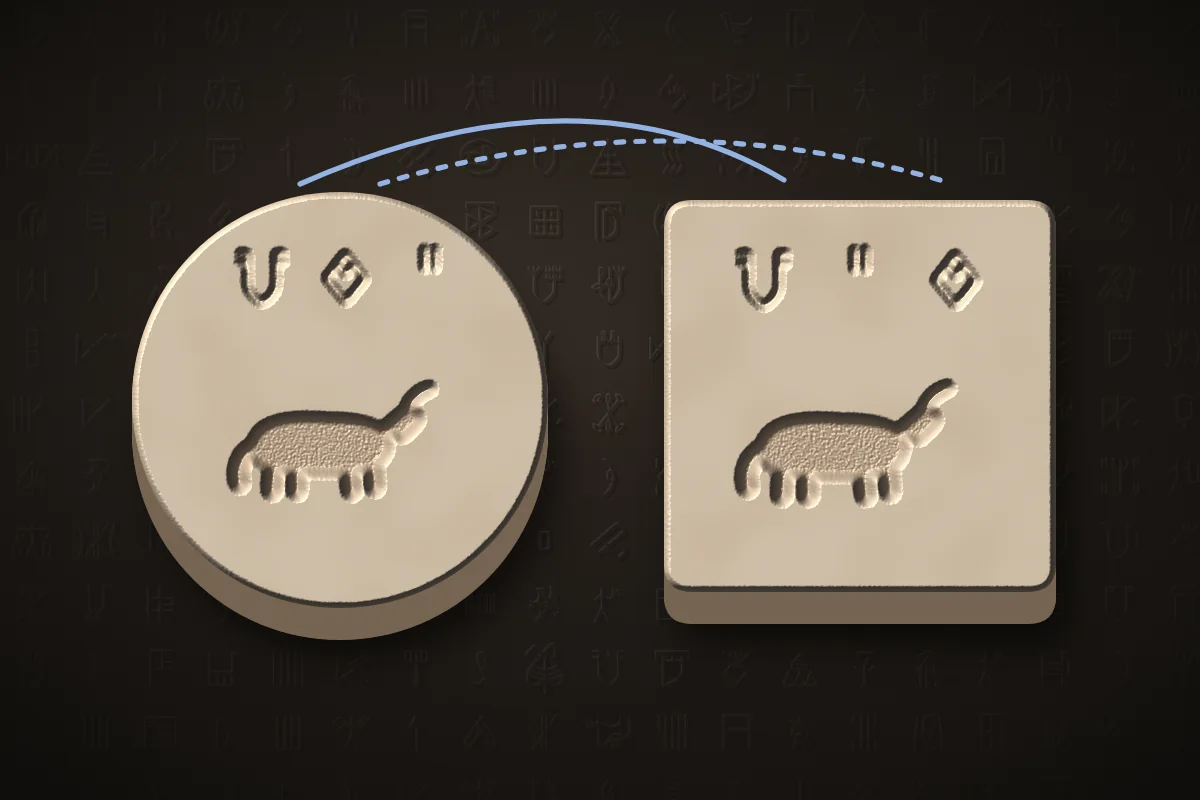
In a sentence
Round seals from the Gulf use Indus signs in combinations rarely seen at home.
In plain words
Traders around Bahrain made round seals of their own style but carved Indus signs on them. Laursen showed these seals use the signs differently, for example often putting a “twins” sign at the front. One explanation is that local names were written with borrowed signs.
Technical detail
Gulf-type round seals show an excess of the prefixed “twins” sign and sign pairs unseen at home. Suggests Indus signs adapted to another language in the Gulf.
How we read it
Read: abstract only (the PDF on harappa.com, the harappa.com content page and the Wiley page all returned 403, and were not retried by other means; Semantic Scholar has the abstract withheld by the publisher; the abstract was read from the OpenAlex record; the paper is not open access per OpenAlex). Sources opened: www.harappa.com/sites/default/files/pdf/The_westward_transmission_of_I, www.harappa.com/content/westward-transmission-indus-valley-sealing-tec, onlinelibrary.wiley.com/doi/abs/10.1111/j.1600-0471.2010.00329.x, api.semanticscholar.org/graph/v1/paper/DOI:10.1111/j.1600-0471.2010.00, api.openalex.org/works/doi:10.1111/j.1600-0471.2010.00329.x.
What they did
- Laursen examined the ‘Gulf Type’ round stamp seals of the end of the third millennium BC as a whole group (abstract).
- He used principal component analysis of seal shape to compare Gulf Type seals with Indus inscriptions against those without (abstract).
- He grouped Gulf Type seals found in the Indus Valley, Iran, Mesopotamia and Bahrain into morphological groups that seem to match different areas of production (abstract).
- He studied the Indus inscriptions on these seals, focusing on the unusual frequency of a prefixed ‘twins’ sign in the western inscriptions (abstract).
- He used a newly found seal with a pseudo-inscription to test the idea that the Gulf seals record a language other than the Harappans’ (abstract).
What they found
- The shape of Gulf Type seals with Indus inscriptions is distinct from that of seals without inscriptions (abstract).
- Gulf Type seals from different regions fall into fairly discrete morphological groups, apparently from different production areas (abstract).
- The western inscriptions show an abnormal number of prefixed ‘twins’ signs (abstract; the counts are in the full paper, not read).
- The hypothesis that a language different from the Harappans’ was written on these seals is reconfirmed by the pseudo-inscription seal (abstract).
- He concludes that breakaway Harappans working in the west invented the Gulf Type seal, and that from about 2050 BC the type became practically synonymous with Dilmun’s merchant communities (abstract).
- No numbers can be reported here, because only the abstract was read.
Strengths and limits
- Combining seal shape, find region and inscription is a strong design, because it ties text features to production groups rather than treating all foreign seals as one set.
- The ‘different language’ conclusion rests partly on one pseudo-inscription seal; a pseudo-inscription can also mean that some makers imitated signs without writing any language.
- The project’s own red team confirmed the order-breaking on foreign texts (9 of 39 flagged, binomial p = 1.1e-4), and the project’s context notes (experiments/context/RESULTS.md) say pseudo-script fits as well as a second language.
- The detailed counts, the group assignments and the PCA loadings could not be checked here.
What the authors say comes next
- None stated in the abstract; the full paper’s discussion was not read. (not available)
Ideas it gives us
- Separate ‘another language’ from ‘pseudo-script’: test whether the flagged Gulf texts share Gulf-only sign pairs with each other more often than texts generated by an imitator who draws Indus signs by frequency with no grammar. A second language written with borrowed signs should create its own repeated pairs across seals; pure imitation should not. The project’s context notes say both explanations currently fit equally well. Open data enough: yes. Needs: The project’s foreign corpus (39 scorable texts) and home M77/ICIT frequencies; power will be low and must be computed first.
- Test whether the order-breaking texts sit in particular production groups: if Laursen’s ‘breakaway Harappan’ early seals follow home order and the later Dilmun seals do not, order-breaking should track his morphological groups and date. It turns his chronology into a falsifiable prediction about the project’s 9 flagged texts, and would show whether the break came with the move to Dilmun workshops. Open data enough: no. Needs: Laursen’s group assignment and dating per seal (in the paywalled paper), matched to the project’s foreign corpus ids.
- Check whether the prefixed twins sign behaves like a fixed title or classifier (followed by many different sequences) or like part of a name (followed by a few recurring ones), against a frequency-matched null. This separates two readings of Laursen’s twins excess without assuming any language. Open data enough: yes. Needs: Foreign corpus texts with the twins sign identified by its M77 or Wells number, which the project already uses in foreign_corpus.
What we take from it
TestedOur round-seal finding builds on this, and adds that round seals found in Indus cities break the order too.