Paper · 2004
The case that the signs might not be writing at all
Farmer, Sproat and Witzel · Electronic Journal of Vedic Studies 11(2)
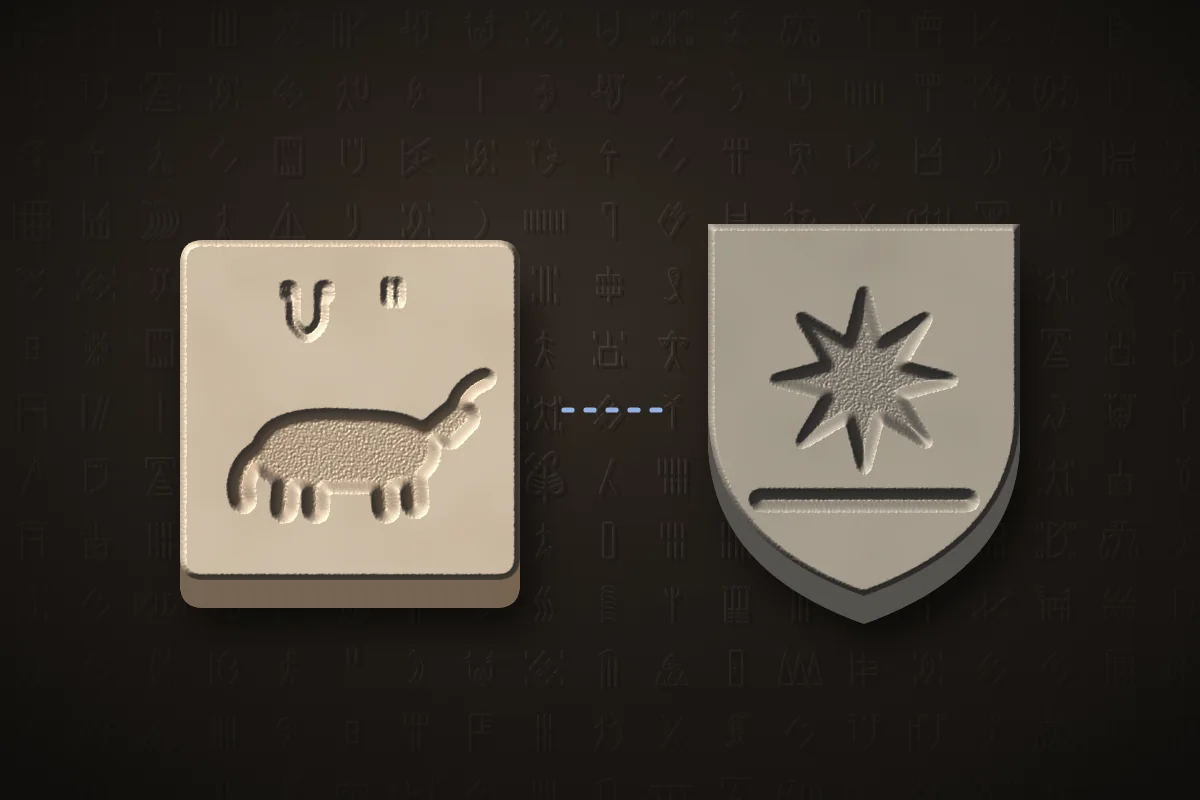
In a sentence
Texts are very short, and many signs are rare: maybe these are symbols, not a script.
In plain words
The authors pointed out that Indus texts are very short, about five signs on average, that many signs appear only once, and that no long text has ever been found. They argued the signs could be a system of symbols, like road signs or coats of arms, rather than writing that records speech.
Technical detail
Arguments from text length (mean about 4.6 signs, longest single-surface text 17), rare-sign frequency and the absence of long texts. Sparked the language-vs-symbols debate continued by Rao et al. 2009 and Sproat 2010 and 2014.
How we read it
Read: full text. Sources opened: safarmer.com/fsw2.pdf.
What they did
- Farmer, Sproat and Witzel reviewed the whole case for the Indus signs being writing and argued it had never been tested, only assumed.
- They set the length of Indus inscriptions against what literate societies leave on durable objects such as pots, walls, stelae and tablets.
- They compared sign frequencies in the Mahadevan and Wells catalogues with Sumerian, Egyptian, Chinese and Scottish heraldry blazons.
- They counted how often a sign repeats inside a single inscription, using 67 Mohenjo-daro seals and 67 Harappa seals matched in length to 67 Egyptian royal cartouches.
- They counted rare and one-off signs and argued, from Near Eastern emblem systems such as kudurru deity symbols, that the signs worked as non-linguistic symbols.
- They closed with five explicit conditions under which they would accept that their model is wrong.
What they found
- The longest text on one surface has 17 signs, fewer than 1 in 100 texts reach 10 signs, and the mean over 2,905 objects in Mahadevan’s concordance is 4.6 signs (p. 22).
- Four of Mahadevan’s 417 signs make up 21% of 13,372 sign occurrences, eight make up 31%, and twenty make up over 50% (p. 26).
- The cumulative frequency curve of Indus signs nearly overlaps that of heraldic blazons and Egyptian hieroglyphs, so they say sign frequency cannot separate scripts from non-scripts (pp. 27-29, Fig. 2).
- In length-matched samples, 67 Egyptian cartouches (465 signs) have 48 repeated signs within an inscription, against 8 in 67 Mohenjo-daro seals (495 signs) and 7 in 67 Harappa seals (493 signs) (p. 33, Table 1).
- The 78 Harappa bar-seal inscriptions in CISI vols. I-II contain one case of sign repetition, and bar seals date late, so they argue the system was not drifting toward sound-writing after about 600 years (p. 33).
- 27% of Mahadevan’s 417 signs occur once and 52% occur five times or fewer; in Wells 1999, 50% of over 600 signs occur once and 75% five times or fewer (p. 36).
- They claim, from unpublished CISI vol. 3 material, that the share of one-off signs rises as new texts are found, the reverse of what a closed script should show (pp. 36-37).
- Their falsifiers: a text with evidence of several hundred signs; a 50+ sign text with random-looking repeats; a bilingual with about 30+ Indus signs; a rule set others can apply; or a lexical sign list (p. 48).
Strengths and limits
- The brevity facts and the low within-text repetition are real and reproducible on the concordance.
- The repetition comparison uses one Egyptian genre (cartouches) as the only writing control, so it cannot tell short name-writing in a logographic script from non-writing.
- The rising-singleton claim rests on unpublished data and on sign-list choices that the authors themselves say are easily shifted (p. 37, n. 23).
- The paper argues for non-writing by analogy and rhetoric as much as by test, and later work (SIGIL, the project’s own language_vs_code) shows these statistics do not decide the question either way.
What the authors say comes next
- Study rare and one-off signs closely, because shifts in symbol use could show how the system was controlled and how Indus society changed. (p. 37, n. 23)
- Combine non-linguistic models of the signs with new stratigraphic dates (HARP bar seals and miniature tablets) to track religious, political and economic change through sign-frequency fluctuations. (p. 44)
- Re-excavate Harappa Area G, where over three dozen moulded tablets from one mould were found near a packed group of skulls. (p. 36, n. 22)
- Find out what role the symbols played in holding the Harappan world together and possibly in its decline. (p. 46)
- Account for second-hand seals before linking seal symbols to their owners. (p. 43, n. 28)
Ideas it gives us
- Test the rising-singleton claim directly: compare the share of one-off signs in M77 texts against ICIT texts first published after 1977, with sampling-size matched rarefaction curves and Chao1 estimates of total inventory. A closed script should show the singleton share fall as the corpus grows; an open emblem system should not. FSW made the claim on unpublished data and nobody has run it with a null. Open data enough: yes. Needs: M77 and ICIT with publication year or excavation year per object; the project’s M77-ICIT bridge.
- Rerun the within-text repetition count with length-matched controls drawn from short logographic name corpora (Ur III seal legends, Linear B personal-name lines) instead of Egyptian cartouches only. The Table 1 contrast may reflect genre (names written logographically repeat little) rather than writing versus non-writing; the project already holds Ur III and Linear B lines. Open data enough: yes. Needs: M77 seal texts of 6-13 signs; existing Ur III and Linear B comparator corpora in language_vs_code.
- Within dated Harappa contexts, test whether bar seals differ from square seals in repetition rate, sign inventory size and share of frame signs. FSW use late bar seals as evidence the system did not evolve toward phoneticism; a direct dated comparison would check that claim instead of assuming it. Open data enough: no. Needs: Seal shape (ICIT has it) plus phase dates for Harappa objects (HARP phase 3A-3C), which are only partly published.
What we take from it
Using itWe test whether the signs are language at all, instead of assuming it.