Paper · Oct 2026
Some sign statistics carry over between languages that share a script; others break
Zhou and Anderson · EMNLP 2026
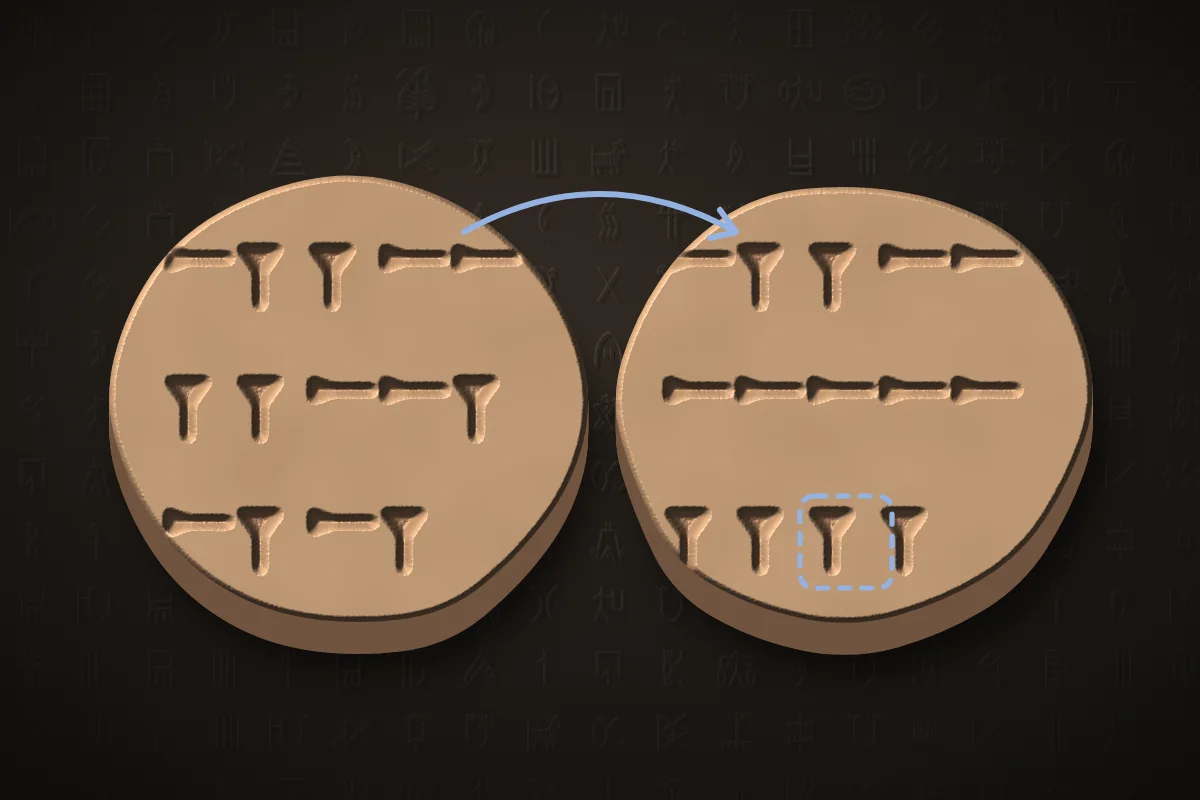
In a sentence
Word-splitting methods trained on one cuneiform language mostly still work on another, until foreign word-signs appear.
In plain words
Cuneiform wrote several unrelated languages, among them Akkadian, Sumerian and Elamite. The authors asked which patterns belong to the script and which to each language. A simple method that splits text where the next sign is hard to predict kept working across languages. It failed badly on Hittite, where about a third of the signs are word-signs borrowed from other languages.
Technical detail
Two dictionary-free segmenters (transitional probability, Morfessor) on ORACC Akkadian, ETCSL Sumerian and Elamite; six cross-language pairs. Within language both reach F1 above 0.97 against 0.74 for a dictionary baseline. Transitional probability stays above 0.95 F1 across all six pairs; Morfessor falls to 0.27 when trained on the 13K-token Elamite source. On Hittite, with 34.7% foreign-script logograms, transitional probability drops 35 points. Segmentation and tagging, not decipherment.
What we take from it
BackgroundThis bears on the mismatch study’s logo-syllabic arm. Borrowed word-signs are a kind of mismatch of their own, different from a related language. A “foreign logograms” variant in the logogram-share slice would test it; nothing in the sealed stage 1 changes.